AMD Framework ICT Trading: Accumulation, Manipulation, Distribution
The AMD Framework — Accumulation, Manipulation, Distribution — is ICT's model for how smart money engineers every major price move. Learn to trade it on any timeframe.
What Is the AMD Framework in ICT?
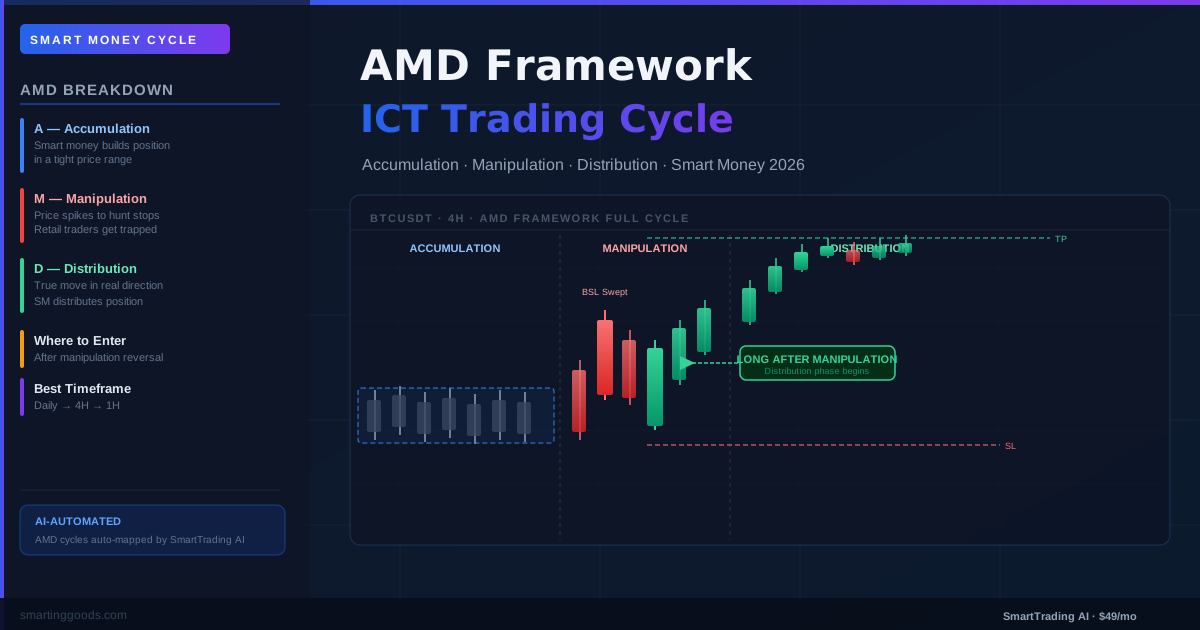
The AMD Framework — Accumulation, Manipulation, Distribution — is the foundational model in ICT (Inner Circle Trader) methodology for understanding how institutional participants engineer price movements. Every major move in any liquid market, regardless of timeframe, follows this three-phase structure. Once you understand AMD, you stop asking "why did price do that?" and start asking "which phase of AMD is this?"
AMD is also called the Power of 3 when applied to daily sessions. The terms are interchangeable in ICT community usage, though AMD is the more general framework that applies across timeframes.
Phase 1 — Accumulation
Accumulation is the quiet phase. Price consolidates in a narrow range as institutional traders build their positions incrementally without moving price significantly. If they bought all at once, their own order would drive price against them. Instead, they accumulate slowly during low-volume periods — the Asian session, overnight, or during news-event lulls.
From a chart perspective, accumulation looks like consolidation or "chop" — many retail traders ignore these zones or try to scalp the range. But the accumulation phase is where smart money is setting up for the next phase. The range's high and low become the manipulation targets.
Key accumulation markers to identify:
- Low ATR (volatility compressed below recent average)
- Repeated tests of both the range high and low without a definitive break
- No significant FVGs forming (balanced order flow)
Phase 2 — Manipulation
Manipulation is the trap. After accumulation has defined a clear range, price is engineered to sweep one side of that range — typically in the direction opposite to where the smart money ultimately wants to go. This sweep serves two purposes:
- Liquidity collection: Stop orders sitting just outside the range boundaries get triggered, providing the liquidity institutions need to fill larger positions.
- Retail positioning: Breakout traders enter in the direction of the sweep, creating the counterparty orders that institutions need to establish their position in the opposite direction.
The manipulation phase is fast — often a single candle or a few minutes at a session open. A bearish manipulation (for a bullish distribution) takes out lows, then immediately reverses. A bullish manipulation (for a bearish distribution) takes out highs, then reverses. The key tell: the sweep closes back inside the accumulation range within the same candle or the very next candle.
Phase 3 — Distribution
Distribution is the real move. After collecting liquidity via the manipulation sweep, institutions have their full position established and begin pushing price in the true direction. Distribution moves are characterized by:
- Displacement candles (large bodied, minimal wicks)
- Consecutive BOS (Break of Structure) in the distribution direction
- FVGs left behind (imbalances from the aggressive move)
- Sustained momentum without significant retracement
The distribution phase is where retail traders who successfully identified the manipulation sweep ride the move. It often extends significantly further than most traders expect — the entire accumulated position is being offloaded into the market over time.
Trading AMD on Multiple Timeframes
AMD operates simultaneously on every timeframe. A weekly AMD cycle contains daily AMD cycles, which contain hourly AMD cycles. A key skill in ICT trading is identifying which timeframe's distribution phase you're trading:
- Weekly AMD: Monday accumulation → Tuesday/Wednesday manipulation sweep → Wednesday-Friday distribution. This is ICT's weekly model.
- Daily AMD: Asian session accumulation → London/NY open manipulation → Session distribution. This is the daily Power of 3.
- Intraday AMD: Pre-session range → Kill Zone sweep → Kill Zone continuation. This is the entry-level AMD cycle.
AMD for Bitcoin Futures
On Binance Futures, the daily AMD cycle is especially clear on BTC. The Asia session (8 PM–midnight EST) consistently creates the accumulation range, the London open (2-5 AM EST) triggers the manipulation sweep, and the New York session (7 AM–noon EST) executes the distribution move. Applying AMD analysis to BTC's 4-hour chart for the weekly cycle gives you the broader direction context for intraday trades.
Automating AMD Analysis with AI
The AMD Framework requires identifying the phase in real time — which demands continuous chart monitoring across multiple timeframes. The Smarting Goods AI trading bot implements AMD analysis on Binance Futures automatically, tracking accumulation ranges, detecting manipulation sweeps at session opens, and executing entries at the start of the distribution phase with pre-calculated targets.
Access the SmartTrading AI platform to automate AMD-based Bitcoin futures trading.
Frequently Asked Questions
What does AMD stand for in ICT?
AMD stands for Accumulation, Manipulation, Distribution. It's ICT's model for the three-phase cycle that precedes every major price move — institutional players accumulate quietly, trigger stops via manipulation, then distribute their position in the true direction.
Is AMD the same as Power of 3?
Yes, essentially. Power of 3 is AMD applied to the daily session cycle specifically. AMD is the broader framework that applies to any timeframe. In practice, the terms are used interchangeably in the ICT community.
How long does the manipulation phase last?
The manipulation phase is typically very short — often just one to three candles at a session open. On the 15-minute chart, the London open manipulation phase might last 15-45 minutes. On the daily chart, the manipulation might last one to two days (Monday-Tuesday) before the weekly distribution begins.
How do I know when distribution starts?
Distribution begins after the manipulation sweep reverses and closes back inside the accumulation range. The first displacement candle in the distribution direction, leaving behind an FVG, is the distribution confirmation signal.
Can I automate AMD Framework trading?
Yes. The Smarting Goods AI bot monitors the AMD cycle on Binance Futures in real time — detecting accumulation ranges, flagging manipulation sweeps at session opens, and executing entries at distribution confirmation.