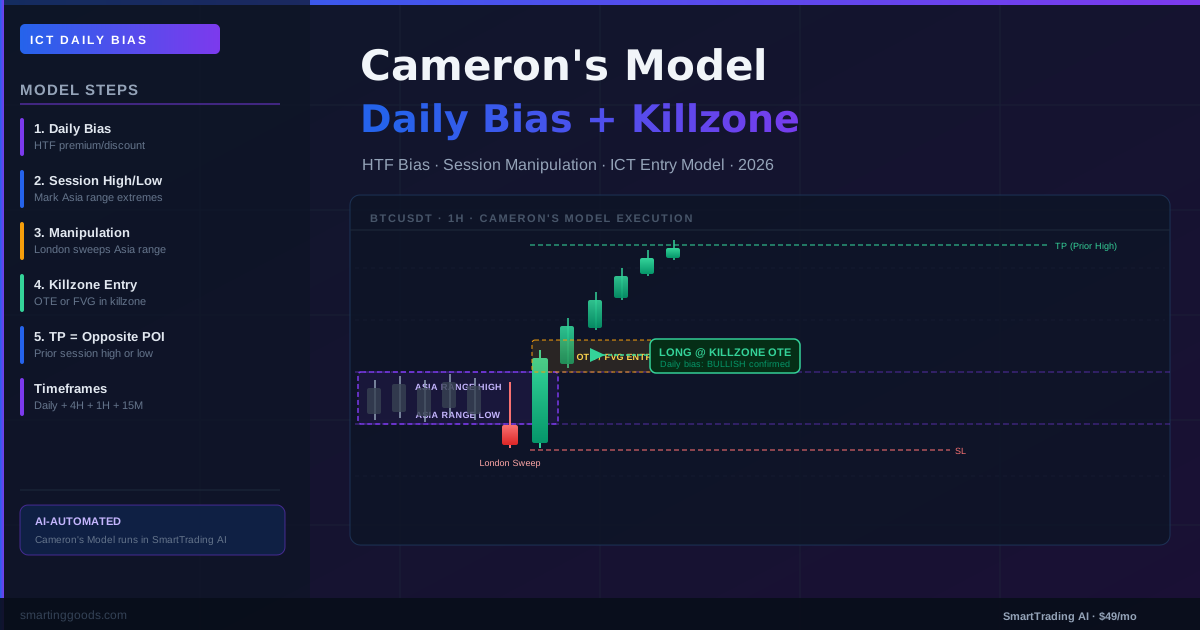
Cameron's Model ICT: The Complete Trading Framework
Cameron's Model is a complete ICT trading framework combining daily bias, session analysis, and precise entry logic. Here's how to apply it step by step.
What Is Cameron's Model in ICT?
Cameron's Model is an ICT-based trading framework that gained significant traction in the ICT community for its systematic, step-by-step approach to combining daily bias with session-specific entries. Named after ICT community trader Cameron, the model structures the entire trading process from top-down analysis through to entry execution — removing ambiguity from the most common failure points in ICT trading.
Unlike loosely defined "trade what you see" approaches, Cameron's Model has a defined sequence: establish daily bias first, confirm with session analysis, then wait for a specific entry pattern within a defined time window. Discipline in sequence is what makes the model work.
The Core Structure of Cameron's Model
Step 1 — Daily Bias Determination
The model starts on the daily chart. Before any session analysis, you must have a clear daily directional bias — bullish or bearish. Cameron's approach uses the prior day's high and low as the primary reference: if today's open is above yesterday's close and price is targeting the prior day's high (PDH), bias is bullish. If targeting the prior day's low (PDL), bias is bearish.
Premium and discount array analysis also factors in: is price in a premium zone (above equilibrium — look to sell) or discount zone (below equilibrium — look to buy)? This anchors your bias within the weekly and monthly ranges.
Step 2 — HTF Market Structure Context
With daily bias established, zoom out to the weekly chart for higher-timeframe context. Is the weekly trend aligned with your daily bias? A daily bullish bias against a weekly bearish structure is a lower-probability setup. Cameron's Model prioritizes setups where the daily and weekly bias agree.
Step 3 — Session Entry Framework
The entry component of Cameron's Model focuses on the New York session, specifically the window from midnight to 8:30 AM EST for pre-market setup, and the 10 AM Silver Bullet window for the primary entry. Price action during these windows is analyzed for:
- Liquidity sweeps (manipulation of prior session highs/lows)
- Fair Value Gap formation in the direction of daily bias
- Order Block identification at key retracement levels
Step 4 — Precision Entry Confirmation
The entry signal in Cameron's Model is specific: a displacement candle in the direction of daily bias, followed by a pullback into an FVG or Order Block, with a subsequent entry on the return to that zone. This is effectively an OTE entry within the session's price action, confirmed by the prior liquidity sweep.
Why Cameron's Model Works for ICT Traders
Many traders learn ICT concepts individually — Order Blocks, FVGs, Kill Zones, OTE — but struggle to combine them into a coherent trading decision. Cameron's Model provides the missing architecture: a sequence that tells you exactly what to look for, in what order, before you risk capital.
The model's insistence on daily bias first is particularly valuable. Most ICT traders who struggle are fighting the higher-timeframe trend because they saw a compelling 5-minute setup. Cameron's Model prevents this by anchoring every intraday decision in the daily context.
Applying Cameron's Model to Bitcoin Futures
On Binance Futures (BTC/USDT), Cameron's Model adapts as follows:
- Daily bias: Use the 4-hour chart as your "daily" equivalent — it shows the same institutional footprint with more granularity relevant to 24/7 crypto markets.
- Session analysis: Focus on London (2-5 AM EST) and New York open (7-10 AM EST) Kill Zones for the session entry component.
- Entry confirmation: The 15-minute chart FVG fill or Order Block rejection during the Kill Zone is your entry trigger, aligned with 4-hour bias.
Cameron's Model + AI Automation
The multi-step sequence of Cameron's Model — daily bias, HTF context, session analysis, entry confirmation — is exactly the type of systematic framework that AI can execute better than manual trading. The Smarting Goods AI trading bot implements the top-down ICT analysis stack on Binance Futures, checking each condition in sequence before executing any entry.
Try the SmartTrading AI platform — it runs Cameron's Model-style systematic ICT analysis 24/7 on Bitcoin futures.
Frequently Asked Questions
Who created Cameron's Model?
Cameron's Model was developed by a prominent ICT community trader known as Cameron. The model synthesizes ICT's core concepts (daily bias, Kill Zones, FVGs, OTE) into a structured trading sequence that gained widespread adoption in the ICT community for its clarity and reproducibility.
What markets does Cameron's Model work on?
Cameron's Model was originally developed for forex (ES, NQ, and currency pairs), but the framework applies directly to any liquid futures market including Bitcoin on Binance Futures. The ICT framework it's built on is market-agnostic.
How is Cameron's Model different from standard ICT?
ICT's original teaching provides all the concepts; Cameron's Model provides a specific sequence for applying them. It's a "how to actually trade" framework, not new theory — think of it as a structured implementation of ICT methodology.
What is the entry trigger in Cameron's Model?
A displacement candle in the direction of daily bias, followed by a pullback to an FVG or Order Block, with entry on the return to that zone. This must occur during a defined session window (Silver Bullet or Kill Zone) that aligns with the daily bias.
Can I automate Cameron's Model?
Yes. The systematic, rule-based nature of Cameron's Model makes it ideal for automation. The Smarting Goods AI bot implements the top-down ICT analysis stack that Cameron's Model is built on, executing on Binance Futures automatically.