Candle Range Theory ICT: Trading the CRT Setup
Candle Range Theory (CRT) is an ICT concept where a larger timeframe candle acts as a manipulation and distribution vehicle. Learn how to trade it step by step.
What Is Candle Range Theory (CRT) in ICT?
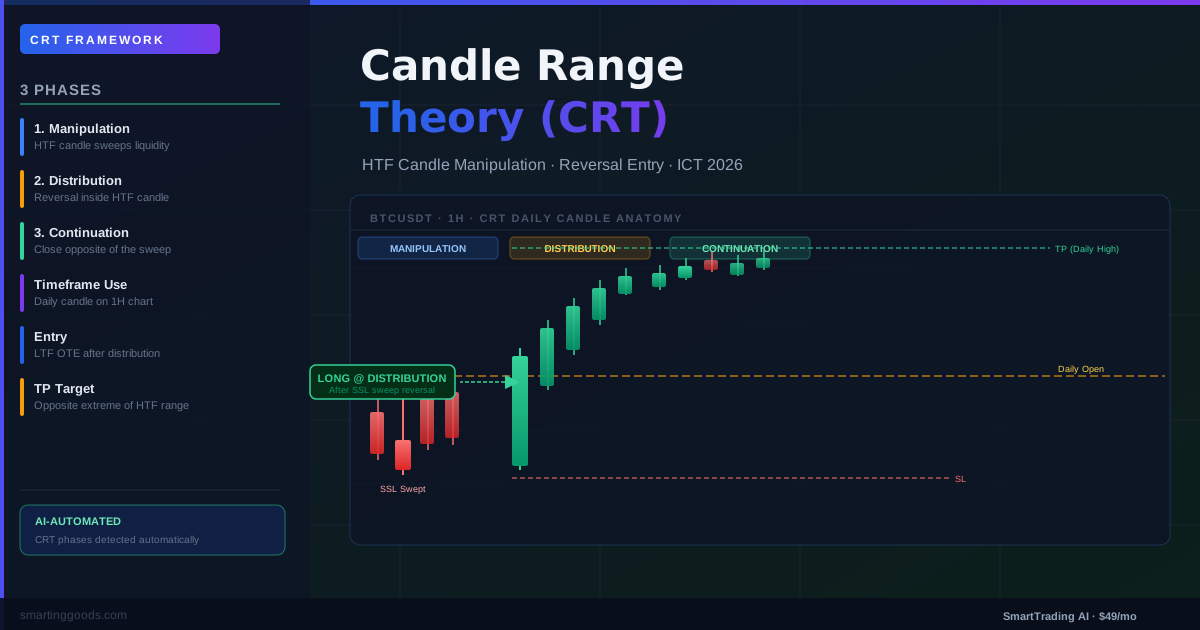
Candle Range Theory (CRT) is an ICT concept that treats a single higher-timeframe candle as its own micro Power of 3 cycle — complete with accumulation, manipulation, and distribution phases contained within one candle's range. The key insight: the high and low of a higher-timeframe candle (like a 4-hour or daily) are liquidity targets that market makers will engineer price to sweep before committing to the candle's true direction.
If you've ever seen price spike just above a daily candle's high or below its low before reversing sharply, you've witnessed CRT manipulation in action. The candle's range is not random — it's structured to trap traders who trade the breakout of that candle's boundaries.
The CRT Framework: Three Phases Inside One Candle
Phase 1 — Range Formation (Accumulation)
As the candle opens, price initially establishes its range. The early part of the candle creates a high and low that define the manipulation targets. On a 4-hour candle, this often corresponds to the first hour's worth of price action.
Phase 2 — Sweep (Manipulation)
Before the candle closes, price will typically sweep one side of the established range — the high or the low — triggering stops and filling institutional orders. On a bullish CRT candle, price sweeps the low first (taking out sell stops below the range), then reverses. On a bearish CRT candle, price sweeps the high first (taking out buy stops above), then reverses.
Phase 3 — Close (Distribution)
After the sweep, price closes toward the opposite extreme of the range — confirming the candle's true direction. A bullish CRT candle sweeps the low and closes near its high. A bearish CRT candle sweeps the high and closes near its low. The close beyond the midpoint of the candle's range is the distribution signal.
How to Trade the CRT Setup
Identifying the CRT Candle
Look for a candle on the 4-hour or daily chart that shows a visible sweep of one extreme followed by a strong close in the opposite direction. The sweep should breach the prior candle's high or low by a noticeable amount before reversing — not just a small wick.
The Entry Strategy
After the CRT candle closes, wait for price to retrace back into the candle's range on the next lower-timeframe (15-minute or 1-hour). This retracement back into the CRT candle body is your entry window. Look for a Fair Value Gap or IFVG inside the CRT candle body to refine your entry.
Stop Loss and Target
Stop loss: just beyond the sweep extreme (the swept high or low). Target: the CRT candle's opposite extreme, then the next liquidity pool beyond it. Risk-to-reward on CRT trades is typically 1:3 or better because the stop is tight (just beyond the sweep) and the target is the full candle range.
CRT on Higher Timeframes
CRT works across timeframes but is most reliable on the 4-hour and daily charts. A weekly CRT setup (a weekly candle that sweeps its prior low before closing bullish) is an especially high-conviction setup for longer-term positions. The principle is the same regardless of timeframe — the candle's range is a liquidity vehicle, and the sweep is the tell.
CRT and the Power of 3 Relationship
CRT is essentially Power of 3 applied to a single candle rather than a full trading session. Both concepts describe the same institutional behavior: accumulate in range, manipulate stops, then distribute in the true direction. Understanding one deepens your understanding of the other. A daily CRT setup and a session-level Power of 3 setup often align on the same day, giving you two confirming frameworks for the same trade.
Automating CRT Detection with AI
Identifying CRT candles in real time requires monitoring candle closes on multiple timeframes and checking for the sweep-then-reversal pattern. The Smarting Goods AI trading bot automates this on Binance Futures — scanning 4-hour and daily candles for CRT patterns, detecting the sweep confirmation, and monitoring the retracement entry on the 15-minute chart within the CRT candle range.
Access the SmartTrading AI platform and automate CRT-based entries on Bitcoin futures.
Frequently Asked Questions
What is Candle Range Theory in ICT?
Candle Range Theory (CRT) is an ICT concept that treats a higher-timeframe candle (4-hour or daily) as a mini Power of 3 cycle. Price sweeps one side of the candle range to collect liquidity before reversing and closing strongly in the true direction.
How do I identify a CRT candle?
Look for a candle that creates a visible spike beyond the prior candle's high or low (the sweep), followed by a strong close in the opposite direction. The sweep and close should both be clearly visible on the 4-hour or daily chart.
What is the entry for a CRT trade?
After the CRT candle closes, wait for a retracement back into the candle body on the 15-minute chart. Enter within the CRT candle range, using an FVG or Order Block inside the candle body as your precision entry.
Does CRT work on crypto?
Yes. Bitcoin on Binance Futures shows clear CRT patterns, especially on the 4-hour chart. The 24/7 nature of crypto means CRT candles can form at any time, though they're most reliable when they coincide with ICT Kill Zone hours.
Can the Smarting Goods AI bot trade CRT setups?
Yes. The SmartTrading AI bot includes CRT detection in its ICT strategy suite, identifying sweep-then-reversal patterns on 4-hour candles and executing entries on Binance Futures.