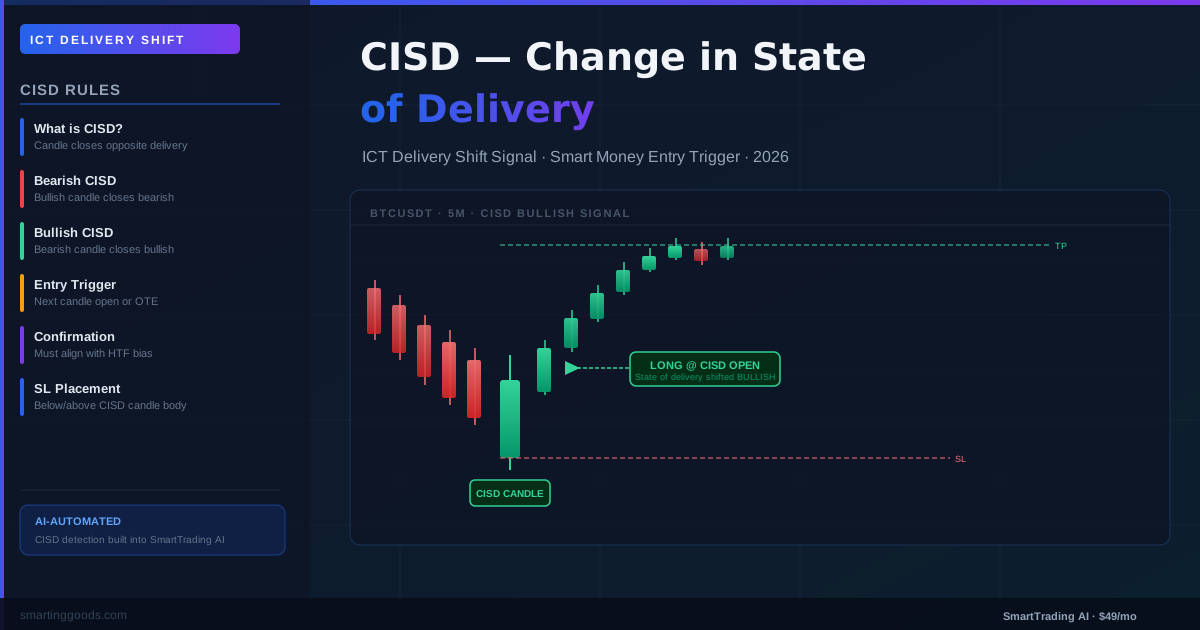
CISD ICT Trading: Change in State of Delivery Explained
CISD (Change in State of Delivery) is ICT's advanced concept for detecting when price shifts from bullish to bearish delivery — and how to trade the transition.
What Is CISD in ICT Trading?
CISD — Change in State of Delivery — is one of ICT's more advanced market structure concepts, and one that separates serious practitioners from those who only understand the basics. While most traders focus on candlestick patterns or indicator crossovers, CISD identifies the precise candle where the market shifts from delivering price upward (bullish) to delivering price downward (bearish), or vice versa.
"State of delivery" is ICT's terminology for the manner in which price is being moved. Bullish delivery means consecutive higher highs and higher lows, smooth upward momentum, FVGs filling to the upside. A CISD signals that this delivery mechanism has changed — the same price action that was climbing now begins distributing.
How to Identify a CISD Candle
A CISD candle has specific structural requirements that distinguish it from a simple pullback or consolidation:
- For a bearish CISD: In a bullish trend, look for a candle that closes below the low of the prior candle. This is not just any red candle — it must close below a prior swing structure point (the low of the most recent up-leg). The close below that structural low signals the delivery has changed.
- For a bullish CISD: In a bearish trend, look for a candle that closes above the high of the prior candle structure. The close above that level signals bullish delivery has resumed.
- Volume confirmation: The CISD candle should show a displacement-quality body — a relatively large candle body compared to recent candles. A small-bodied CISD is a weaker signal.
The key distinction from a standard CHoCH (Change of Character) is specificity. CHoCH can be identified after the fact; CISD is about identifying the delivery candle in real time as it closes.
CISD vs. CHoCH vs. BOS — Key Differences
These three ICT concepts are related but not interchangeable:
- BOS (Break of Structure) — Price breaks a prior swing high/low in the direction of the current trend. Confirmation of momentum continuation.
- CHoCH (Change of Character) — Price breaks a swing point counter to the current trend. Signals a potential reversal. Often seen as the first sign of trend change.
- CISD (Change in State of Delivery) — The specific candle(s) where the delivery mechanism switches. More granular than CHoCH — CISD identifies the turning point candle, while CHoCH confirms the structural break.
In practice, a CISD often precedes or coincides with a CHoCH. Identifying the CISD candle gives you an earlier, tighter entry with less risk than waiting for the full CHoCH confirmation.
Trading the CISD Setup
Entry Strategy
After a bearish CISD candle closes in an uptrend, wait for a brief retracement back toward the CISD candle's body (the "delivery zone"). This retracement is your entry window. The CISD candle body itself acts as an Order Block — a demand or supply zone where institutional orders were placed.
Stop Loss Placement
For a bearish CISD short entry, place your stop loss above the high of the CISD candle. If price returns above that high, the bearish delivery signal is invalidated.
Target Levels
Target the most recent swing low (for bearish setups) or the nearest liquidity pool below price. CISD entries often produce sharp, fast moves because you're entering at the point where institutional delivery switches — not after it's already moved significantly.
CISD in Multi-Timeframe Analysis
The most reliable CISD setups occur when a CISD on the 15-minute chart aligns with a larger-degree structure shift on the 1-hour or 4-hour chart. A 15-minute bearish CISD during a 1-hour bearish trend is a continuation entry — high probability, tight risk. A 15-minute bearish CISD against a 4-hour bullish trend is a counter-trend trade — lower probability, wider targets needed.
ICT's approach is always top-down: establish the 4-hour bias, confirm on 1-hour, then use the 15-minute CISD for precision entry.
How SmartTrading AI Detects CISD in Real Time
Manual CISD identification requires watching candle closes carefully — easy to miss on faster timeframes. The Smarting Goods AI trading bot monitors candle closures on 1m, 5m, and 15m timeframes on Binance Futures, identifies CISD candles against multi-timeframe structural context, and flags high-probability CISD entry setups with pre-calculated SL and TP levels.
Access the SmartTrading AI platform to automate CISD detection and entry execution.
Frequently Asked Questions
What does CISD stand for in ICT?
CISD stands for Change in State of Delivery. It's an ICT concept that identifies the specific candle where the market shifts from bullish price delivery to bearish (or vice versa), providing early entry signals before a full CHoCH confirms.
How is CISD different from a regular reversal signal?
CISD is structural, not pattern-based. It doesn't rely on candlestick shapes or indicator divergence. It identifies the exact candle where the institutional delivery mechanism changes, making it more precise and less subjective than traditional reversal signals.
What timeframe is best for CISD trading?
The 15-minute chart is the primary ICT timeframe for CISD identification, with 1-hour and 4-hour charts providing directional context. For scalping, the 5-minute CISD is used but requires tighter stops.
Can CISD be used for crypto futures?
Yes. CISD works on any liquid futures market. Bitcoin on Binance Futures shows clear CISD patterns especially during Kill Zone hours (London and New York opens).
Does the Smarting Goods bot trade CISD setups?
Yes. The SmartTrading AI bot includes CISD detection as part of its ICT strategy suite on Binance Futures, identifying delivery changes in real time and executing entries when multi-timeframe confluence confirms.