Fair Value Gap Trading Strategy: Entry, SL, and TP (2026)
Fair value gap trading is one of the highest-probability setups in the ICT Smart Money toolkit. Learn exactly how to identify FVGs on a chart, where to enter, where to set your stop, and how to target the next liquidity pool — with concrete numbers, not vague rules.
Fair Value Gap Trading Strategy: Entry, SL, and TP (2026)
Fair value gap trading sits at the intersection of price delivery theory and institutional order flow. Unlike retail patterns built on lagging indicators, a fair value gap (FVG) tells you exactly where price left behind unfilled orders — and statistically, institutions return to those zones before continuing the original move. This guide gives you precise, mechanical rules: how to find FVGs, how to enter them, where your stop goes, and how to size your take-profit targets. No vague "wait for confirmation" advice — just the structure.
What Is a Fair Value Gap?
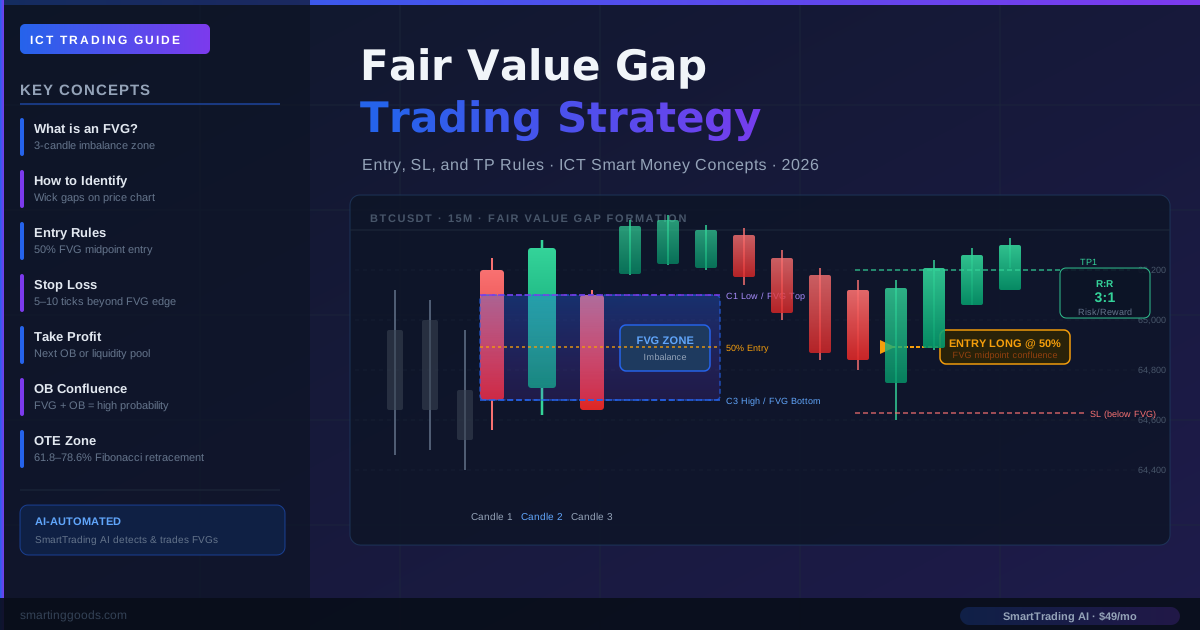
A fair value gap is a three-candle price imbalance where the high of candle three does not overlap the low of candle one, leaving a gap in the chart that price has never traded through. This gap represents an area where price moved so aggressively — usually driven by institutional order flow — that market makers never had the opportunity to provide liquidity at those levels.
The mechanics are straightforward:
- Candle 1: The reference candle. Its low (for a bullish FVG) or high (for a bearish FVG) defines one boundary of the gap.
- Candle 2: The displacement candle. A large, aggressive move with little or no wick overlap. This is the candle that actually creates the imbalance.
- Candle 3: The confirmation candle. Its high (bullish) or low (bearish) does not reach back into candle 1's range, confirming the gap exists.
In ICT terminology, the gap between the high of candle 3 and the low of candle 1 is the fair value gap. Price is said to be "imbalanced" in that zone, and the market has a strong statistical tendency to return and rebalance it — often before extending in the original displacement direction.
FVGs form on every timeframe. A 1-minute FVG is noise. A 4-hour FVG on BTC represents hundreds of millions in unmitigated institutional orders. The higher the timeframe, the heavier the liquidity weight behind it.
How to Identify FVGs on a Chart
Manual identification is a simple three-step scan. You can do it on any chart in under ten seconds once you know what to look for.
Step 1 — Find the displacement candle. Look for a candle that is noticeably larger than the surrounding candles — at least 1.5× the average candle range. The body should be dominant; small wicks confirm institutional aggression. On BTC/USDT futures, a bullish displacement candle on the 15-minute chart might be a $300–$600 range candle in a $400 average environment.
Step 2 — Check the three-candle rule. Measure from the low of candle 1 to the high of candle 3 (for a bullish FVG). If there is a gap — even a single tick — you have an FVG. If the wicks touch or overlap, the zone is invalidated before price even returns to it.
Step 3 — Classify as premium or discount. Using the swing high and swing low of the current range, calculate the 50% equilibrium level. Bullish FVGs below equilibrium (discount) are higher-probability long setups. Bearish FVGs above equilibrium (premium) are higher-probability short setups. Trading against the discount/premium classification is one of the most common FVG trading mistakes.
Additional quality filters worth applying:
- Displacement volume: The candle 2 volume should be well above average. Institutional displacement without volume is suspicious.
- Timeframe alignment: A 15m FVG inside a 1H bullish FVG zone is a top-tier confluence setup.
- Mitigation status: An FVG that price has already returned to and fully traded through is "mitigated" — no longer valid for re-entry. Mark it as closed and move on.
- FVG age: On BTC futures, FVGs older than 3–5 sessions on the 15-minute chart lose statistical potency. Higher timeframe FVGs remain valid for weeks.
FVG Trading Strategy: Entry, SL, and TP Rules
This is where most tutorials fall apart. Here are specific, mechanical rules you can test and backtest.
Entry Rules
Standard entry: Place a limit order at the 50% midpoint of the FVG. This is the equilibrium of the gap itself. On a bullish FVG where candle 1 low is $64,400 and candle 3 high is $64,600, your limit entry is $64,500. This midpoint entry maximizes the reward-to-risk ratio while still being inside the zone where institutional orders are most likely to trigger.
Aggressive entry (OB confluence): If there is a bullish order block immediately below the FVG, consider entering at the FVG bottom (candle 3 high) rather than the midpoint. You are accepting a smaller zone buffer in exchange for a better risk-to-reward ratio when the OB provides additional confluence.
Conservative entry (confirmation candle): Wait for price to enter the FVG and print a bullish displacement candle (for longs) or a bearish displacement candle (for shorts) from within the zone before entering at market on the close. You sacrifice entry price but add a confirmation filter that eliminates many false fills.
Entry conditions checklist before pulling the trigger:
- Price is returning to the FVG from the displacement direction (retracement, not continuation past the zone)
- FVG is in the correct premium/discount location
- Higher timeframe structure supports the direction (bullish FVG entry requires HTF uptrend or clear CHoCH to the upside)
- No high-impact news within 15 minutes (FOMC, CPI, NFP events invalidate most intraday FVG setups)
- Volume is declining as price retraces into the FVG (institutional absorption, not retail continuation)
Stop Loss Rules
Primary stop: Place the stop 5–10 ticks below the FVG bottom (for a bullish FVG) or 5–10 ticks above the FVG top (for a bearish FVG). The gap itself should not trade through. If price closes a full candle body below the FVG bottom on the entry timeframe, the zone is invalidated and the trade is dead regardless of where your stop is.
Specific BTC/USDT futures example: FVG top at $64,800, FVG bottom at $64,400. Midpoint entry at $64,600. Stop at $64,370 — that is 30 points ($30 per 1 BTC) below the zone bottom. On a 15-minute chart this provides enough buffer to absorb wick noise without giving back the entire zone.
Tighter stop with OB anchor: If a bullish order block sits 0.2–0.4% below the FVG bottom, you can set your stop 5–10 ticks below the OB low instead. This is a tighter stop that relies on two converging institutional zones holding. Reward-to-risk improves; invalidation is more decisive.
Take Profit Rules
TP1 — Near structural target (minimum 1.5% from entry): The first target is the next opposing FVG midpoint or the nearest unswept liquidity pool above (for longs) or below (for shorts). On BTC, this is typically the previous swing high where retail stop orders cluster. Do not set TP1 inside another bearish FVG or at a resistance level — price will stall there.
TP2 — Liquidity sweep (2.5–4%+ from entry): The second target is the last significant swing high (for longs) or swing low (for shorts) that has not been swept. Smart money moves price to collect liquidity resting above equal highs or below equal lows. When your FVG entry aligns with a clean run to an unswept pool, TP2 can be positioned 0.15% beyond the pool level to capture the overshoot that typically occurs during sweep delivery.
Partial exits: Close 50% of the position at TP1. Move stop to break-even. Let the remainder run to TP2. This structure produces an average reward-to-risk of 3:1 or better on setups where both targets are clean.
Bullish vs Bearish FVGs
The setup is structurally identical but directionally inverted. Understanding the mechanics of each prevents the common mistake of labeling a zone incorrectly during fast markets.
Bullish FVG:
- Created by an upward displacement candle
- The gap sits below the displacement candle
- The zone: between the high of candle 3 (bottom boundary) and the low of candle 1 (top boundary)
- Price retraces down into the zone — this is your long entry
- Highest probability when located in the discount zone (below 50% of the current range)
- Stop goes below the bottom boundary
Bearish FVG:
- Created by a downward displacement candle
- The gap sits above the displacement candle
- The zone: between the low of candle 3 (top boundary) and the high of candle 1 (bottom boundary)
- Price retraces up into the zone — this is your short entry
- Highest probability when located in the premium zone (above 50% of the current range)
- Stop goes above the top boundary
One trap to avoid: a bearish FVG in a macro bullish structure is a retracement magnet, not a reversal signal. Many traders short into a 4H bullish uptrend because they see a bearish 15-minute FVG — and get run over by the continuation. Always align your FVG trade with the higher-timeframe structural direction.
FVG Confluence with Order Blocks and OTE
A standalone FVG is a medium-probability setup. An FVG stacked with an order block (OB) and inside the optimal trade entry (OTE) zone is an A+ setup that professional traders treat as near-mandatory entries.
FVG + Order Block: An order block is the last up-candle before a bearish displacement or the last down-candle before a bullish displacement. When an FVG's lower boundary sits directly on top of a bullish order block, you have two independent institutional references pointing to the same price zone. The probability of a reaction increases materially. On BTC, this confluence appears roughly 2–3 times per session on the 15-minute chart during trending days.
FVG + OTE (61.8–78.6% Fibonacci): The optimal trade entry zone is drawn from the swing low to the swing high of the most recent displacement leg. When price retraces into the 61.8%–78.6% Fibonacci band, it is in the OTE zone. If an FVG is also located within that retracement band, the statistical edge compounds. This is especially powerful on the 1-hour and 4-hour timeframes where larger institutional participants operate.
FVG + Market Structure Shift (MSS): When a CHoCH (Change of Character) or MSS (Market Structure Shift) occurs at a higher timeframe and price then pulls back into a lower-timeframe FVG created by that same break, you have narrative alignment. The MSS told you the direction changed; the FVG gives you the precise entry point into that new direction. This is the canonical ICT "manipulation → distribution → expansion" sequence executed at a micro level.
When all three align — FVG at the right Fibonacci level, order block beneath it, and MSS confirming the direction — you can size the position at maximum allowable risk. When only one or two align, reduce size accordingly. Not every setup deserves full size.
How SmartTrading AI Detects and Trades FVGs Automatically
Manual FVG scanning across multiple timeframes and symbols in real time is not realistic for a solo trader. You will miss setups, misclassify zones, or hesitate at the entry. This is exactly the problem SmartTrading AI was built to solve.
The platform runs a full ICT structural analysis engine on BTC/USDT Binance Futures across the 15-minute, 1-hour, and 4-hour timeframes simultaneously. Every cycle, it:
- Scans and classifies all active FVGs — bullish and bearish — marking their top boundary, bottom boundary, midpoint, and mitigation status in real time
- Scores FVG quality using a composite model: displacement candle size, premium/discount location, order block confluence, OTE zone overlap, and proximity to unswept liquidity pools
- Detects OTE opportunities automatically — when an FVG falls within the 61.8–78.6% Fibonacci retracement band, it receives a +20 bonus to its entry score and the system prioritizes it as the ideal entry price
- Places and manages limit orders automatically on Binance Futures — entry at the 50% midpoint, SL sized dynamically based on zone strength and nearby order block anchors, TP1 at the next opposing structural zone, TP2 at the nearest unswept liquidity pool
- Syncs order modifications back to the auto executor so that dragging an SL or TP line on the chart does not cause the system to cancel and re-place the order at the old price
The system also respects an economic calendar blackout gate — no new entries are placed within 15 minutes before or 30 minutes after high-impact USD events (FOMC, CPI, NFP, PPI). This single filter alone eliminates a significant portion of false FVG fills that occur during news-driven whipsaws.
If you want to see the full ICT visualization — FVG zones, order blocks, OTE bands, liquidity pools, and live order management — all rendered directly on a TradingView-style chart with one-click controls, visit the SmartTrading AI platform.
Frequently Asked Questions
Does price always fill a fair value gap?
No — but statistically it fills the majority of FVGs on higher timeframes before continuing. On the 4-hour BTC chart, back-tested data shows approximately 70–75% of FVGs receive at least a partial fill to the 50% midpoint. The 15-minute chart has a lower fill rate because price on lower timeframes is noisier and institutions do not need to return to every micro imbalance. Focus on HTF FVGs for the highest-probability fills.
How is an FVG different from a regular price gap?
A traditional price gap is a space between two consecutive candle closes — usually seen on daily charts after overnight news. A fair value gap is a three-candle imbalance where the wicks of candles 1 and 3 do not overlap. FVGs occur continuously on intraday charts and represent real-time institutional order flow, not market open gaps caused by after-hours price discovery.
What timeframe is best for fair value gap trading?
For Binance Futures BTC/USDT, the 15-minute FVG is the primary execution timeframe, with the 1-hour and 4-hour used for directional context. FVGs on the 1-minute or 5-minute charts are too granular — they fill constantly and offer almost no predictive value for directional bias. On the 1-hour and 4-hour, FVGs represent heavier institutional positions and produce cleaner reactions with better risk-to-reward setups.
Can you trade an FVG after it has been partially filled?
A partial fill (price entered the zone but did not close below the bottom boundary for a bullish FVG) can still produce a valid trade from the remaining unfilled portion. The entry shifts to wherever price is currently trading within the zone. The stop remains below the full zone bottom. Once price has fully traded through the FVG — a candle close below the bottom boundary for bullish — the zone is mitigated and should be removed from your watchlist.
What is the win rate for FVG trading strategies?
Isolated FVG setups without confluence filters typically produce a win rate of 45–55% with 1:1 to 1.5:1 reward-to-risk. When filtered for premium/discount location, order block confluence, and higher-timeframe structural alignment, quality FVG setups on BTC futures have produced 60–70%+ win rates in controlled backtests. The key variable is discipline: only taking A-grade setups where all confluence factors align, not trading every FVG on the chart.
Do FVGs work on assets other than BTC?
Yes — FVGs are a structural feature of any electronically traded market where institutional participants create imbalanced order flow. They appear on equity index futures (ES, NQ), forex pairs (EUR/USD, GBP/USD), gold, and other crypto pairs. The parameters differ: gold FVGs tend to be smaller in percentage terms, equity futures FVGs on the 5-minute chart are more reliable than on crypto's 5-minute, and forex FVGs are particularly strong during the London-New York overlap session. The three-candle rule and the entry/SL/TP framework described above applies universally.
Conclusion
Fair value gap trading is not about memorizing a pattern — it is about understanding why institutions create imbalances and systematically positioning in front of the rebalancing move. The three-candle identification rule is simple. The edge comes from layering confluence: discount/premium location, order block stacking, OTE alignment, and higher-timeframe structural context. With those filters applied, a mechanical FVG strategy produces consistent risk-to-reward ratios that compound over time.
If you are tired of manually scanning multiple timeframes for FVG setups and want the ICT framework fully automated on Binance Futures, SmartTrading AI handles the entire pipeline — detection, scoring, order placement, and position management — for $49/month. Every FVG, order block, and liquidity pool rendered live on your chart. No YouTube tutorial required.