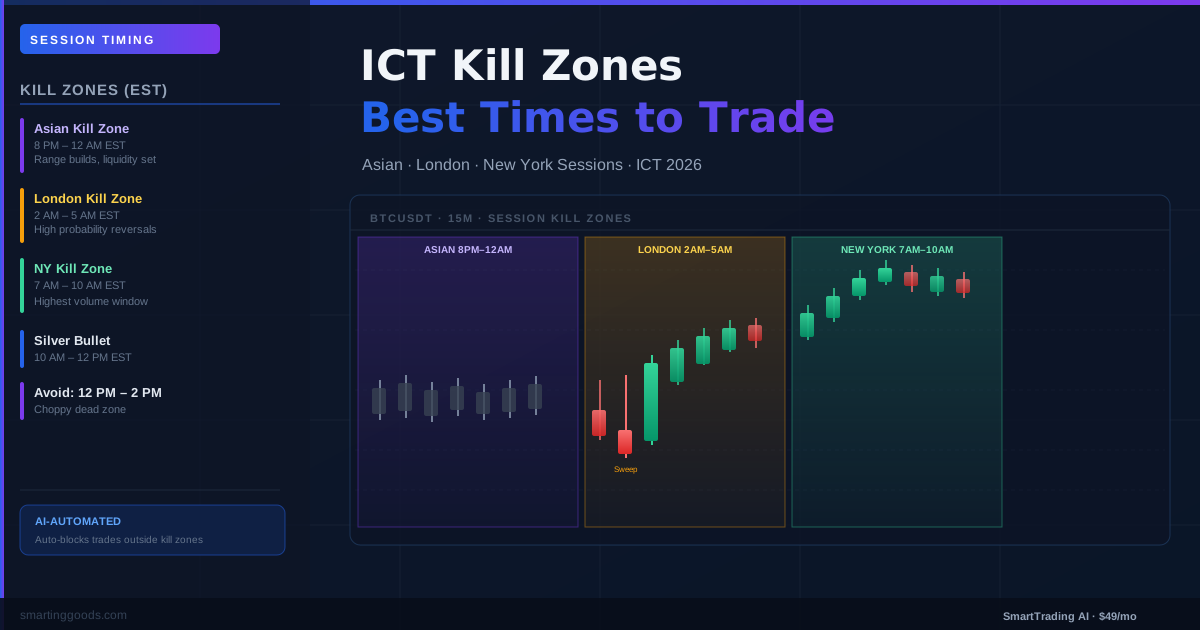
ICT Kill Zones: The Best Times to Trade Using ICT
ICT Kill Zones are the four high-probability trading windows where institutional order flow is strongest. Learn which hours to trade and which to avoid.
What Are ICT Kill Zones?
ICT Kill Zones are specific time windows during the trading day when institutional order flow is highest — and therefore when ICT setups have the greatest probability of working. Trading outside Kill Zones means fighting low liquidity, random noise, and stop hunts that go nowhere. Trading inside them means aligning with the market's most predictable, high-volume price action.
Michael J. Wuollet (ICT) identified four primary Kill Zones based on decades of observing how market makers accumulate and distribute positions at session opens and closes. These windows are not arbitrary — they correspond directly to when the world's largest banks and institutions are actively engaged in the market.
The Four ICT Kill Zones
1. Asian Kill Zone — 8:00 PM to 12:00 AM EST
The Asian session is primarily an accumulation phase. Price typically consolidates within a tight range as Tokyo banks build positions. This session creates the "Asia range" — the high and low that London and New York sessions will later manipulate and target. For ICT traders, the Asian Kill Zone is less about active trading and more about marking key levels for the sessions that follow.
2. London Kill Zone — 2:00 AM to 5:00 AM EST
London open is the most explosive Kill Zone. With European institutions entering the market after Asian consolidation, this session frequently produces the day's major manipulation sweep — a false break of the Asia high or low followed by a sharp reversal. The London Kill Zone is ideal for short-term trades on the 5-minute and 15-minute timeframes with targets at internal liquidity pools.
3. New York Kill Zone — 7:00 AM to 10:00 AM EST
The New York open Kill Zone overlaps with London's closing hours, creating the highest-volume window of the trading day. This is when USD economic data releases hit (CPI, NFP, FOMC) and when the biggest intraday moves occur. ICT's New York model focuses heavily on 8:30 AM EST — the typical data release time — and the hour before it as a setup window. Expect significant displacement candles, FVG fills, and Order Block reactions in this window.
4. London Close Kill Zone — 10:00 AM to 12:00 PM EST
The London Close Kill Zone captures the reversal or continuation move as European banks square positions. Price often retraces a significant portion of the New York morning move, or accelerates through it, depending on the day's bias. This is a secondary session for ICT day traders who missed the primary New York open setups.
Why Kill Zones Matter for ICT Traders
ICT methodology is pattern-based — Order Blocks, Fair Value Gaps, OTE zones, and liquidity sweeps all exist on every chart at every hour. But the same pattern has dramatically different outcomes at 3 AM EST (London Kill Zone) versus 2 PM EST (dead zone). The pattern alone is not the edge; the timing of the pattern is.
Studies of ICT traders' real trade logs consistently show that 80%+ of profitable ICT setups execute during these four windows. Trading outside Kill Zones — especially during the midday New York dead zone (noon to 2 PM EST) or overnight European afternoon — produces random, unreliable results even with technically perfect setups.
ICT Kill Zones for Crypto and Bitcoin
Crypto markets run 24/7, but institutional activity still clusters around traditional forex and equity sessions. For Bitcoin and Binance Futures traders, the relevant Kill Zones are:
- London Kill Zone (2-5 AM EST) — Consistently the most active BTC manipulation window
- New York Kill Zone (7-10 AM EST) — Strongest directional moves, especially on macro data days
- Asian Kill Zone (8 PM-midnight EST) — Range accumulation; set alerts, don't actively trade
The midday and overnight windows on BTC are characterized by lower volume, erratic moves, and higher spread environments — exactly the conditions where ICT setups fail most often.
How to Use Kill Zones in Your Trading Plan
- Do your analysis before the Kill Zone opens — not during it. Mark your Order Blocks, FVGs, and liquidity targets in advance.
- Set price alerts for your key levels. When price enters your zone during a Kill Zone, that's your trigger to assess the setup.
- Use a hard stop: if you're 30 minutes into the Kill Zone with no setup, skip it. Force entries are the leading cause of ICT traders losing on sound methodology.
- Log your trade times. After 30-50 trades, you'll see exactly which Kill Zone produces your best results — double down there.
Automating Kill Zone Monitoring with AI
One of the biggest advantages of automated trading is never missing a Kill Zone setup. The Smarting Goods AI trading bot runs continuously on Binance Futures, with Kill Zone-aware logic that increases its sensitivity during high-probability windows and reduces false signals during low-volume periods. No alarm clocks, no missed setups.
Access the SmartTrading AI platform to trade ICT Kill Zones automatically, around the clock.
Frequently Asked Questions
What time is the ICT Kill Zone?
There are four: Asian Kill Zone (8 PM–midnight EST), London Kill Zone (2–5 AM EST), New York Kill Zone (7–10 AM EST), and London Close Kill Zone (10 AM–noon EST). The New York open is generally the most reliable for high-probability setups.
What is the best ICT Kill Zone for day trading?
For most traders in North America, the New York Kill Zone (7–10 AM EST) is optimal. It combines the highest volume, clearest displacement candles, and the most predictable liquidity sweeps of the trading day.
Do ICT Kill Zones work on crypto?
Yes. Bitcoin and major altcoins on Binance Futures show clear increased volatility and directional clarity during the London (2-5 AM EST) and New York (7-10 AM EST) Kill Zones. The same institutional participants trading forex and indices also participate in crypto.
What should I do outside Kill Zones?
Mark your charts, log your analysis, and review previous trades. ICT's own advice is to not trade outside Kill Zones — the edge simply isn't there. Use the dead hours productively without touching live positions.
Can a bot trade Kill Zones automatically?
Yes. The Smarting Goods AI bot is Kill Zone-aware and prioritizes ICT setups during the London and New York session windows on Binance Futures, exactly when institutional order flow is highest.
Start AI Trading
See how our ICT bot automates Binance Futures trading.
Start AI Trading