ICT Trading Bot: How to Automate Smart Money Concepts on Binance (2026)
ICT traders know the methodology. The problem is execution: manually scanning for Order Blocks, Fair Value Gaps, and OTE zones across multiple timeframes is exhausting and error-prone. Here is how an ICT trading bot changes that — and why most bots completely miss the point of Smart Money Concepts.
ICT Trading Bot: How to Automate Smart Money Concepts on Binance (2026)
ICT traders know the methodology. The problem is execution: manually scanning for Order Blocks, Fair Value Gaps, and OTE zones across multiple timeframes is exhausting and error-prone. Most traders who learn ICT concepts from Michael J. Huddleston's teachings eventually hit the same wall — they understand what to look for, but they cannot monitor markets 24/7 and execute with the precision the methodology demands.
That is where an ICT trading bot enters. But here is the catch: nearly every "smart money bot" on the market is just a rebranded indicator-crossover system with ICT labels slapped on top. If you actually trade ICT, you know the difference immediately.
This guide breaks down what a real ICT trading bot needs to do, what the current tools get wrong, and what purpose-built automation actually looks like for SMC traders on Binance Futures.
What Is ICT Methodology? (And Why It Is Hard to Automate)
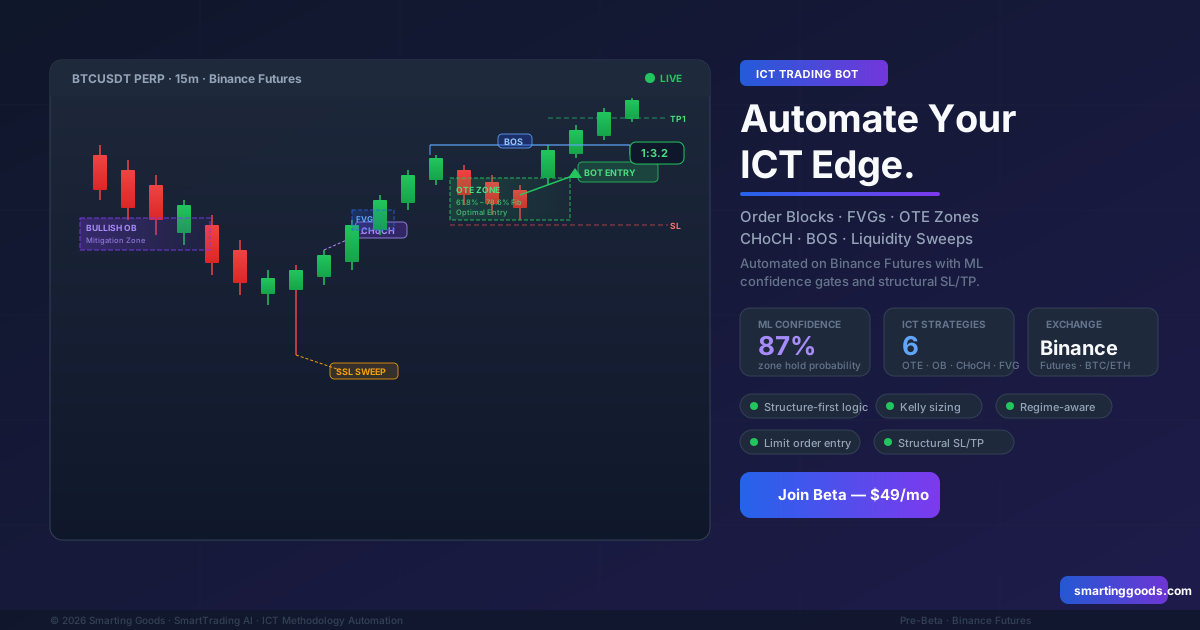
ICT (Inner Circle Trader) methodology — developed by Michael J. Huddleston — is a framework for reading institutional order flow. Instead of lagging indicators, it focuses on market structure: where smart money is positioned, where liquidity pools exist, and how price delivers to those areas with precision.
The core concepts include:
- Order Blocks (OB) — the last opposing candle before a significant move, representing institutional accumulation or distribution zones
- Fair Value Gaps (FVG) — three-candle imbalances where price moved too fast for fair two-sided trading, creating high-probability return zones
- Optimal Trade Entry (OTE) — the 61.8%–78.6% Fibonacci retracement zone within a displacement move, where risk-to-reward is most favorable
- Change of Character (CHoCH) — the first structural shift signaling a potential trend reversal
- Break of Structure (BOS) — continuation confirmation that trend direction is established
- Liquidity Sweeps — price engineering to hunt stop-loss clusters above swing highs and below swing lows before reversing
The challenge for automation is that ICT is context-dependent. An Order Block is only valid if it precedes displacement. A Fair Value Gap only matters if it sits within the premium or discount of a larger range. A CHoCH only means something in the context of the higher-timeframe trend. None of these rules can be reduced to a simple cross-above-cross-below logic.
This is why most ICT trading bots fail: they identify the shapes without understanding the logic.
What Most "ICT Bots" Actually Do (And Why They Fall Short)
Search for an ICT trading bot and you will find two categories of tools:
Category 1: Indicator-Based Systems Wearing ICT Clothes
These bots use RSI, MACD, or Bollinger Bands and relabel the outputs as "Order Blocks" or "Smart Money." They do not read market structure. They cannot detect CHoCH because CHoCH requires understanding the prior swing context. They cannot validate an FVG because FVG validity depends on whether displacement actually occurred. The ICT branding is cosmetic.
Category 2: Generic Crypto Bots With SMC Add-Ons
Platforms like 3Commas, Cryptohopper, and Pionex offer powerful automation infrastructure — DCA bots, grid bots, signal marketplaces. Some have added community-built SMC strategies. But the underlying logic still boils down to indicator crossovers, and the position sizing, entry logic, and exit management have nothing to do with ICT principles like Kelly-criterion sizing, mitigation block re-entries, or liquidity-pool-based take-profits.
The fundamental problem is not effort — it is architecture. These platforms were built for rule-based indicator strategies. ICT methodology requires structural analysis, which is a different problem entirely.
What a Real ICT Trading Bot Needs to Do
For an ICT trading bot to actually execute ICT methodology, it needs to solve five distinct problems:
1. Real-Time Market Structure Parsing
The bot must maintain a live map of swing highs, swing lows, and structural shifts across at least two timeframes simultaneously. When price breaks a swing high on the 15-minute chart after a CHoCH on the 1-hour, that context matters for trade validity. This requires stateful analysis — the bot must remember what happened, not just what is happening now.
2. Zone Detection With Validity Rules
Identifying an Order Block is straightforward. Knowing whether it is still valid — unmitigated, preceded by displacement, sitting in a premium or discount area — requires layered rule evaluation. A valid OB for a long setup must be in a discount zone (below the 50% of the larger range), preceded by a bullish displacement, and unmitigated by subsequent price action.
3. Multi-Factor Confluence Scoring
ICT traders never rely on a single zone. High-probability setups require confluence: an OB that aligns with an FVG, sitting in an OTE zone, with a recent liquidity sweep as the catalyst. A bot needs to score these confluences, not just detect individual zones.
4. Structural Stop-Loss and Take-Profit Placement
ICT methodology has specific rules for SL and TP placement. Stop-losses go beyond the Order Block's origin candle low/high — specifically positioned to avoid being caught in a normal liquidity sweep. Take-profits target liquidity pools: equal highs/lows, previous day's highs/lows, and swing structure points. Fixed percentage-based SL/TP completely misses this.
5. Adaptive Execution on Futures
For crypto futures on Binance, the bot must handle limit order placement at zone entry, monitor for invalidation (price closing through the OB without the expected reaction), manage partial fills, and adjust for funding rates and market liquidity. This is operational complexity far beyond what a simple webhook-triggered bot handles.
The ML Layer: Why Structure Analysis Alone Is Not Enough
Even with perfect zone detection, ICT setups fail. Markets are non-stationary — an OB that held 80% of the time in a trending regime may only hold 45% of the time in a ranging regime. A sophisticated ICT trading bot needs to model this uncertainty.
Machine learning adds two critical capabilities on top of pure ICT structural analysis:
Zone hold probability: Given the current regime (trending, ranging, volatile), the timeframe, the number of confluence factors, and the historical behavior of similar zones — what is the probability this OB holds? This confidence score acts as a gate: only take setups above a threshold.
Regime detection: A Hidden Markov Model or similar approach can classify market regimes from volatility, volume, and structure data. ICT strategies perform very differently across regimes. Automating this switch — more aggressive in trending regimes, reduced size or no trade in ranging or high-volatility regimes — dramatically improves the equity curve.
The combination of rule-based ICT analysis (structure, zones, liquidity) with ML confidence gates (regime awareness, zone quality scoring) is what separates a real ICT automation system from a dressed-up indicator bot.
How SmartTrading AI Automates ICT Methodology on Binance Futures
This is exactly the problem SmartTrading AI was built to solve. It is the first trading bot platform that runs genuine ICT structural analysis with ML-powered execution gates — not an indicator system with SMC labels.
Here is what the system actually does:
- Live structure mapping — Continuous CHoCH and BOS detection across 15m, 1H, and 4H timeframes simultaneously. The system maintains a stateful picture of market structure, not just a snapshot.
- Zone detection with validity rules — Order Blocks are validated against displacement confirmation, mitigation status, and premium/discount positioning. FVGs are scored by size, recency, and structural context. OTE zones are drawn dynamically from the most recent displacement leg.
- Confluence scoring — Every potential entry is scored on a composite scale: OB quality, FVG alignment, OTE zone positioning, liquidity sweep catalyst, and regime favorability. Only high-confidence setups execute.
- ML confidence gates — A trained model predicts zone hold probability given current market conditions. Below the confidence threshold, the bot waits. This prevents over-trading in low-quality setups.
- Structural SL/TP placement — Stop-losses are placed beyond the ICT invalidation point. Take-profits target identified liquidity pools — equal highs/lows and structural swing levels — rather than arbitrary percentage targets.
- Kelly criterion position sizing — Position size is calculated from expected edge (win rate × RR ratio) and account equity, not a fixed percentage. Size adapts to setup quality.
- Binance Futures execution — Native limit order placement with automatic management: order monitoring, fill confirmation, SL/TP adjustment post-fill, and invalidation exits when structure breaks before entry fills.
The platform is currently in closed beta, targeting $49/month at launch. If you know ICT and want to stop manually executing every setup, join the waitlist for SmartTrading AI.
ICT Trading Bot Setup: What to Look For (If You Build Your Own)
If you are evaluating building your own ICT automation before committing to a platform, here are the benchmarks to use:
Does it detect CHoCH and BOS correctly? Test it on a historical chart. CHoCH should only trigger on the first structural break after a sustained move. BOS should confirm continuation, not trigger on every swing break. If it fires on every minor swing, it is not reading structure.
Does it validate OB quality? Show it a chart with mitigated Order Blocks (price has already revisited and pushed through the zone). A real ICT bot should not mark those as valid entry zones. If it does, it is identifying shapes, not structure.
Does it understand premium vs. discount? For a bullish OB setup, the entry zone should be below the 50% equilibrium of the current range. If the bot takes long entries in premium areas "because there is an OB there," it is missing a foundational ICT principle.
Does SL placement respect the invalidation level? SL should sit below the OB's origin candle low (for longs), not at a fixed 1% or 2% below entry. If you see percentage-based stops, the system is not ICT-native.
Common Questions About ICT Trading Bots
Frequently Asked Questions
Q: Can you fully automate ICT trading?
A: Yes, but only with purpose-built architecture. ICT requires stateful structural analysis and multi-factor confluence scoring — not indicator crossovers. The systems that fail at ICT automation are trying to retrofit indicator-based infrastructure to a structure-based methodology. With the right ML-augmented approach, ICT strategies can be automated with high fidelity to the original methodology.
Q: What win rate should an ICT trading bot achieve?
A: A well-validated ICT strategy on BTC futures in trending regimes typically shows 45%–65% win rates when confluence requirements are strict. More important than raw win rate is the risk-to-reward ratio: ICT setups targeting liquidity pools typically offer 1:2 to 1:4 RR, meaning positive expectancy even at 40% win rate. Be skeptical of any bot claiming >70% win rate consistently.
Q: Which exchanges work best for ICT bot trading?
A: Binance Futures is the dominant choice for crypto ICT traders due to deep liquidity, tight spreads on BTC/ETH perpetuals, and reliable API access for limit order execution. The deep liquidity is important specifically because ICT methodology targets the sweep-and-reverse pattern — thin liquidity markets do not generate clean sweeps and reversals at institutional zones.
Q: Do I need to know Python to run an ICT trading bot?
A: For custom builds, yes — most serious ICT automation requires either Python (pandas, ccxt, custom zone logic) or Pine Script for TradingView alerts with a webhook executor. For platforms like SmartTrading AI, the analysis and execution layers are handled by the platform — you configure the risk parameters, and the system handles the rest.
Q: How is SmartTrading AI different from 3Commas or Cryptohopper?
A: 3Commas and Cryptohopper are excellent for DCA bots, grid bots, and indicator-based automation. They are not built for ICT/SMC. SmartTrading AI was designed specifically around ICT methodology: it runs CHoCH/BOS detection, OB/FVG/OTE analysis, and liquidity sweep identification as the core engine — not as an add-on feature. The ML confidence layer and structural SL/TP placement are also ICT-native, not adapted from generic quant strategies.
The Bottom Line
Automating ICT methodology is genuinely hard. The methodology is context-dependent, multi-timeframe, and built on structural relationships that do not reduce to simple rules. That is why the "ICT bot" space is currently full of noise — systems that identify ICT-shaped patterns without understanding ICT logic.
The traders who will benefit most from a real ICT trading bot are not beginners looking for a system to follow blindly. They are experienced SMC traders who understand the methodology, can identify when a setup is valid versus marginal, and want to remove the execution bottleneck that prevents scaling their edge.
If that describes you, SmartTrading AI is built for you. It is the only platform that automates genuine ICT structural analysis — not indicator overlays — with ML-powered confidence gates on Binance Futures. Early beta access starts at $49/month.
Join the SmartTrading AI waitlist and be among the first ICT traders to automate their edge.