Inversion Fair Value Gap: How to Trade IFVG in ICT
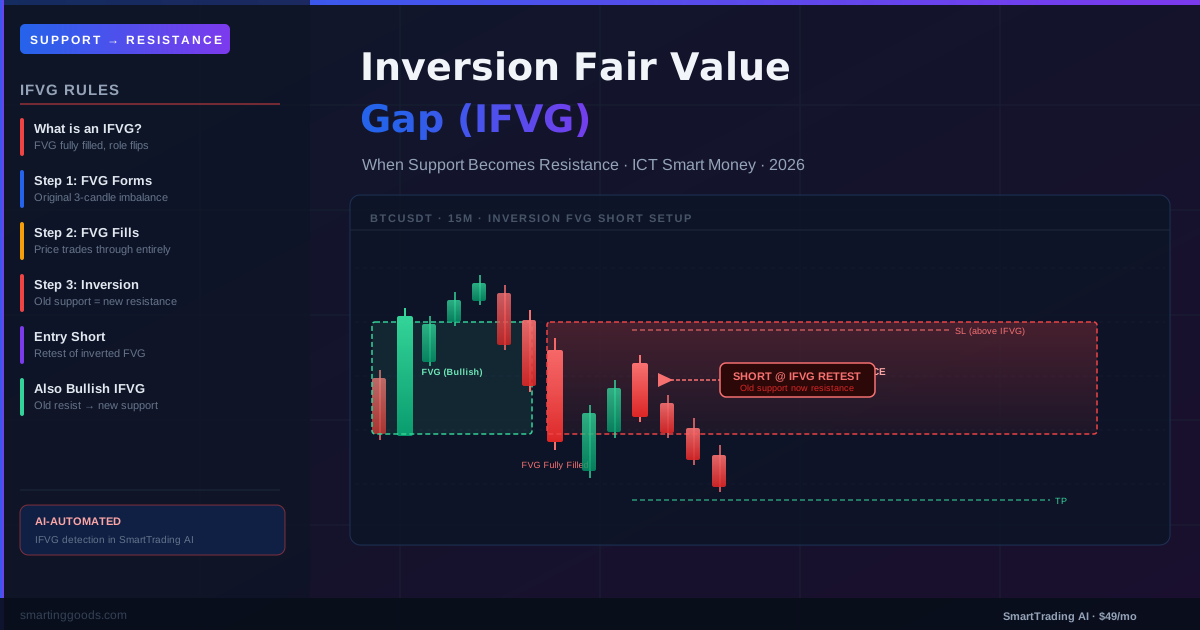
An inversion fair value gap (IFVG) forms when price violates a standard FVG and it flips from support to resistance (or vice versa). Here's how to trade it.
What Is an Inversion Fair Value Gap (IFVG)?
An Inversion Fair Value Gap — commonly abbreviated as IFVG — is what happens when a standard Fair Value Gap gets violated. In normal FVG trading, you expect price to respect the gap as support (for bullish FVGs) or resistance (for bearish FVGs) and reverse from it. When price instead drives through the FVG without respecting it, that gap "inverts" — it flips its polarity from support to resistance or from resistance to support.
This inversion concept is directly analogous to how traders think about broken support levels becoming resistance. In ICT methodology, the FVG is where institutional orders were placed. When those orders are violated, the same price area becomes relevant again — but now as the opposing side flips into the driver's seat.
How an IFVG Forms
The formation sequence is straightforward:
- A bullish FVG forms — three candles create an upward imbalance (gap between candle 1 high and candle 3 low). This is standard FVG formation.
- Price returns to the FVG but does not respect it. Instead of bouncing, price closes below the bullish FVG (or above the bearish FVG). The gap is now violated.
- The violated FVG becomes the IFVG. What was bullish support is now bearish resistance. The same price level that was a buy zone is now a sell zone.
The inversion is only confirmed on a candle close through the FVG — a wick into and back out of the gap does not constitute an inversion. The full candle body must close beyond the opposite boundary of the FVG.
Why IFVGs Are Powerful Entry Points
When price violates an FVG and then retraces back to that zone, the IFVG becomes one of ICT's highest-probability entry zones. Here's why:
- Double institutional significance: The zone was significant enough to create an FVG in the first place (institutional order placement), and then significant enough to be violated (shift in institutional intent). Two events concentrate order flow at the same price.
- Retail stop cluster: Many retail traders who bought the original bullish FVG have their stops just below it. When the FVG is violated, those stops trigger. The IFVG then becomes a zone where those same retail traders might try to re-enter — giving institutions a sell-side pool to execute against on the retracement.
- Clean definition: Unlike subjective resistance levels, the IFVG has exact price boundaries (the original FVG range), making SL placement objective and precise.
Trading the IFVG: Entry and Risk Management
Entry
Wait for price to retrace back into the IFVG zone after the violation. The ideal entry is at the midpoint of the original FVG range (50% level). Some ICT traders use the first touch of the zone; others wait for a rejection candle forming inside the IFVG before entering.
Stop Loss
Place the stop loss just beyond the far boundary of the IFVG. For a bearish IFVG entry (selling the retracement into a violated bullish FVG), your stop goes just above the original FVG high. If price clears that level, the bearish thesis is invalidated.
Target
The primary target is the most recent swing low (for bearish IFVG setups) or the liquidity pool that caused the initial FVG violation. Secondary targets are FVGs and Order Blocks in the direction of the IFVG trade.
IFVG vs. Standard FVG — Which to Trade?
Both setups are valid; the context determines which takes priority. Key differences:
- Standard FVG: Higher hit rate in trending markets, especially when FVG aligns with trend direction. Simpler to identify and execute.
- IFVG: Higher hit rate in reversal contexts, when price has swept a major liquidity level and the FVG violation confirms the structural shift. More precise entries, tighter stops, but requires prior FVG identification first.
An FVG trading strategy post covers the standard FVG in more depth — read that first if you're new to the concept.
IFVGs on Bitcoin Futures
Bitcoin's high-volatility nature creates frequent FVG violations, making IFVG setups especially common on BTC. The 15-minute and 1-hour charts show the clearest IFVGs during Kill Zone hours. On daily and 4-hour charts, IFVGs at major structural levels (previous ATH areas, key demand zones) are high-conviction setups that the Smarting Goods AI trading bot specifically monitors.
Access the SmartTrading AI platform to see IFVG detection and automated entry execution on Binance Futures.
Frequently Asked Questions
What is an inversion fair value gap in ICT?
An IFVG is a standard Fair Value Gap that has been violated — price closed through it rather than respecting it as support or resistance. Once violated, the FVG inverts: a bullish FVG that fails becomes bearish resistance, and a bearish FVG that fails becomes bullish support.
How do I know if a FVG is inverted or just testing?
Inversion requires a candle close through the far boundary of the FVG. A wick that enters the FVG and closes back above (for bullish) or below (for bearish) is a test, not an inversion. Wait for the close confirmation.
Are IFVGs more reliable than regular FVGs?
IFVGs are typically higher-conviction setups because they represent a double institutional event. However, they require an additional step (waiting for violation, then retracement), so they occur less frequently than standard FVG setups.
What timeframe is best for trading IFVGs?
The 15-minute and 1-hour charts provide the best balance of reliability and trade frequency for IFVG setups. Daily-chart IFVGs are the highest conviction but rarest; 1-minute IFVGs are high-frequency but noisy.
Does the AI bot detect IFVGs automatically?
Yes. The Smarting Goods AI bot tracks all active FVGs on Binance Futures, detects when they are violated, and monitors the IFVG zone for entry setups on retests — all in real time.
Start AI Trading
See how our ICT bot automates Binance Futures trading.
Start AI Trading