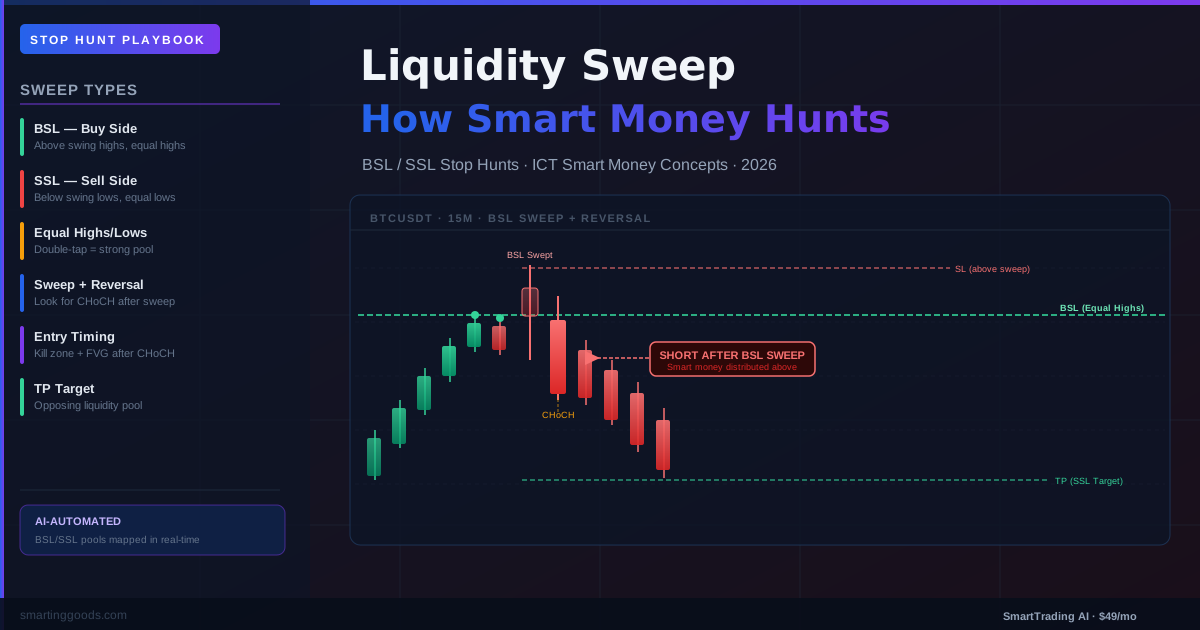
Liquidity Sweep Trading: How Smart Money Hunts Your Stops
Liquidity sweeps are engineered stop hunts where smart money collects retail orders before reversing. Learn to spot them, trade them, and automate them on Binance Futures.
What Is a Liquidity Sweep in Trading?
Liquidity sweep trading is built on one of ICT's most fundamental observations: before any significant price move, the market engineeres a brief excursion to hunt stop orders. These stop orders — clustered at predictable levels like prior swing highs, equal highs, daily extremes, and round numbers — represent the liquidity that large institutional players need to execute their own large orders without excessive slippage.
The mechanics are simple: a bank wanting to sell $500M worth of BTC can't just place a market sell order. That would crash the price before the order is filled. Instead, price is pushed above a prior swing high where buy stop orders are sitting (retail traders' stop losses on short positions, plus breakout buyers entering on the break). The bank sells into all of those buy orders — collecting the liquidity it needs to establish its short position at the desired price.
That spike above the high followed by an immediate reversal? That's not random volatility. That's a liquidity sweep.
Types of Liquidity in ICT
Buy-Side Liquidity (BSL)
Buy-side liquidity pools sit above the market — above swing highs, equal highs (EQH), prior day/week highs, and round numbers. When price sweeps buy-side liquidity, it spikes above these levels to trigger buy stop orders, then often reverses sharply downward. Bearish setups form when BSL is swept.
Sell-Side Liquidity (SSL)
Sell-side liquidity pools sit below the market — below swing lows, equal lows (EQL), prior day/week lows, and the .00 price handles. When price sweeps sell-side liquidity, it dips below these levels to trigger sell stop orders, then often reverses upward. Bullish setups form when SSL is swept.
Internal vs. External Liquidity
ICT distinguishes between internal liquidity (FVGs, Order Blocks within a trading range) and external liquidity (swing highs/lows beyond the current range). Sweeps of external liquidity produce the largest reversals; fills of internal liquidity are more common but produce smaller moves.
How to Identify Liquidity Pools
Marking liquidity pools is a core charting skill in ICT methodology:
- Equal Highs (EQH) and Equal Lows (EQL): Two or more swing points at virtually the same price level. These are the most obvious stop clusters — visible to every trader, which makes them prime manipulation targets.
- Prior Day High/Low (PDH/PDL): Yesterday's high and low are universally referenced by algo systems. They always contain significant stop clusters.
- Prior Week High/Low (PWH/PWL): Same principle at the weekly level — even larger stop clusters for longer-term positions.
- Round numbers: $100,000 BTC, $50,000 BTC — retail traders cluster stops at round numbers. Price sweeps these predictably.
- Swing structure highs/lows: Any prominent HH/LL in the prevailing trend is a liquidity pool waiting to be tapped.
Trading the Liquidity Sweep: Entry Strategy
Step 1 — Mark Your Liquidity Pools
Before each session, identify the major BSL and SSL pools on the daily and 4-hour charts. These are your primary manipulation targets for the day.
Step 2 — Monitor at Kill Zone Opens
Most sweeps occur during ICT Kill Zones. The London open (2-5 AM EST) and New York open (7-10 AM EST) are when institutions have the order flow to push price to liquidity pools and reverse.
Step 3 — Confirm the Sweep
A valid liquidity sweep has two components: the breach of the pool (price trades above EQH or below EQL) and the reversal (price closes back below the swept EQH or above the swept EQL within 1-3 candles). A sustained close beyond the level is NOT a sweep — it's a real breakout.
Step 4 — Enter After the Reversal Candle
After the sweep candle closes back inside the prior range, look for a displacement candle in the reversal direction, an FVG forming on the 1-minute to 15-minute chart, or an Order Block at the sweep level. These are your precision entry tools. The sweep level itself also becomes a reference for your stop: if price returns above the swept high (for bearish entries), your thesis is wrong.
Liquidity Sweep on Bitcoin Futures
Bitcoin's high-leverage derivatives ecosystem makes liquidity sweep trading especially effective. With billions in open interest on Binance Futures, the stop clusters at equal highs, round numbers, and prior weekly extremes are enormous. Institutions and large whale accounts regularly engineer these sweeps before reversing — and the patterns are highly predictable if you know where the liquidity sits.
The most reliable BTC liquidity sweep setups occur at:
- Prior weekly highs/lows (especially on Monday manipulation)
- Equal highs or lows that have been tested 2+ times on the 4-hour chart
- Whole number price levels ($100K, $95K, $90K, etc.)
- Open futures gaps that represent unfilled imbalances
Automating Liquidity Sweep Detection with AI
Manually tracking dozens of liquidity pools across multiple timeframes and watching for sweeps in real time is a full-time job. The Smarting Goods AI trading bot automates the entire process on Binance Futures — mapping BSL and SSL pools in real time, detecting sweep events as they happen, and executing entries at the reversal confirmation with pre-calculated SL and TP levels anchored to structural targets.
Access the SmartTrading AI platform and let the bot trade liquidity sweeps automatically on Bitcoin futures.
Frequently Asked Questions
What is a liquidity sweep in ICT?
A liquidity sweep is when price temporarily moves beyond a significant level (swing high, equal high, prior day high) to trigger stop orders sitting there, then reverses sharply. It's how institutions collect the order flow they need to execute large positions — by hunting retail stop losses.
How is a liquidity sweep different from a breakout?
A breakout sustains above the level — price closes beyond it and continues. A liquidity sweep is temporary: price spikes through the level and closes back inside the prior range within 1-3 candles. The reversal after the sweep is the tell.
What levels are most likely to be swept?
Equal Highs (EQH), Equal Lows (EQL), prior day/week highs and lows, round number price handles, and any swing point that has been tested multiple times. The more visible a level is to retail traders, the more stop orders sit there, and the more attractive it is as a sweep target.
Is liquidity sweep trading the same as stop hunting?
Yes — liquidity sweep, stop hunt, and stop raid are all terms describing the same phenomenon: price is moved to trigger stop orders, providing institutional players with the liquidity they need, before reversing.
Can AI detect and trade liquidity sweeps automatically?
Yes. The Smarting Goods AI bot identifies all major BSL and SSL pools on Binance Futures, detects sweep events in real time, and executes reversal entries automatically when the sweep pattern confirms — no manual monitoring required.