Order Block Trading Strategy: How to Trade OBs Like Smart Money (2026)
Order blocks are the institutional price zones where smart money places its largest orders. Learn the exact validity rules most traders miss, how to identify bullish and bearish OBs, and a precise entry/SL/TP framework for trading them on Binance Futures.
Order Block Trading Strategy: How to Trade OBs Like Smart Money (2026)
If you've been studying ICT methodology for any length of time, you already know that the order block trading strategy is the backbone of how institutional traders — the banks, hedge funds, and proprietary desks — position into the market. But most educational content stops at "find the last bearish candle before a bullish move." That's the surface. This guide goes deeper: we'll cover the exact validity rules that separate a tradable order block from a random candle, how to classify bullish and bearish OBs, what breaker blocks and mitigation blocks tell you, and a precise entry, stop-loss, and take-profit framework you can apply on any timeframe on Binance Futures.
What Is an Order Block?
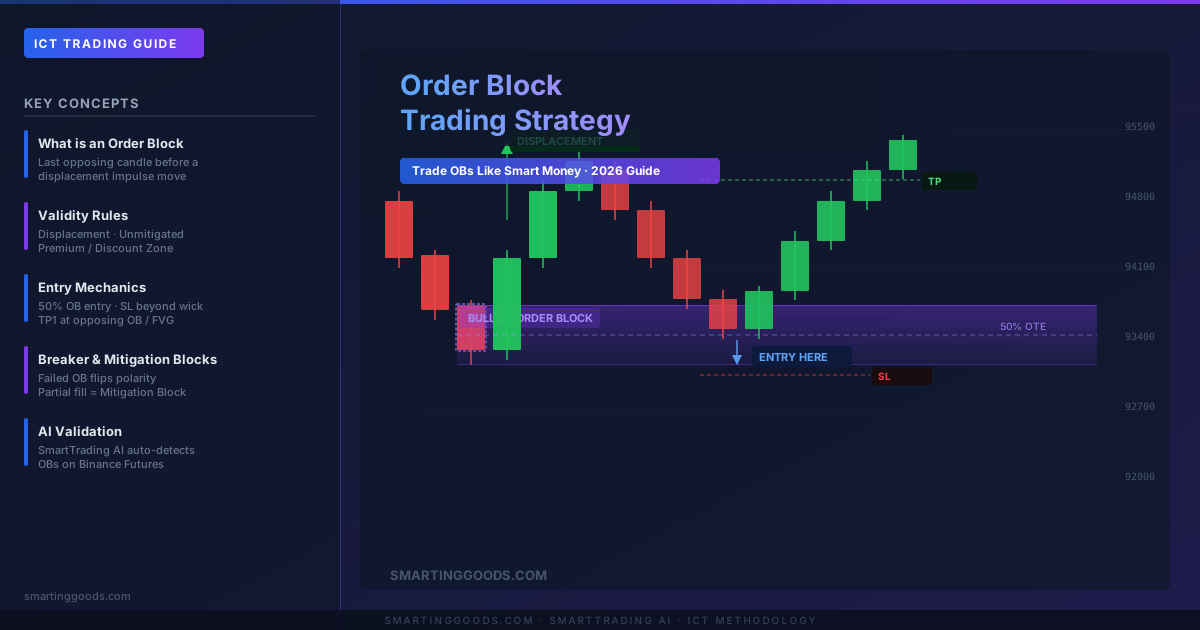
An order block (OB) is the last opposing candle (or candle range) before a significant displacement move. More precisely, it is the price zone where institutional participants accumulated or distributed a large position — and because those orders couldn't all be filled at once, a portion of that institutional intent remains unfilled at that zone. When price returns to the OB, the remaining orders get triggered, creating a predictable reaction.
From a structural standpoint, a bullish order block is the last bearish candle (or cluster of bearish candles) before a bullish displacement impulse. A bearish order block is the last bullish candle (or cluster) before a bearish displacement impulse. The key word is displacement — without it, you don't have an order block, you have noise.
Order blocks are not support and resistance in the classical sense. Classical S/R is reactive: price bounced here before, so it might bounce again. OBs are causal: institutional orders sitting at this price level will cause a reaction when price returns. That distinction changes how you mark them, how you enter, and how you manage risk.
How to Identify Valid Order Blocks (The Rules Most Traders Skip)
This is where most retail traders get it wrong. They mark every last candle before a move and call it an order block, then wonder why price blasts through half their "setups." Valid order blocks require three conditions to be met simultaneously:
1. Displacement Is Non-Negotiable
The move away from the OB must show displacement: a strong, impulsive, large-range candle (or sequence of candles) with little or no upper or lower wick depending on direction. The displacement candle should close well above the high of the OB (bullish) or well below the low of the OB (bearish). If the move away from the last opposing candle is slow, grinding, or overlapping — that is not displacement, and that candle is not a valid OB.
Displacement also implies an engineered liquidity sweep in many cases. Before the bullish displacement, smart money often sweeps sell-side liquidity (equal lows, previous day low, swing low) to trigger retail stop-losses, acquire long positions at a discount, and then displace price aggressively to the upside. Recognizing this sweep-and-displace sequence dramatically filters OB quality.
2. The OB Must Be Unmitigated
An order block is mitigated when price has already returned to it and traded through the full range (low to high for bullish, high to low for bearish). Once mitigated, the institutional orders sitting at that level have been filled. The OB is no longer valid for re-entry.
Partial mitigation creates a different structure — we cover that in the Mitigation Block section below. For a standard OB trade, you want price returning for the first time after displacement. A second or third return to the same zone carries significantly lower probability because smart money's residual orders have largely been consumed.
3. Premium and Discount Positioning
This is the validity rule most content ignores entirely. ICT teaches that institutions buy at a discount and sell at a premium relative to the current price range. For a bullish order block to be valid, it must sit in the discount zone — below the 50% equilibrium of the relevant price leg or dealing range. For a bearish OB, it must sit in the premium zone — above the 50% level.
How do you find the relevant range? Use the most recent swing high to swing low (or low to high) on the timeframe you're trading. The 50% midpoint is equilibrium. Bullish OBs below 50% are in discount. Bearish OBs above 50% are in premium. An OB sitting at equilibrium or on the wrong side dramatically lowers its probability — institutions buying at premium or selling at discount would be moving against their own incentive structure.
When you combine all three rules — displacement, unmitigated, and correct premium/discount positioning — you are left with a significantly smaller number of setups, but those setups have a structural reason to work rather than a statistical hope.
Bullish vs. Bearish Order Blocks
Understanding the directional distinction matters because the entry mechanics and the market context you need differ between the two.
Bullish Order Block:
- Last bearish candle before bullish displacement
- Zone defined from the candle's low to its open (body, not full range) — some ICT traders also include the full wick, but the body carries higher probability
- Must be in discount (below 50% of current dealing range)
- Price should return from above after the displacement (retracement, not reversal)
- Confirmation: look for a Change of Character (CHoCH) or a Market Structure Shift (MSS) on a lower timeframe as price interacts with the OB
Bearish Order Block:
- Last bullish candle before bearish displacement
- Zone defined from the candle's high to its open
- Must be in premium (above 50% of current dealing range)
- Price should return from below after displacement
- Confirmation: CHoCH or MSS on a lower timeframe as price rejects the OB zone
Multi-timeframe alignment multiplies the edge. A bullish OB on the 15-minute chart that sits inside a bullish OB on the 1-hour chart — which sits inside a discount zone on the 4-hour chart — is a meaningfully stronger setup than a 15m OB in isolation. This is the confluence-stacking approach that separates mechanical rule-followers from genuine ICT practitioners.
Breaker Blocks and Mitigation Blocks
Order blocks don't always hold. When they fail, they don't simply become neutral — they flip polarity and create two related structures worth understanding.
Breaker Blocks
A breaker block forms when an order block fails: price sweeps through the OB, creating a liquidity sweep, and then reverses aggressively. The failed OB zone now acts as a barrier of opposing order flow — a breaker.
Mechanically: a bullish OB gets swept (price trades through the low of the OB), then price reverses and breaks back above the OB high. That OB has become a bearish breaker. On the return, price will often react at the breaker zone as a resistance point where short positions are valid.
The logic is institutional: smart money laid a trap at the original OB zone. Retail longs entered. Price swept through, triggered their stops, collected the liquidity, and reversed. The breaker zone now marks where those trapped longs exist — and they become a source of sell pressure on any return to that area.
Mitigation Blocks
A mitigation block is a more nuanced structure. It forms when an OB is partially mitigated — price enters the OB zone but does not trade through the full range. Some institutional orders get filled (partial mitigation), but residual intent remains.
Mitigation blocks are typically seen in trending markets where price revisits a zone multiple times in smaller bites. Each return to the mitigation block reduces the available order flow. When the remaining orders are finally consumed, the mitigation block has been fully mitigated and offers no further edge. Until that point, it remains a valid zone — often with tighter entry criteria because the body of the zone has shrunk.
The practical takeaway: if you miss the first return to an OB but price pulls back again, check whether the first visit was a partial mitigation. If the zone wasn't fully traversed, there may still be a secondary entry — just expect a shallower reaction than the first tap.
Order Block Trading Strategy: Entry, Stop-Loss, and Take-Profit
This is the most specific part of the guide. The following rules assume you have identified a valid OB (displacement + unmitigated + premium/discount) with multi-timeframe alignment. Adjust timeframes and sizing for your own risk parameters.
Entry Rules
- Primary entry: Limit order at the 50% level of the OB body (open + low for bullish OB, divided by 2). This is the OTE (Optimal Trade Entry) zone — you're entering at the midpoint of institutional positioning, not at the extreme.
- Aggressive entry: Limit at the full OB high (for bullish) — you get a worse price but higher probability the zone holds because price barely enters the zone before reacting.
- Conservative entry: Wait for a lower-timeframe MSS or CHoCH as price taps the OB. The LTF confirmation adds latency but dramatically reduces false entries in choppy sessions.
- Avoid entries: During major news events (FOMC, CPI, NFP). Volume and displacement during news often creates false OBs. Let the news candle complete before re-marking zones.
Stop-Loss Placement
- Place stop-loss below the wick of the OB candle for bullish trades (or above the wick for bearish). Not the body — the wick. The wick defines the actual liquidity sweep potential of that candle.
- Add a 0.3–0.5% buffer beyond the wick to account for spread, slippage, and minor sweeps. On BTC/USDT Futures at $94,000, this equates to roughly $280–$470 of price range beyond your structural invalidation point.
- The OB is invalidated if price trades fully through the zone (below the wick on a bullish OB). If that happens, exit immediately — don't average down into a broken structure.
Take-Profit Targets
- TP1: The opposing order block, fair value gap (FVG), or swing high/low that formed during the original displacement move. This is typically 1.5x–2.5x your stop distance, giving you a risk-reward above 1.5:1 at minimum.
- TP2: The nearest unswept buy-side or sell-side liquidity pool beyond TP1 — equal highs, previous day high, HTF swing high. Let TP2 run with a trailing stop set at a key structural level.
- Partial exit: Take 50–60% off at TP1. Move stop-loss to breakeven. Let the remainder run to TP2 with no emotional pressure. This is especially important in Binance Futures trading where funding rate and leverage make holding losers expensive.
Timeframe Selection
For Binance Futures BTC/USDT trading, the most reliable OB setups come from the 15-minute and 1-hour charts for entries, confirmed against the 4-hour and daily for structural bias. Avoid the 1-minute and 3-minute for OB trades — displacement on these timeframes is frequently noise rather than institutional activity, and the OBs fail at a much higher rate.
How SmartTrading AI Validates Order Blocks Automatically
Identifying, classifying, and monitoring order blocks manually across multiple timeframes is time-intensive — especially in 24/7 Binance Futures markets. SmartTrading AI automates the entire OB validation pipeline using the same institutional criteria described in this guide.
The system continuously scans BTC/USDT Futures across multiple timeframes and applies the three-condition validity check in real time: displacement verification, mitigation tracking, and premium/discount zone classification. When a valid OB is identified, the platform calculates the OTE entry, dynamic stop-loss (anchored to the nearest structural level rather than a fixed percentage), and TP targets based on unswept liquidity pools beyond the OB zone.
Beyond detection, SmartTrading AI integrates order block signals with the broader ICT context engine: Fair Value Gaps, Change of Character, Break of Structure, and multi-timeframe confluence scores are all factored in before a trade is proposed. This prevents the most common failure mode in manual OB trading — valid OB, wrong market structure context.
The platform also runs on Binance Futures Hedge Mode, enabling simultaneous long and short exposure management — critical when OBs exist on both sides of the market at the same time, as they frequently do in ranging BTC markets.
Frequently Asked Questions
What is the difference between an order block and support/resistance?
Support and resistance are statistical — price bounced here before, so it might again. Order blocks are causal — institutional orders sitting at this exact price level will create a reaction. OBs have a specific structure (displacement, body range), a validity condition (unmitigated), and a directional context (premium/discount). When an OB is fully mitigated, it no longer carries the same edge. Traditional S/R levels don't have an equivalent invalidation mechanic.
How many times can price return to an order block?
A valid OB can be traded on the first return (highest probability), potentially the second return if the first was a partial mitigation. By the third return, the residual institutional orders have largely been absorbed and the zone behaves more like standard support/resistance — lower probability, tighter reactions. Always track whether each visit fully traversed the zone body.
Do order blocks work on all timeframes?
Order blocks are fractal — they exist on every timeframe. The higher the timeframe, the more significant the OB. A 4-hour OB carries more institutional weight than a 5-minute OB. For Binance Futures BTC trading, the sweet spot for entries is the 15-minute to 1-hour range, confirmed by 4-hour and daily bias. Very short timeframe OBs (under 5 minutes) produce high false-positive rates due to algorithmic noise.
What invalidates an order block?
Full mitigation invalidates an OB — price trades through the entire zone (from the body open to the wick extreme) without reversing. A Change of Character on the originating timeframe (without returning to the OB first) can also indicate the market has shifted away from the OB's structural context. Additionally, if the broader market structure flips against the OB direction (e.g., a bullish OB forms but HTF structure turns bearish), the OB should be removed from your active list even if technically unmitigated.
Can I use order blocks with other ICT concepts?
This is where the strategy becomes most powerful. Order blocks paired with Fair Value Gaps (price returning to both an OB and a FVG in the same zone), breaker blocks (OB polarity flips), liquidity sweeps before entry, and multi-timeframe OTE (Optimal Trade Entry) confluence create the highest-probability setups in the ICT framework. Isolated OBs without any other confluence are valid but carry lower probability — think of them as single-factor setups versus multi-factor setups.
Why does price sometimes blast through what looks like a valid order block?
Three common reasons: (1) the premium/discount condition wasn't met — the OB was at equilibrium or on the wrong side of the dealing range; (2) the move creating the OB wasn't true displacement — it was a slow grind that didn't reflect institutional accumulation; or (3) the OB was valid but higher timeframe structure overpowered the setup — a 15m bullish OB gets steamrolled when the 4-hour is in a strong bearish displacement. Always check HTF context before entering.
Conclusion
The order block trading strategy is one of the most powerful frameworks in ICT methodology — but only when applied with precision. The three validity rules (displacement, unmitigated, premium/discount) are non-negotiable filters. Breaker blocks and mitigation blocks extend the framework to handle OB failures gracefully rather than treating them as random noise. And a disciplined entry at the 50% OB level with a wick-anchored stop and liquidity-pool TP keeps your risk-reward structurally sound on every trade.
The challenge is execution speed and consistency: manually tracking OBs, their mitigation status, and multi-timeframe confluence across a 24/7 BTC futures market is demanding. That's precisely the problem SmartTrading AI is built to solve — automated OB detection, validation, and execution on Binance Futures so you can trade institutional methodology without institutional infrastructure costs.
Ready to see how automated order block detection works in practice? Explore SmartTrading AI →