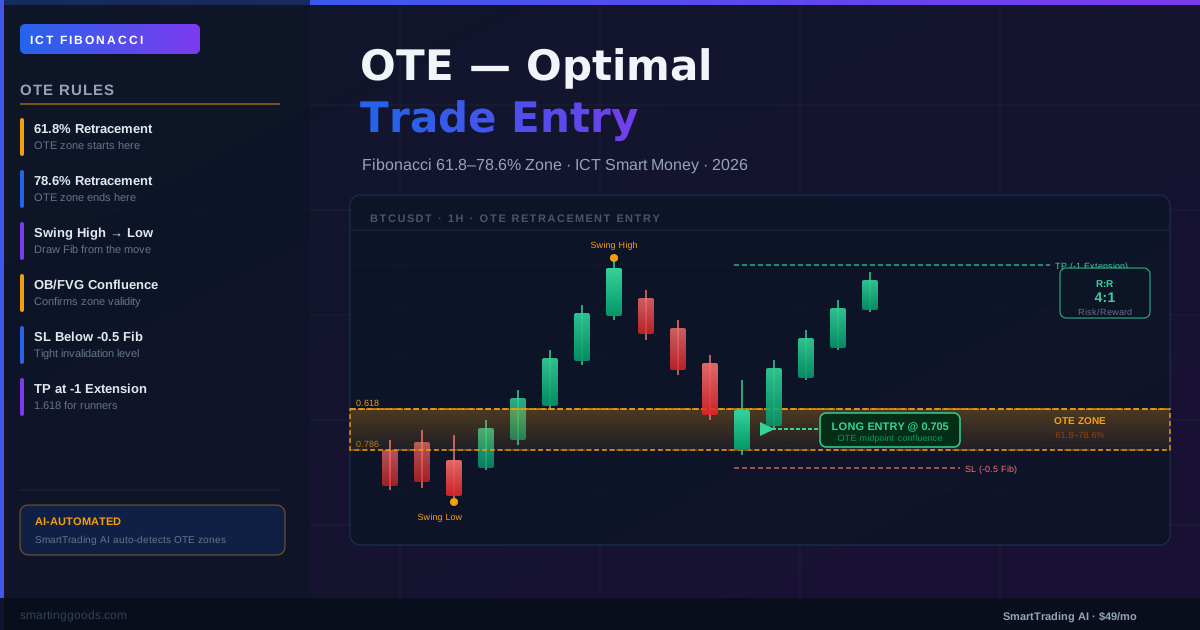
OTE Trading Strategy: How to Use Optimal Trade Entry
Master the OTE trading strategy — ICT's Optimal Trade Entry using the 62-79% Fibonacci retracement to enter high-probability trades at institutional prices.
What Is OTE (Optimal Trade Entry)?
The OTE trading strategy — Optimal Trade Entry — is one of ICT's (Inner Circle Trader) most precise entry techniques. Instead of chasing breakouts or entering at random swing points, OTE teaches you to wait for price to retrace into a specific Fibonacci zone before committing to a position.
The zone itself spans the 62% to 79% Fibonacci retracement of a confirmed impulse move. When price pulls back into this window after a structural break, you're entering at the same price levels where institutional traders — banks, hedge funds, and market makers — are loading positions. That's the entire premise: don't fight the institutions, join them.
OTE is not a standalone system. It requires a confirmed Change of Character (CHoCH) or Break of Structure (BOS) first, followed by a liquidity sweep of the prior swing, and then the retracement into the 62-79% zone. All three conditions must align before you enter.
How to Identify the OTE Zone
Setting up the OTE zone correctly is everything. Here's the step-by-step process ICT traders use:
- Step 1 — Identify a confirmed impulse leg. Look for a strong displacement candle that breaks a significant swing high or low. This displacement is the A→B leg of your Fibonacci draw.
- Step 2 — Draw Fibonacci from A to B. For a bullish OTE, draw from the swing low (A) to the swing high (B). For a bearish OTE, draw from swing high (A) to swing low (B).
- Step 3 — Mark the 62% and 79% levels. The area between these two levels is your OTE zone. Price retracing into here is your entry window.
- Step 4 — Wait for confirmation. Look for a rejection candle, an Order Block, or a Fair Value Gap inside the OTE zone before pulling the trigger.
- Step 5 — Set your stop loss. Place your SL just below the 90% retracement (the invalidation level). If price goes deeper than 90%, the OTE thesis is broken.
Why ICT Traders Rely on OTE
Most retail traders buy breakouts or enter after price has already moved significantly. By the time they're in, institutional players are already taking profits — directly into retail longs. The OTE framework flips this dynamic.
When you buy the 62-79% retracement of a bullish impulse, you're entering at a discount, with tight risk (SL at 90%), and clear targets above: the B swing high, then the next liquidity pool beyond it. The risk-to-reward on a properly executed OTE trade is typically 1:3 minimum and often 1:5 or higher.
The OTE also concentrates your entries at times when market makers are repositioning — filling their orders at better prices before continuing in the original direction. You're not predicting direction; you're reading the order flow that's already been established.
OTE + Fair Value Gap Confluence
The highest-probability OTE setups occur when the 62-79% retracement zone also overlaps with an open Fair Value Gap (FVG). When price retraces into a 3-candle imbalance inside the OTE window, the fill of that FVG often triggers a sharp rejection — exactly the kind of entries ICT models target.
Similarly, if a bullish Order Block sits inside the OTE zone — meaning the last bearish candle before the impulse move falls within the 62-79% band — that Order Block becomes a high-confluence entry point. Two institutional concepts aligning in the same price area signals genuine demand or supply, not noise.
Common OTE Mistakes to Avoid
- Drawing Fibonacci on the wrong swing. The impulse leg must be clean and impulsive. Using a choppy consolidation range invalidates the setup.
- Entering without a prior structural break. OTE is a continuation entry, not a reversal tool. You need a BOS or CHoCH first.
- Ignoring time of day. OTE setups have far higher hit rates during ICT Kill Zones — London Open (2-5 AM EST), New York Open (7-10 AM EST), and the afternoon session (1-4 PM EST).
- Oversizing into the zone. Even perfect OTE setups fail occasionally. Use consistent position sizing; never risk more than 1-2% per trade.
How SmartTrading AI Automates OTE Entries
Manually monitoring price for a retracement into a 62-79% Fibonacci window across multiple timeframes is time-consuming and easy to miss. The Smarting Goods AI trading bot solves this by scanning for OTE zones in real time on Binance Futures.
The system automatically identifies impulse legs, plots the Fibonacci draw, monitors for retracements into the OTE zone, and checks for confluence with Order Blocks and FVGs — all without you watching the chart. When all conditions align, the bot flags the setup and, if auto-execute is enabled, places the entry order with pre-calculated SL and TP levels based on the structural targets above.
Ready to automate your OTE entries? Access the SmartTrading AI platform and put your ICT strategy on autopilot.
Frequently Asked Questions
What is the OTE zone in ICT?
The OTE (Optimal Trade Entry) zone is the 62% to 79% Fibonacci retracement of a confirmed impulse move. ICT traders use it to enter trades at institutional price levels after a structural break and liquidity sweep.
What is the difference between OTE and standard Fibonacci retracement?
Standard Fibonacci uses the 38.2%, 50%, and 61.8% levels as broad retracement zones. ICT's OTE narrows this to 62-79%, with a hard invalidation at 90%, making entries more precise and stops tighter.
Does OTE work on crypto markets?
Yes. OTE works on any liquid market where institutional order flow is present, including Bitcoin and Ethereum on Binance Futures. The key is using it on the 15-minute, 1-hour, and 4-hour timeframes where institutional footprints are clearest.
Can I automate OTE trading?
Yes. The Smarting Goods AI trading bot automates OTE zone detection and entry placement on Binance Futures, scanning in real time and executing trades when ICT confluence conditions are met.
What stop loss should I use with OTE?
Place your stop loss just below the 90% Fibonacci retracement level. This is ICT's defined invalidation point — if price retraces beyond 90%, the OTE thesis is no longer valid.