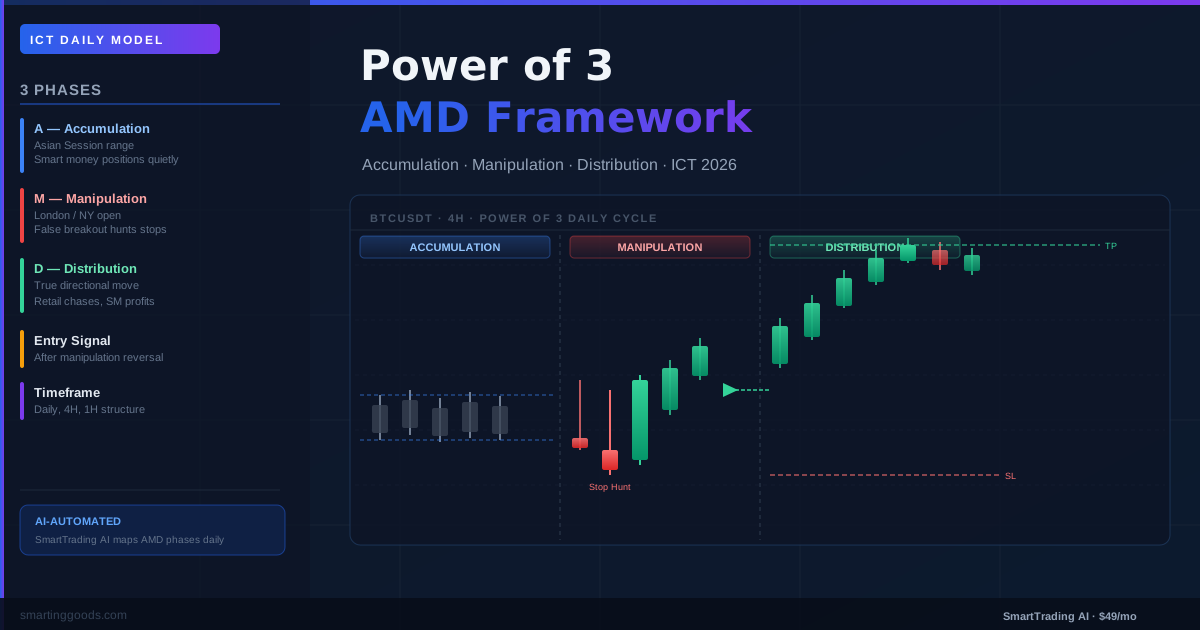
Power of 3 ICT Trading: AMD Framework Explained
Learn ICT's Power of 3 (Accumulation, Manipulation, Distribution) — the daily market cycle that smart money uses to trap retail traders before the real move.
What Is the Power of 3 in ICT Trading?
The Power of 3 ICT trading concept — also called AMD (Accumulation, Manipulation, Distribution) — describes the three-phase cycle that repeats in every liquid market on a daily basis. Understanding it tells you why price moves the way it does, and more importantly, when to position yourself with institutional order flow rather than against it.
Michael J. Wuollet (ICT) codified this framework from observing how banks and market makers engineer liquidity before committing to a directional move. Once you see it, you cannot unsee it in Bitcoin, forex, indices — any market with real institutional participation.
The Three Phases of Power of 3
Phase 1 — Accumulation
Accumulation happens during low-volume, range-bound conditions — typically the Asia session (8 PM to midnight EST) or during the overnight equilibrium period. Price consolidates within a tight range as smart money quietly builds positions at defined prices. Volume is thin, moves are small, and the range is boring by design. This phase creates the range that will be manipulated in Phase 2.
Phase 2 — Manipulation
This is the trap. At the open of a high-volume session (London or New York), price sweeps outside the accumulation range — often by a few pips or ticks — to trigger stop losses and pull in breakout traders. A bearish manipulation move (fake drop below the Asia low) precedes a bullish distribution day. A bullish manipulation move (fake rally above the Asia high) precedes a bearish distribution day. This sweep hunts the retail stop orders sitting just outside the overnight range and gives institutions the liquidity they need to fill large positions at better prices.
Phase 3 — Distribution
After the manipulation sweep, price reverses sharply and moves in the true direction for the session. This is the distribution phase — smart money offloading accumulated positions into retail traders who got stopped out or are now chasing the breakout in the wrong direction. Distribution moves are typically impulsive, clean, and sustained through the trading session.
How to Trade the Power of 3 Setup
- Mark the Asia range — the high and low of the 8 PM to midnight EST session.
- Watch for the manipulation sweep at London or New York open. A false break below the Asia low on a bullish day, or above the Asia high on a bearish day.
- Wait for the reversal candle after the sweep. Look for a displacement candle, Order Block, or FVG forming at the swept level.
- Enter in the direction of distribution. If the Asia low was swept, you go long. If the Asia high was swept, you go short.
- Target the opposing range extreme and beyond — liquidity pools above/below the Asia high/low are common targets.
Power of 3 on Bitcoin and Crypto
The Power of 3 applies directly to Bitcoin and crypto markets, though the session times are more compressed. On BTC, the New York open (7-9 AM EST) is the most reliable manipulation window. The Asia session (midnight to 6 AM EST) frequently creates the accumulation range that gets hunted at the New York open.
Because crypto trades 24/7, you need to adapt the framework: use the 4-hour and daily charts to identify multi-day AMD cycles, and the 15-minute chart to time your entry on the manipulation sweep. The AMD Framework post goes deeper on applying this to multi-day setups.
Why Power of 3 Gives You an Edge
Most retail traders buy the breakout of the Asia high or short the break of the Asia low — exactly what the manipulation phase is designed to trigger. The Power of 3 flips your perspective: the "breakout" is the signal that the real move is about to go the other way. You're no longer chasing; you're waiting for the trap to spring, then riding the distribution with institutions.
Combined with ICT Kill Zones timing, the Power of 3 becomes one of the most reliable intraday frameworks in ICT methodology.
Automating Power of 3 with AI
Identifying the Asia range, detecting the manipulation sweep, and timing the entry in real time requires constant chart attention — or automation. The Smarting Goods AI trading bot monitors Power of 3 setups on Binance Futures 24/7, flags manipulation sweeps as they happen, and executes entries when reversal confluence confirms. No alarm clocks, no screen time.
Try the SmartTrading AI platform and let the bot watch for AMD setups while you focus on strategy.
Frequently Asked Questions
What does Power of 3 mean in ICT?
Power of 3 refers to ICT's three-phase daily market cycle: Accumulation (building positions in a quiet range), Manipulation (false breakout to trigger stops), and Distribution (the real directional move that follows). It's also called AMD.
What time does the manipulation phase happen?
Most often at the London open (2-5 AM EST) or the New York open (7-10 AM EST). These are the high-volume sessions where institutions have the order flow to move price aggressively enough to trigger stops outside the Asia range.
How do I know if the sweep is manipulation or a real breakout?
Look for a quick spike beyond the range extreme followed by a sharp reversal within the same candle or the next. Real breakouts tend to have follow-through. A manipulation sweep often closes back inside the Asia range on the same candle that breached it.
Does Power of 3 work on all timeframes?
The daily AMD cycle is the most reliable. You can also find weekly AMD patterns (Monday manipulation, Tuesday-Wednesday distribution) and even intraday cycles on the 1-hour chart. ICT himself focuses primarily on the daily cycle.
Can an AI bot trade Power of 3 setups automatically?
Yes. The Smarting Goods AI bot detects Asia range boundaries, monitors for manipulation sweeps at session opens, and triggers entry orders when reversal signals confirm — all on Binance Futures without manual intervention.
Start AI Trading
See how our ICT bot automates Binance Futures trading.
Start AI Trading