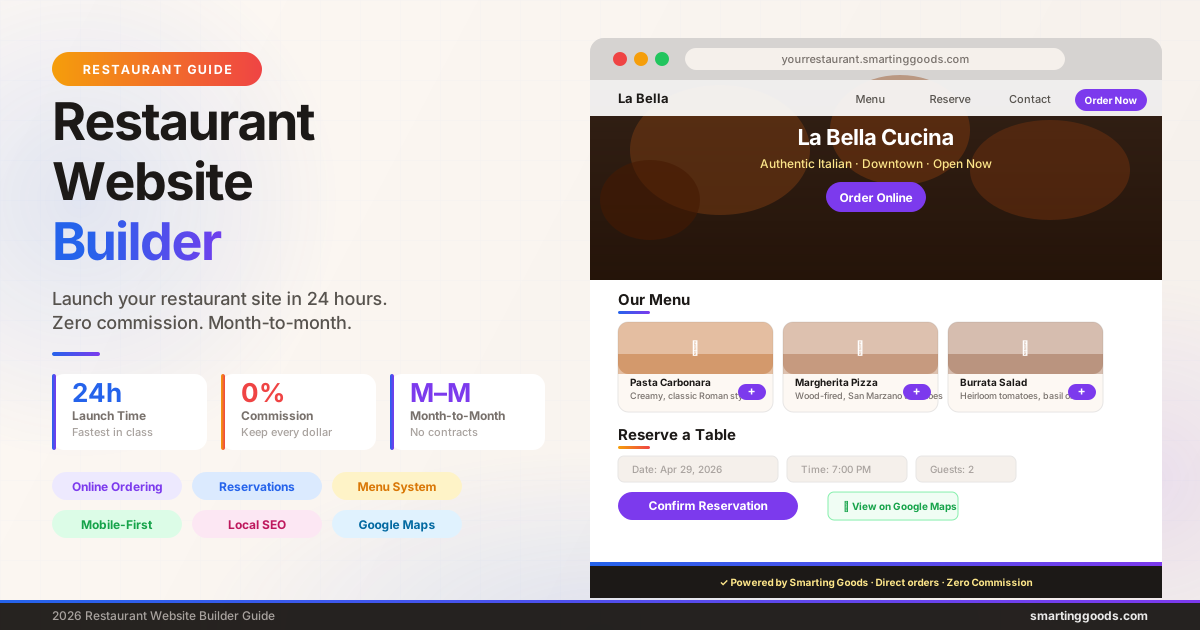
Restaurant Website Builder: Launch Your Site in 24 Hours (2026)
A restaurant website builder should do more than look good — it needs online ordering, reservations, and a menu system that works on mobile. Here's how to choose the right one, and how Smarting Goods gets you live in 24 hours with zero commission on orders.
If your restaurant doesn't have its own website, you're handing money to third-party platforms every single day. The right restaurant website builder gives you a professional online presence, built-in online ordering, and a reservation system — all without a developer, a long-term contract, or a commission cut taken out of every order. In 2026, diners check your website before they ever pick up the phone. If they can't find you, order from you, or book a table online, they'll find somewhere else to eat.
This guide covers what to look for in a restaurant website builder, compares the five most popular options on the market, and shows you how Smarting Goods gets your restaurant live in 24 hours with zero commission on every online order you take.
Why Your Restaurant Needs a Dedicated Website (Not Just a Google Listing or Social Media)
Google Business profiles and Instagram pages are useful, but they are not a substitute for owning your digital presence. Here's why a dedicated restaurant website matters more than ever:
- You own the ordering channel: When customers order through DoorDash or Uber Eats, you pay 15–30% commission on every ticket. A restaurant website with built-in online ordering means that money stays in your pocket. On $10,000 in monthly online orders, that's up to $3,000 a month you get to keep.
- Google ranks websites, not social profiles: When someone searches "best Thai restaurant near me" or "pizza delivery [your city]," Google returns websites — not Instagram posts. SEO lives on your website, not your social feed.
- You control the customer experience: A Google listing shows your hours and reviews. Your website shows your full menu with photos, your story, your specials, your reservation form, and your brand. That's what converts browsers into paying customers.
- You collect customer data: Every order and booking on your own site is customer data you own — names, emails, order history. Third-party platforms keep that data for themselves. You can't market to customers you don't know.
- Credibility and trust: Diners judge restaurants by their digital presence. A clean, mobile-optimized website signals that you run a professional operation — before they've tasted a single dish.
The bottom line: your restaurant website is your most profitable marketing channel. The only question is which builder gives you the best combination of speed, features, and cost.
What to Look For in a Restaurant Website Builder
Not every website builder is built for restaurants. A generic drag-and-drop page builder won't cut it if you need online ordering, a live menu, or a table reservation system. Before you commit to any platform, check it against this criteria:
- Built-in online ordering with zero (or low) commission: This is the most important feature on this list. If the platform takes a cut of every order, your profit margin takes a permanent hit. Look for a flat monthly fee instead of per-order commission.
- Menu management: You need to update prices, add seasonal specials, and upload food photos without calling a developer. A proper restaurant website builder has a menu editor that any staff member can use.
- Reservations and booking system: Customers want to book tables online. Your website should handle this automatically — without you manually confirming every booking by text or email.
- Mobile-first design: More than 70% of restaurant website traffic comes from smartphones. If your site doesn't load fast and look great on mobile, you're losing orders before the page even finishes loading.
- SEO built in: Clean URLs, fast page speed, structured data for menus and local business — these are what get you found on Google. Most generic website builders treat SEO as an afterthought.
- Month-to-month pricing: Annual contracts are a red flag. Your business needs change. You should be able to leave (or switch plans) without paying a cancellation penalty.
- Speed to launch: Every week your website isn't live is revenue you're not capturing from online orders. The best platforms get you live in 24 hours or less.
Top 5 Restaurant Website Builders Compared (2026)
1. Wix
Best for: Restaurants that want maximum design flexibility and have time to build from scratch.
- Pros: Massive template library; highly customizable drag-and-drop editor; app marketplace with ordering integrations; decent SEO tools; no transaction fees on paid plans.
- Cons: Online ordering requires a third-party app (adds cost and complexity); no native reservation system built for restaurants; setup is time-consuming — expect days, not hours; Wix templates are generic and require heavy customization to feel like a real restaurant site; Wix ADI (AI builder) still produces mediocre results for food businesses.
- Price: Business plans start at $17–$36/month. Online ordering via third-party apps adds $9–$50/month extra. No commission on orders, but transaction fees apply on lower-tier plans.
2. Squarespace
Best for: Upscale restaurants or cafes where design aesthetics are a priority.
- Pros: Beautiful, award-winning templates; strong portfolio and photo presentation; built-in SEO tools; good blogging features; SSL included.
- Cons: Online ordering and reservations require integrations (not native); limited restaurant-specific features out of the box; steeper learning curve than it appears; customer support can be slow; annual billing required for best pricing.
- Price: Business plan $23/month (annual); Commerce plans $28–$52/month for e-commerce features. 3% transaction fee on Business plan; waived on Commerce plans. No native online ordering — requires OpenTable ($49+/month) or a third-party order system.
3. GloriaFood
Best for: Restaurants that want online ordering only, with no interest in a full website.
- Pros: Free online ordering widget that embeds on any website; solid order management interface; real-time order notifications; handles delivery and pickup orders; POS integrations available.
- Cons: GloriaFood is an ordering widget, not a website builder — you still need a separate website; the free version has limited customization; premium features (printing, order ahead, promo tools) require a paid plan; branding is not as polished as standalone restaurant website builders; website integration feels bolted on rather than native.
- Price: Free ordering widget; Sales Optimized plan at $9/month; Advanced Delivery at $29/month. No commission on orders. Separate website cost not included.
4. Square for Restaurants
Best for: Restaurants already using Square POS that want a tightly integrated system.
- Pros: Seamless Square POS sync; online ordering built in; solid floor plan and table management tools; Square Online store included on paid plans; trusted brand with reliable uptime.
- Cons: Website design is functional but generic — not built to win on aesthetics or SEO; annual contract encouraged for best pricing; online ordering commission-free only on in-person pick-up (delivery via DoorDash Drive still carries fees); limited control over website design without a developer; not ideal if you're not already in the Square ecosystem.
- Price: Free plan available (2.9% + 30¢ per online transaction); Plus plan $60/month; Premium plan requires custom pricing. No per-order commission on direct orders, but card processing fees apply to all plans.
5. Smarting Goods
Best for: Restaurant owners who want to launch fast, keep 100% of their order revenue, and never deal with a developer or long-term contract.
- Pros: Launches in 24 hours — genuinely. You provide your menu, photos, and details; the platform builds and deploys your site same-day. Built-in online ordering with zero commission on every order. Includes a full booking and reservation system at no extra charge. Mobile-first design optimized for local SEO. Month-to-month pricing — no annual commitment, no cancellation fees. Designed specifically for local businesses including restaurants, so every feature is relevant.
- Cons: Less design customization than Wix or Squarespace if you want to build everything from scratch; newer platform with a smaller template library than established players; best suited for restaurants that want an effective, professional site fast rather than a fully bespoke design project.
- Price: Month-to-month flat pricing. Zero commission on all online orders — you keep 100% of every order. No hidden per-order fees, no transaction percentages taken by the platform.
Ready to see what your restaurant site could look like? Get started with Smarting Goods here.
Must-Have Features for Restaurant Websites
Whether you're launching your first restaurant website or rebuilding an outdated one, these are the features that directly drive revenue:
Online Ordering with Zero Commission
This is the single highest-ROI feature any restaurant website can have. Enabling direct online ordering — and routing customers away from third-party apps — can save you thousands of dollars per month. Every platform on this list offers some form of online ordering, but the commission structure varies dramatically. Make sure you understand exactly what percentage (if any) the platform takes from each order before signing up.
Menu with Photos and Descriptions
Menus without photos convert at a fraction of the rate of visual menus. Diners eat with their eyes first. Your website should display your full menu with high-quality photos, clear pricing, and the ability to update items without touching code. Seasonal specials, sold-out items, and price changes should take minutes — not a support ticket.
Reservations and Table Booking
An online reservation form that sends automatic confirmation emails (and reminder messages) reduces no-shows and frees up your front-of-house staff from managing a phone queue. Look for a booking system that integrates directly into your website rather than redirecting customers to a third-party app.
Google Maps Integration and Local SEO
Your restaurant website needs to be findable. That means a Google Maps embed on your contact page, structured data markup (schema.org/Restaurant) so Google reads your hours and menu, a fast-loading mobile site, and consistent NAP (name, address, phone number) across your site and Google Business profile. These are not advanced features — they're table stakes for any restaurant website builder worth paying for.
Mobile-Optimized Design
Over 70% of restaurant website visits happen on mobile. A site that looks great on a laptop but breaks on a phone is worse than no site at all — a bad mobile experience actively damages your reputation and kills conversions. Test every restaurant website builder you consider on a phone before you commit. Tap the "Order Online" button. Try to add an item to a cart. If it's clunky, move on.
Fast Page Load Speed
Google uses page speed as a ranking factor for local searches. Slow sites also have dramatically higher bounce rates — a restaurant website that takes more than 3 seconds to load loses roughly half its visitors. Look for a builder that hosts on a CDN, compresses images automatically, and scores well on Google PageSpeed Insights.
How Smarting Goods Launches Your Restaurant Website in 24 Hours
Most restaurant website builders expect you to do the work: choose a template, drag elements around, write your copy, upload your menu, configure your ordering system, set up payments, and test everything before you go live. For a busy restaurant owner, that's an entire week of work — time you don't have.
Smarting Goods takes a different approach. You provide the inputs (your menu, your photos, your location, your hours, your booking preferences) and the platform builds and deploys your site within 24 hours. When you wake up the next morning, your restaurant has a professional, mobile-optimized website with:
- A full online ordering system — zero commission, all orders go directly to you
- Your complete menu with photos, descriptions, and pricing
- A reservation and booking system that sends automated confirmations
- Google Maps integration and local SEO optimization baked in
- A mobile-first design that works on every device
- Month-to-month pricing — no contracts, no lock-in
There's no developer required. No design degree needed. No months-long onboarding process. If you can describe your restaurant, you can launch your website.
The same platform powers websites for other local businesses too — including salons and spas (see our beauty salon website builder if you run a salon or spa alongside your restaurant). One platform, consistent experience across every type of local business.
The zero-commission model is what sets Smarting Goods apart from every other option on this list. Platforms like Toast, Uber Eats, and DoorDash take 15–30% of every order. Even platforms with a "no commission" label often charge per-transaction processing fees that add up fast. Smarting Goods charges a flat monthly fee — whatever you make on online orders, you keep.
For a restaurant doing $15,000/month in online orders, switching from a 20% commission platform to Smarting Goods saves $3,000 every single month. That's $36,000 a year back in your pocket just from one channel.
Frequently Asked Questions
What is the best restaurant website builder in 2026?
The best restaurant website builder depends on your priorities. If design flexibility is your top concern, Wix or Squarespace are strong options — but expect to spend days or weeks building your site. If you want to launch fast and keep 100% of your online order revenue, Smarting Goods is the best choice in 2026: it launches in 24 hours, charges zero commission on orders, and includes online ordering and reservations in the base price.
Do restaurant website builders charge commission on online orders?
It depends on the platform. Third-party delivery apps like DoorDash and Uber Eats typically charge 15–30% commission per order. Most dedicated restaurant website builders (GloriaFood, Square, Smarting Goods) do not charge per-order commission — they charge a flat monthly fee instead. Always read the pricing page carefully and look for hidden transaction fees before signing up.
Can I add online ordering to my existing restaurant website?
Yes. GloriaFood, for example, provides an embeddable ordering widget you can add to any existing website. However, if you're starting from scratch or rebuilding, it's better to choose a restaurant website builder that includes online ordering natively rather than bolting on a third-party widget. Native ordering systems are faster, more reliable, and provide a better customer experience.
How long does it take to build a restaurant website?
With a general-purpose builder like Wix or Squarespace, expect 3–7 days of work to build, configure, and launch a restaurant website. With a dedicated restaurant platform like Smarting Goods, the process takes 24 hours — you provide the details, the platform builds and deploys your site same-day. The faster you launch, the faster you start capturing online orders.
Do I need a developer to build a restaurant website?
No. Every platform on this list is designed to be used without any coding knowledge. The difference is how much work you personally have to do. General-purpose builders require significant hands-on setup time. Smarting Goods handles the build for you — you fill in a form, and your restaurant website goes live within 24 hours.
What features should every restaurant website have?
At minimum, your restaurant website needs: online ordering (ideally with zero commission), a visual menu with photos, a reservation/booking system, Google Maps integration, a mobile-optimized design, and basic local SEO setup (your address, hours, and structured data). Any restaurant website builder that doesn't include all of these features out of the box is not built specifically for restaurants.
Is Smarting Goods only for restaurants?
No — Smarting Goods powers websites for all types of local businesses, including salons, spas, and other service businesses. If you run a beauty salon or spa, check out the beauty salon website builder page for features tailored to booking and client management for salons.
Conclusion: Pick the Right Restaurant Website Builder Before Your Competitors Do
Every restaurant in your market that has a fast, mobile-friendly website with direct online ordering is capturing revenue that restaurants without one are leaving behind. The right restaurant website builder is not the one with the most features or the prettiest templates — it's the one that gets you live fastest, keeps your operating costs low, and makes it as easy as possible for hungry customers to order from you directly.
If your restaurant doesn't have a website yet, or if your current site is slow, outdated, or sending customers to a third-party ordering platform that takes a 20–30% cut, there's never been a better time to fix that.