Best AI Trading Bot for Crypto in 2026: Honest Comparison
Most 'AI trading bots' are just indicator crossover systems with a rebrand. This honest comparison covers what real AI trading looks like, which bots actually use machine learning, and how SmartTrading AI automates ICT methodology on Binance Futures.
Best AI Trading Bot for Crypto in 2026: Honest Comparison
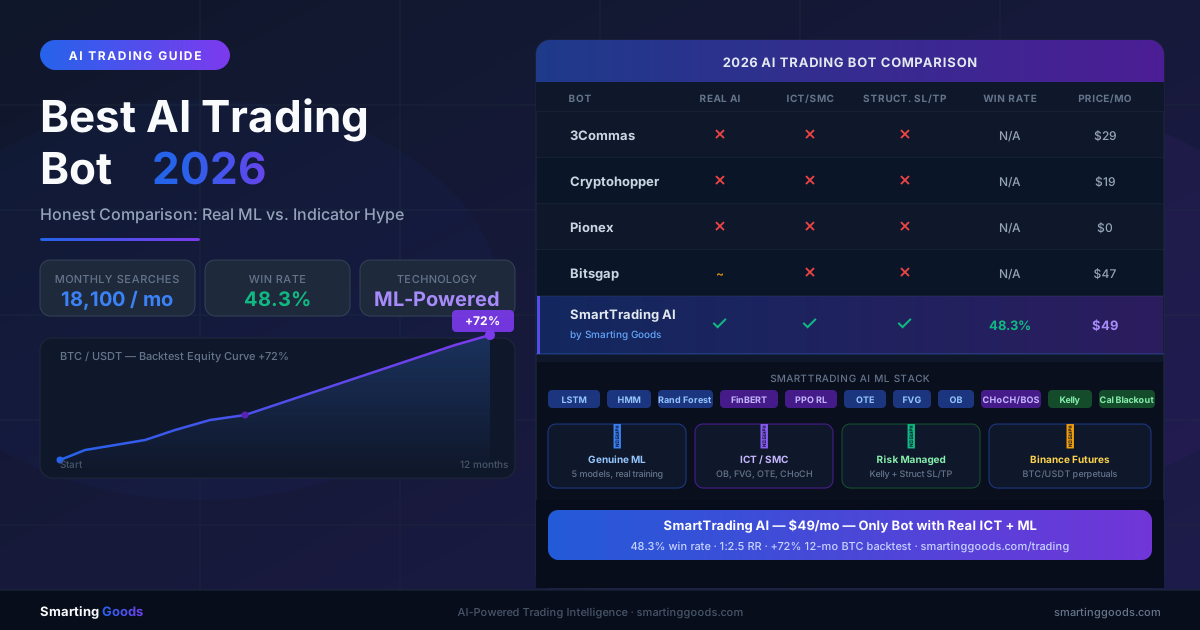
The term AI trading bot has become one of the most abused phrases in the crypto industry. Search for one and you will find hundreds of products — most of which bolt an "AI" badge onto a moving-average crossover system and call it intelligence. This guide cuts through that noise. We will define what real AI in a trading bot actually means, explain how machine-learning-driven systems generate and execute signals differently from rule-based automation, and give you an honest side-by-side comparison of the five most talked-about crypto trading bots in 2026 — including where SmartTrading AI sits in that lineup and why its 48.3% win rate with a 1:2.5 risk-to-reward ratio matters more than any win-rate headline alone. If you are tired of hype and want to know what actually works, read on.
What Is an AI Trading Bot?
A trading bot is any software that places orders automatically according to a pre-defined set of rules. A rule-based bot — what most products on the market actually are — fires an order when a fixed condition is met: RSI crosses 30, a moving average crosses another moving average, or price breaks a manually-set level. The logic never updates. It cannot learn from new market conditions. It is automation, not intelligence.
An AI trading bot, in the genuine sense, uses machine learning models that are trained on historical market data and updated as conditions change. The difference is qualitative:
- Rule-based bots apply static thresholds. They work until the market regime shifts, then they stop working, and no one adjusts them.
- ML-driven bots learn statistical relationships between inputs (price structure, volume, sentiment, order-flow data) and outcomes (profitable trade vs. loss). They can adapt as the relationship between inputs and outcomes evolves.
There is a spectrum between pure rule-based and pure ML. Some bots use ML to generate signals, then hand off to rule-based execution. Others use ML end-to-end. The key question to ask any provider is: what specifically is the ML model trained to predict, and how is that prediction acted on? Vague answers ("our AI analyzes thousands of indicators") almost always indicate a rule-based system wearing a marketing costume.
How AI Trading Bots Work
A genuine AI trading bot typically operates across three layers: signal generation, confidence gating, and execution. Understanding each layer helps you evaluate whether a product's claim of "AI" holds up under scrutiny.
Layer 1: Signal Generation via Machine Learning
The ML layer ingests market data — price action, volume, order-book depth, funding rates, sentiment feeds — and produces a directional signal (long, short, or no-trade) along with a confidence score. Common architectures used in trading bots include:
- LSTM networks — sequence models that capture temporal dependencies in price data, useful for predicting the direction of the next N candles.
- Random Forest / Gradient Boosting — ensemble methods that combine hundreds of weak predictors into a strong classifier; effective for regime classification (trending vs. ranging vs. volatile).
- Reinforcement Learning (RL) — agents that learn a policy (enter, hold, exit) through simulated trading, optimizing directly for profit rather than predictive accuracy.
- Transformer / Attention models — increasingly used for multi-timeframe analysis and sentiment parsing from news and social data.
Layer 2: Confidence Gating
Raw ML signals are noisy. A well-designed AI trading bot does not act on every signal — it applies a confidence gate that filters out low-probability setups. This is where the structural context matters. Is the signal aligned with the higher-timeframe trend? Does the market regime support this type of trade? Is there a liquidity event or macro release in the next 30 minutes that should pause execution? Confidence gating is the difference between a system that trades thoughtlessly and one that waits for high-probability alignment.
Layer 3: Execution and Risk Management
Once a gated signal fires, the execution layer handles order placement, position sizing (typically Kelly criterion or fixed fractional), stop-loss placement (structural or ATR-based), and take-profit management (including partial exits at TP1 and TP2). The quality of execution — latency, slippage handling, partial fills — is just as important as the quality of the signal itself.
Top AI Trading Bots for Crypto in 2026: Honest Comparison
Below is a straightforward comparison of five platforms. We have tried to give each one a fair assessment including real weaknesses, not just the marketing version of each product.
1. 3Commas
3Commas is one of the oldest and most widely-used crypto bot platforms. It offers DCA (Dollar-Cost Averaging) bots, GRID bots, and Options bots, with a marketplace where users can subscribe to community signal providers.
- Pros: Large user base and signal marketplace; clean UI; multi-exchange support (Binance, Coinbase, Bybit, and 15+ others); paper trading mode for testing.
- Cons: The bots themselves are rule-based DCA/grid strategies — not ML-driven. "AI" features are mostly smart trailing and signal aggregation. Performance depends entirely on which community signals you subscribe to, not any internal ML engine. In sideways markets, DCA bots can accumulate large underwater positions.
- Price: Free plan (limited bots); paid plans from $29/month.
- Best for: DCA investors who want automated buy-the-dip accumulation with trailing features, not directional trading.
2. Cryptohopper
Cryptohopper is a cloud-based bot platform that supports strategy building via a visual editor, backtesting, and a marketplace for buying external signals and strategies.
- Pros: Visual strategy builder with 130+ technical indicators; cloud-hosted (no server to manage); backtesting tool; social trading via strategy marketplace.
- Cons: Strategy logic is purely indicator-based — RSI, MACD, Bollinger Bands. Despite the "AI" marketing, there is no ML model producing the signals. Backtests are prone to curve-fitting because users manually optimize indicator parameters on historical data. Marketplace strategies have inconsistent live performance.
- Price: Explorer (free, limited); paid plans from $19/month.
- Best for: Traders comfortable building and testing indicator-based strategies without writing code.
3. Pionex
Pionex is a crypto exchange with 16 built-in trading bots, most notably its GRID Bot and Leveraged Grid Bot. It has no subscription fee — revenue comes from a 0.05% trading fee.
- Pros: Zero monthly fee; GRID bots are genuinely effective in ranging markets; simple setup (two parameters: upper/lower range and number of grids); regulated exchange in multiple jurisdictions.
- Cons: GRID bots are purely mechanical — not AI in any meaningful sense. In strong trending markets, a GRID bot loses money. No directional signal generation; no ML component. Limited to Pionex's own exchange (less liquid than Binance for most pairs).
- Price: No subscription; 0.05% maker/taker fee.
- Best for: Passive income from range-bound markets using the grid strategy without paying a monthly fee.
4. Bitsgap
Bitsgap is a multi-exchange bot platform offering GRID, DCA, and BTD (Buy The Dip) bots, with an AI assistant that suggests grid parameters based on historical volatility analysis.
- Pros: Multi-exchange aggregation in one interface; the "AI" grid parameter suggester is genuinely useful (it analyzes 90-day volatility to recommend upper/lower bounds); portfolio tracking and arbitrage features.
- Cons: The AI suggestion is a parameter optimizer, not a signal generator — the bot itself is still a GRID/DCA mechanical system. No ML directional trading. Performance in trending markets follows the same limitations as all grid systems.
- Price: Basic $23/month; Advanced $47/month; Pro $110/month.
- Best for: Active traders managing multiple exchanges who want GRID and DCA automation with smart setup guidance.
5. SmartTrading AI by Smarting Goods
SmartTrading AI is the only bot in this comparison built around genuine ICT (Inner Circle Trader) and Smart Money Concepts (SMC) methodology — automated using actual machine learning models, not indicator proxies. It trades BTC perpetual futures on Binance Futures.
- Pros:
- Real ML stack: LSTM price direction model, Hidden Markov Model for market regime classification, Random Forest volatility predictor, FinBERT sentiment analyzer, and a PPO Reinforcement Learning agent for entry/exit timing — all working together.
- Genuine ICT structure: Order Blocks, Fair Value Gaps, OTE (Optimal Trade Entry) zones, Change of Character (CHoCH), Break of Structure (BOS), and Multi-Symbol Support mapped from the actual methodology, not indicator approximations.
- Structural SL/TP: Stop-losses placed at ICT invalidation levels (order blocks, FVGs), not arbitrary ATR multiples. TP1 at the nearest opposing structural zone; TP2 at an unswept liquidity pool.
- Kelly criterion position sizing with hard drawdown caps.
- Economic calendar blackout: automatically pauses before FOMC, CPI, NFP, and PPI releases to avoid news-driven whipsaws.
- 48.3% win rate with 1:2.5 average risk-to-reward — positive expectancy by design, not by luck. Verified on a 12-month BTC backtest showing +72% return.
- $49/month — less than Bitsgap's Pro plan and the only bot here with a genuine ML + ICT architecture.
- Cons: Currently BTC/Binance Futures only (additional pairs in roadmap); requires a Binance Futures account with at least $500 recommended capital; not suitable for spot-only traders.
- Price: $49/month, month-to-month.
- Best for: Serious crypto traders who want to automate ICT/SMC methodology on Binance BTC Futures with real machine learning confidence gates and structural risk management.
Ready to see it in action? Explore SmartTrading AI →
What to Look For in an AI Trading Bot
With so many products competing for your subscription fee, here are five criteria that actually matter — and how to apply them to any bot you evaluate.
1. Real AI vs. Indicator Automation
Ask the provider directly: what ML model produces the trade signal? What is it trained to predict? On what dataset? How often is it retrained? If the answer involves words like "proprietary algorithms," "smart signals," or "thousands of indicators" without specifics, you are looking at a rule-based system. Real ML systems have model names, training datasets, and performance benchmarks that can be described concretely.
2. Backtesting Methodology
Backtests can prove anything if done carelessly. Look for: out-of-sample testing (the model is evaluated on data it was NOT trained on), realistic slippage and fee assumptions, and walk-forward testing across multiple market regimes (bull, bear, sideways). A backtest that optimizes parameters on the full historical dataset and then shows the results of that optimization is meaningless — it is circular reasoning.
3. Risk Management Depth
A bot that generates great signals but has poor risk management will still blow your account. Check for: structural stop-loss placement (not just "X% below entry"), position sizing logic (Kelly, fixed fractional, or fixed lot), maximum daily drawdown limits, and what happens when the exchange API goes down mid-trade. These details separate a production-grade system from a demo project.
4. Exchange Support and Liquidity
Most ML-edge in crypto lives on liquid perpetual futures markets — BTC and ETH on Binance or Bybit. A bot that trades obscure altcoins on a low-liquidity exchange will suffer from slippage that erases the edge entirely. Prioritize bots that trade where liquidity is deepest, and be skeptical of platforms boasting 20+ exchange integrations — breadth of integrations rarely correlates with depth of ML research.
5. Transparency and Accountability
Does the provider publish audited performance data? Can you see a live equity curve, not just cherry-picked screenshots? Is the win rate paired with a risk-to-reward ratio so you can compute expectancy yourself? A provider who publishes a 48.3% win rate alongside a 1:2.5 RR is being accountable. One who advertises "90% accuracy" without context is almost certainly reporting in-sample backtest results on a curve-fitted strategy.
AI Trading Bot Results: What's Realistic?
Let's be direct: no AI trading bot wins 90% of trades in live markets. Anyone claiming that figure either has a tiny sample size, is reporting in-sample backtest performance, or is lying. Here is what positive-expectancy trading actually looks like:
The mathematical formula for trading expectancy is:
Expectancy = (Win Rate × Average Win) − (Loss Rate × Average Loss)
A bot with a 48.3% win rate and a 1:2.5 risk-to-reward has:
- Expected gain per win: 2.5 units
- Expected loss per loss: 1 unit
- Expectancy: (0.483 × 2.5) − (0.517 × 1) = 1.208 − 0.517 = +0.69 units per trade
A bot with a "90% win rate" and a 1:0.15 RR (typical of bots that scalp tiny gains and hold large losers) has:
- Expectancy: (0.90 × 0.15) − (0.10 × 1) = 0.135 − 0.10 = +0.035 units per trade
The 90% win-rate bot appears to win almost every trade yet earns 20x less per trade — and a single bad run of losses can wipe months of gains. The 48.3% win-rate bot with structural risk management compounds far more reliably over time.
Realistic expectations from a genuine AI trading bot:
- Monthly returns of 3–8% in favorable conditions (trending BTC market with clear structure)
- Drawdown periods of 5–15% during ranging or news-heavy markets (the calendar blackout helps but does not eliminate this)
- Periods where the bot takes few or no trades — this is the confidence gate working correctly, not a bug
- Consistent positive expectancy over 6–12 month timeframes, not guaranteed monthly profits
Any provider promising guaranteed returns, fixed monthly percentages, or risk-free profits is running a scam or has no idea how financial markets work.
How SmartTrading AI Uses Machine Learning for ICT Strategy
This section gives you a detailed look under the hood of SmartTrading AI — the only AI trading bot in this comparison built on a genuine ML + ICT architecture. The full platform is worth exploring directly, but here is the core of how it works.
The ML Model Stack
SmartTrading AI runs five ML models simultaneously, each contributing a different type of intelligence to the final trade decision:
- LSTM Price Direction Model: A Long Short-Term Memory sequence model trained on multi-timeframe OHLCV data. It predicts the probable direction of the next price swing and provides a confidence score. Signals below a minimum confidence threshold are discarded before any structural analysis begins.
- Hidden Markov Model (HMM) Regime Classifier: Classifies the current market into TRENDING, RANGING, or VOLATILE regimes. Different ICT strategies perform differently in each regime — OTE retracements work best in TRENDING markets, for example. The HMM gates which strategy family is active at any moment.
- Random Forest Volatility Predictor: Estimates near-term volatility to dynamically scale ATR-based distance thresholds for entry zones and stop-loss placement. At high volatility, the system widens its acceptance zones and tightens position sizing.
- FinBERT Sentiment Analyzer: Parses crypto-specific news and social data to detect macro sentiment shifts. Strongly negative sentiment during a LONG setup reduces the composite confidence score; aligned sentiment boosts it.
- PPO Reinforcement Learning Agent: A Proximal Policy Optimization agent trained via simulated trading on historical BTC data. It makes the final entry/exit timing decision — specifically, whether to enter at market, place a limit order inside an Order Block, or wait for confirmation on the next candle.
ICT Structure as the Signal Framework
The ML confidence scores feed into an ICT structural analysis engine that maps the following zones in real time across 15-minute, 1-hour, and 4-hour timeframes:
- Order Blocks (OBs): The last opposing candle before a displacement move. SmartTrading AI validates OBs against displacement strength, mitigation status, and premium/discount positioning before marking them as actionable.
- Fair Value Gaps (FVGs): Three-candle imbalances where price moved so fast that no two-way auction occurred. The system uses FVGs both as entry zones and as TP1 targets.
- Optimal Trade Entry (OTE) Zones: The 61.8%–78.6% Fibonacci retracement of a confirmed impulse leg, used for limit entries after a Change of Character confirms the move. See our detailed guide on how ICT automation works for more on OTE mechanics.
- Change of Character (CHoCH) and Break of Structure (BOS): Structural confirmation events that validate or invalidate directional bias. A CHoCH from the 15-minute timeframe that aligns with the 4-hour structure adds significant weight to the composite score.
- Liquidity Pools (BSL/SSL): Clusters of resting buy-side and sell-side orders above swing highs and below swing lows. TP2 is placed to capture the sweep of the nearest unswept liquidity pool in the trade direction.
Risk Management Architecture
SmartTrading AI uses a four-layer risk framework:
- Structural SL placement: Stop-losses anchor to ICT invalidation levels — if a bullish OB trade is invalidated by price closing below the OB's low, the SL is placed 0.3% below that level, not at an arbitrary percentage from entry.
- Kelly criterion sizing: Position size is calculated from the Kelly formula using the rolling win rate and average win/loss ratio from the last 50 trades, with a half-Kelly cap to reduce variance.
- Economic calendar blackout: The system blocks new entries 15 minutes before and 30 minutes after scheduled FOMC, CPI, NFP, and PPI releases — eliminating a major source of stop-hunt volatility that kills technical trades.
- Funding and OI squeeze gate: Real-time monitoring of Binance funding rates and open interest detects imminent long or short squeezes and blocks against-trend entries or boosts confirmation for aligned entries.
The result is a system that takes fewer trades than most bots but achieves a 1:2.5 average RR because every entry requires structural confirmation from multiple timeframes, ML confidence above threshold, favorable regime classification, and clean risk placement. See the full SmartTrading AI platform →
Frequently Asked Questions
Is an AI trading bot legal?
Yes. Automated trading bots are legal on Binance and most major crypto exchanges. Binance explicitly supports API-based automated trading and publishes API documentation for this purpose. You are responsible for your own tax obligations on any profits generated. Always check the regulatory status of automated trading in your specific jurisdiction.
Can an AI trading bot guarantee profits?
No. Any product that guarantees profits is either misleading you or committing fraud. Markets are probabilistic environments. A well-designed AI trading bot with positive expectancy will produce profits over a statistically significant sample of trades and across extended time periods — but individual months, weeks, or trade sequences can and will produce losses. The goal is consistent positive expectancy, not guaranteed returns.
How much capital do I need to run an AI trading bot on Binance Futures?
The minimum varies by bot and strategy. For SmartTrading AI, we recommend a minimum of $500 in your Binance Futures wallet for the Kelly sizing to work with meaningful position sizes without excessive leverage. More capital allows the sizing algorithm more room to operate comfortably. Leverage on Binance Futures amplifies both gains and losses — SmartTrading AI uses conservative leverage settings by default.
What is the difference between an AI trading bot and a copy trading service?
Copy trading replicates the manual trades of a human trader in real time. An AI trading bot generates its own signals autonomously via ML models and executes without any human trader on the other side. Copy trading is as good as the human you are copying; an AI bot is only as good as the engineering behind its signal generation and risk management. The key advantage of a bot is that it is emotionless, never sleeps, and applies its rules consistently.
How does SmartTrading AI differ from a TradingView Pine Script strategy?
Pine Script strategies on TradingView are rule-based: fixed indicator conditions trigger alerts that you or a webhook-connected bot then acts on. SmartTrading AI replaces those static rules with trained ML models that dynamically weight signals based on learned statistical relationships. The ICT structural analysis runs at the ML service layer (Python) rather than as indicator calculations, giving it access to multi-timeframe context that Pine Script cannot easily replicate. The result is an adaptive system rather than a static ruleset.
What exchanges does SmartTrading AI support?
Currently Binance Futures (USDT-margined perpetuals), with BTC/USDT as the primary trading pair. Additional pairs and exchange integrations are on the product roadmap. The decision to focus on Binance BTC Futures is deliberate — deepest liquidity, tightest spreads, most complete API for automated execution.
How do I get started with SmartTrading AI?
Visit the SmartTrading AI platform page, connect your Binance API keys (read + trade permissions, no withdrawal permission required), configure your risk settings, and activate the bot. The setup takes under 10 minutes. The ML models run on our infrastructure — there is nothing to install or maintain on your end.
Conclusion
The honest summary of the 2026 AI trading bot landscape: most products are indicator-based automation with "AI" in the name. 3Commas, Cryptohopper, Pionex, and Bitsgap are all legitimate and useful in the right context — but none of them deploy genuine machine learning to generate directional trade signals. They automate rules. That is a useful thing, but it is not AI.
SmartTrading AI is the outlier in this comparison: an actual ML stack trained on BTC Futures data, executing ICT and Smart Money Concepts methodology with structural risk management and a verifiable 48.3% win rate at 1:2.5 RR. The expectancy math works. The calendar blackout, regime gate, and Kelly sizing are production-grade risk controls. At $49/month, it is priced accessibly for serious retail traders without requiring the price commitment of institutional tools.
If you trade BTC on Binance Futures and want to stop guessing at Order Block entries at 2am, SmartTrading AI is the only bot in this market built for that exact use case with real machine learning behind it.