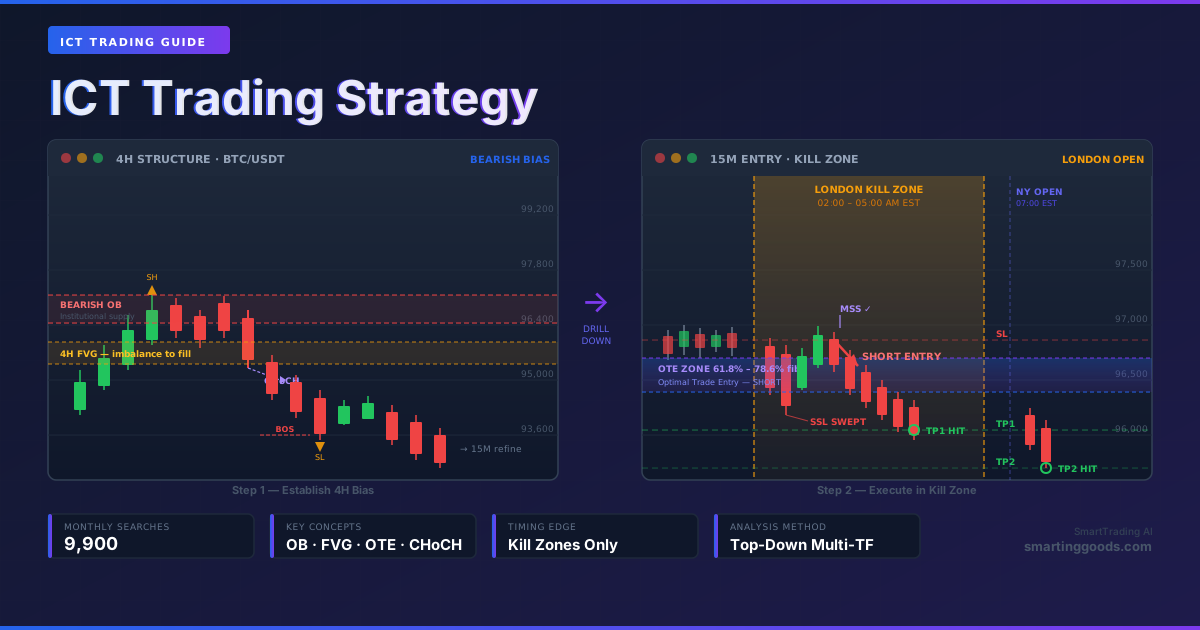
ICT Trading Strategy: The Complete 2026 Guide
The ICT trading strategy combines top-down market structure analysis, kill zone timing, and institutional order flow concepts to find high-probability entries. This is the complete 2026 guide — from core concepts to automated execution.
ICT Trading Strategy: The Complete 2026 Guide
The ICT trading strategy is a framework developed by Michael Huddleston — known as the Inner Circle Trader — that models how institutional participants (banks, market makers, central banks) actually move price. Rather than chasing indicators or patterns, ICT teaches you to read liquidity, market structure, and order flow the way the institutions that set prices do it. If you have tried smart money concepts but want the full systematic picture — from the monthly chart down to a 1-minute entry — this guide gives you the complete methodology.
We cover every core concept, the exact step-by-step entry framework, kill zone timing, the mistakes that cost most traders money, and how SmartTrading AI automates every stage of this process on Binance Futures.
What Is the ICT Trading Strategy?
ICT stands for Inner Circle Trader. The methodology is built on one premise: price does not move randomly. It is engineered by market makers to reach specific liquidity pools — clusters of resting buy and sell orders (stop losses, pending orders) — before reversing or continuing. Once you accept that, every seemingly chaotic price move starts to make sense.
The ICT trading strategy is not a single setup. It is a multi-timeframe framework for identifying:
- Where price is going (directional bias via higher-timeframe structure)
- Why it will go there (liquidity sitting above/below old highs and lows)
- When to enter (specific trading sessions and kill zones)
- Exactly where to enter, stop, and target (Order Blocks, FVGs, OTE zones)
Unlike indicator-based systems, every ICT concept has a structural reason behind it — which means confluence is real, not correlation. This is why the methodology has become one of the most-studied frameworks in retail trading since 2020, and why serious traders on crypto, forex, and futures apply it across all liquid markets.
For context on how ICT fits within the broader universe of smart money concepts, read that guide first if you are new to institutional trading methodology.
The Core ICT Concepts
You cannot trade the ICT strategy without mastering these building blocks. Most guides skim over them. We will not.
Market Structure: CHoCH and BOS
Everything in ICT begins with market structure — the sequence of highs and lows that tells you who is in control.
- Break of Structure (BOS): Price breaks a prior swing high in an uptrend (or swing low in a downtrend) and continues in the same direction. A BOS confirms trend continuation. It tells you to stay aligned with the prevailing direction on lower timeframes.
- Change of Character (CHoCH): Price breaks against the trend — a swing low breaks in an uptrend, or a swing high breaks in a downtrend. This is the first signal that the dominant side is losing control. A CHoCH does not mean the trend has reversed; it means you need to start looking for signs the opposite side is taking over.
The distinction matters because most traders flip bias too early on a CHoCH and get caught in the pullback before the trend resumes. ICT teaches you to wait for confirmation — a second CHoCH or a confirmed BOS in the new direction — before trading against the prior trend.
Order Blocks (OBs)
An Order Block is the last opposing candle before a strong impulse move. In a bullish move, the OB is the last bearish (down) candle before price accelerated upward. In a bearish move, it is the last bullish candle before a sharp drop.
Why do Order Blocks work? Because institutions cannot fill large orders in a single candle. They distribute orders across a price zone. When price returns to that zone, unfilled institutional orders are still sitting there, absorbing the pullback and providing the fuel for the next move. The OB is where the smart money is waiting.
Key rules for valid Order Blocks:
- The candle must precede a significant impulsive move (not just a normal swing)
- The impulsive move after it should leave an imbalance (FVG) — more on that below
- Price should not have returned to the OB already (once mitigated, the OB loses significance)
- Higher-timeframe OBs (4H, daily) carry more weight than lower-timeframe OBs
Fair Value Gaps (FVGs)
A Fair Value Gap is a three-candle imbalance where the third candle's body does not overlap with the first candle's wick. The gap between them represents price moving so fast that no two-sided trading occurred — one side was completely overwhelmed. Markets tend to fill these gaps because participants who missed the move enter on the return, and institutions use the gap to distribute remaining orders.
Bullish FVG: The gap sits below price after an upward impulse. Price tends to return to it before continuing higher. The ideal entry is at the 50% or 61.8% level of the gap, not the bottom — buying too early into a gap risks getting swept if the FVG fills completely.
Bearish FVG: The gap sits above price after a downward impulse. It acts as a resistance zone on any pullback. Trade entries on the rejection of a bearish FVG in a confirmed downtrend are among the highest-probability setups in the ICT framework.
Optimal Trade Entry (OTE)
The OTE zone is the Fibonacci retracement sweet spot for institutional pullback entries. Using a swing low to swing high (for longs) or swing high to swing low (for shorts), the OTE sits between the 61.8% and 78.6% retracement levels. This is the zone where smart money re-enters after driving price up (or down), before the continuation.
Confluence makes the OTE much more powerful. If a 61.8–78.6% retracement also aligns with an Order Block, an FVG, or a key liquidity level, that is a tier-1 ICT setup. On its own, the OTE is a guideline. With structural confluence, it becomes high-probability.
Liquidity Pools: BSL and SSL
Buy-side liquidity (BSL) sits above old highs — stop losses from short sellers and buy-stop orders from breakout traders. Sell-side liquidity (SSL) sits below old lows — stop losses from long holders. Market makers engineer price to sweep these pools before the real move.
This concept reframes everything. When you see price spike above a resistance level and immediately reverse, that is not a failed breakout — it is a BSL sweep. The move above resistance was engineered to collect the stops sitting there, and the reversal is the actual direction. Trading with this lens means you stop getting caught in false breakouts and start trading the reversals after sweeps.
ICT Trading Strategy Step-by-Step
The ICT entry framework has a specific sequence. Skipping steps is the single biggest reason traders fail with this methodology.
Step 1: Establish Higher-Timeframe Bias
Start on the weekly or daily chart. Identify the current market structure — is price making higher highs and higher lows (bullish), or lower highs and lower lows (bearish)? Mark the most recent swing high and swing low. Note where BSL and SSL sit.
Then step down to the 4-hour chart. Identify the 4H bias and mark the 4H Order Blocks, FVGs, and any CHoCH signals. The 4H chart is where directional bias gets refined from weekly/daily context into an actionable direction for the current week or day.
Rule: Only take long setups when the 4H is bullish. Only take short setups when the 4H is bearish. Do not fight the higher-timeframe structure. This is the rule most traders break — they take a 15-minute long setup inside a confirmed 4H downtrend and wonder why they get stopped out.
Step 2: Identify the Premium / Discount Array
On the 4H swing (low to high for bullish bias, or high to low for bearish bias), mark the 50% equilibrium line using Fibonacci. Prices above 50% are premium — where smart money sells. Prices below 50% are discount — where smart money buys.
Simple rule: in a bullish higher-timeframe structure, you only buy in the discount. In a bearish structure, you only sell in the premium. This filters out the majority of poor entries.
Step 3: Wait for the Kill Zone
Do not sit in front of the chart all day. ICT setups concentrate in three windows. Enter a trade outside these windows only if you have a specific reason — otherwise, wait. (More on kill zone times in the next section.)
Step 4: Mark Entry Zones on the 15-Minute Chart
Inside the kill zone, drop to the 15-minute chart. Look for:
- A liquidity sweep (price dips below an old SSL low then reclaims, or spikes above a BSL high then rejects)
- A CHoCH on the 15-minute chart in the direction of your 4H bias
- An OTE zone aligning with an OB or FVG
The ideal sequence is: higher-timeframe in discount (bullish bias) → 15-minute sweeps SSL → 15-minute CHoCH to bullish → OTE pullback into OB/FVG → enter long. All five elements together is a tier-1 entry. Three or four elements is still tradeable. Fewer than three, wait for the next setup.
Step 5: Set Stop Loss and Take Profits
Stop loss: Place it beyond the swing low that was swept (for longs) or swing high that was swept (for shorts). If you entered at an OB, the SL sits below the OB's low (longs) or above the OB's high (shorts) with a small buffer of 0.2–0.5% to avoid wicks touching your stop.
TP1: The nearest opposing liquidity — a swing high (for longs) sitting just above your entry, or an FVG/OB on the other side. Take partial profit here (25–50% of position).
TP2: The next BSL/SSL pool or a key HTF level. Move stop to breakeven after TP1 is hit.
ICT Kill Zones and Session Trading
ICT is explicit about when to trade. The strategy works because institutional participants are active at predictable times, and their activity creates the displacement moves you need for FVGs, OB mitigations, and liquidity sweeps. Outside these windows, price tends to drift in low-volume chop that produces false signals.
London Kill Zone: 2:00 AM – 5:00 AM EST
The London open is the highest-volume kill zone of the trading day. European institutions come online, and the first thing they do is run stops accumulated overnight. The typical London open sequence: price sweeps below Asian session lows (collecting SSL from traders who went long in Asia), then reverses sharply higher as real institutional buying begins — or it sweeps Asian session highs and drives lower all day.
For BTC and crypto futures, the London kill zone is less dominant than it is for forex, but it still produces measurable displacement moves because European institutional participation increases significantly at this time. Watch for the sweep of the Asian range in the first 60–90 minutes.
New York Kill Zone: 7:00 AM – 10:00 AM EST
The New York open is the second kill zone and arguably the most volatile for crypto. US institutional order flow dominates global volume from 7:00 AM EST onward. The 7:00–10:00 AM window typically either continues the London direction with a second leg, or reverses it with a stop hunt of the London session high or low.
For BTC/USDT Futures traders, the NY kill zone is where most of the day's major moves originate. A London open that moved lower followed by a 7:00 AM BSL sweep and reversal higher is a textbook ICT London-NY reversal setup.
London Close Kill Zone: 10:00 AM – 12:00 PM EST
Less high-profile but still worth knowing. As London closes, institutional rebalancing often creates a short displacement in the opposite direction of the morning move. This kill zone is best used to take profits on open positions rather than as a primary entry window.
Asian Session: 8:00 PM – 12:00 AM EST
The Asian session is not a kill zone for entries — it is a range-building period. Price typically consolidates and sets the liquidity pools that London and New York will sweep the next day. Mark the Asian session high and low before London open. Those levels become your target zones for the day.
Common ICT Trading Mistakes
The ICT framework is comprehensive enough that most traders make the same set of errors. Knowing them in advance saves months of drawdown.
Trading Against the Higher-Timeframe Structure
A 15-minute CHoCH means nothing if the 4H is still in a clear downtrend. The most common beginner error is taking a counter-trend setup on a lower timeframe without HTF confirmation. The pullback you are buying into looks like a reversal on the 15-minute chart, but it is just a retracement on the 4H. Wait for the 4H CHoCH before flipping bias.
Entering Before the Liquidity Sweep
If your entry zone is an OB at support, and price has not yet swept the lows below that support, do not enter. The sweep is what triggers the real institutional order flow. Entering before the sweep means you are entering before the market maker has finished collecting stops — and your stop becomes part of what gets swept. Wait for the sweep, then enter on the CHoCH confirmation.
Trading Outside Kill Zones
The concepts work in kill zones because that is when institutional liquidity is highest. During the New York afternoon or the dead hours between sessions, you will get the same visual setups on your chart — OBs, FVGs, OTE zones — but without the institutional volume to drive displacement, they fail at a much higher rate. Restrict your active trading to kill zone windows.
Using OBs and FVGs Without Structure Confirmation
An OB is only valid when it sits in the correct premium/discount zone AND the structure is aligned. A bullish OB in a discount zone during a bullish 4H trend is a setup. A bullish OB in a premium zone during a bearish 4H trend is a trap. Do not mark every OB and FVG on the chart — filter ruthlessly by structure and premium/discount context.
Misidentifying Order Blocks
Not every opposing candle before an up move is a valid OB. The candle needs to precede a significant displacement — at minimum a three-candle run that creates an FVG, ideally an impulsive move that takes out a prior swing. If the move after the "OB" was gradual rather than impulsive, the zone carries little institutional significance.
Overcomplicating the Framework
ICT traders often try to apply every concept simultaneously and end up paralyzed. In practice, three to four clean confluences are enough for a high-probability entry: HTF bias + kill zone + liquidity sweep + 15-minute CHoCH. You do not need all nine ICT tools active at once on every trade.
How SmartTrading AI Automates the ICT Trading Strategy
SmartTrading AI was built specifically to automate the ICT methodology on Binance Futures — starting with BTC/USDT. Every step of the framework described above is handled by the system algorithmically, in real time, 24 hours a day.
Automated Top-Down Analysis
The platform runs continuous multi-timeframe analysis across the weekly, daily, 4H, 1H, and 15-minute charts. The system identifies the current higher-timeframe structure (bullish/bearish/ranging), marks premium/discount zones, and establishes a directional bias that filters all lower-timeframe entry signals. You get the full top-down ICT analysis without manually reviewing five timeframes before every session.
Real-Time Order Block and FVG Detection
SmartTrading AI identifies Order Blocks and Fair Value Gaps on every timeframe as they form. The system scores each zone by confluence — an OB that aligns with an FVG, an OTE retracement, and a premium/discount boundary scores significantly higher than an isolated OB. Only tier-1 confluences trigger entry signals.
Kill Zone Timing Built-In
The system is configured to gate entries to the London kill zone (2:00 AM – 5:00 AM EST) and New York kill zone (7:00 AM – 10:00 AM EST). It also filters around high-impact economic events (FOMC, CPI, NFP) using a live economic calendar feed — blocking new entries 15 minutes before and 30 minutes after scheduled events to avoid getting caught in stop-hunt volatility around news.
Liquidity Sweep Detection and CHoCH Confirmation
Before placing any order, SmartTrading AI waits for the liquidity sweep (SSL/BSL run) and then confirms a market structure shift (CHoCH or MSS on the 15-minute chart). This mirrors the manual ICT entry sequence exactly — no entry is placed until the sweep has occurred and structure has confirmed in the direction of the 4H bias.
Dynamic SL/TP Placement
Stop losses are placed structurally — below the swept swing low (for longs) or above the swept swing high (for shorts), with a dynamic buffer based on nearby liquidity pool strength. Take-profit targets are set at the nearest opposing BSL/SSL pools and key FVG zones, not at arbitrary percentages. The system uses a zone-based TP1 (nearest structural target) and a sweep-through TP2 (beyond the next liquidity pool) to maximize R:R on every trade.
Regime Gate and Volatility Filter
A Hidden Markov Model regime classifier runs in parallel, identifying whether the market is trending or ranging. In ranging conditions, the system tightens confluence requirements significantly — requiring higher-timeframe confirmation than it would in a trending regime. This prevents the classic ICT mistake of trading structure setups in a directionless market.
At $49/month, SmartTrading AI runs the full ICT analysis stack continuously — something that would take a human trader 4–6 hours of chart work per day to replicate manually.
Frequently Asked Questions
How long does it take to learn the ICT trading strategy?
Most traders need 3–6 months of focused study before they can consistently identify valid setups in real time. The concepts themselves are learnable in a few weeks, but internalizing the nuance — distinguishing a valid OB from a trap, reading when a CHoCH is meaningful versus a noise signal — takes screen time. Journaling every trade with notes on which ICT confluences were present (and which were absent) dramatically accelerates the learning curve.
Does the ICT trading strategy work on crypto?
Yes. The ICT framework applies to any liquid market where institutional participants are active. Bitcoin futures on CME and perpetual futures on Binance both show clear ICT structure — Order Blocks hold, FVGs fill, kill zone sweeps are measurable. The primary adaptation for crypto is that the Asian session carries more weight than it does in forex (crypto trades globally 24/7), and volatility thresholds need to be wider because BTC moves in percentage terms more aggressively than major forex pairs.
What timeframes are best for ICT trading?
The standard ICT workflow uses: weekly/daily for macro bias, 4H for directional bias and key zones, 1H for refining entry zones, 15-minute for entry triggers, and optionally the 1-minute for precise execution. Most traders run their primary entry setup on the 15-minute chart and use 4H for bias. Scalpers sometimes drop to the 5-minute for entries, but the 15-minute is where the signals are cleanest because enough bars form within each kill zone to see the sweep-and-reverse sequence clearly.
What is the difference between an ICT Order Block and a support/resistance zone?
Support/resistance is backward-looking — you draw lines at levels where price bounced before. Order Blocks are forward-looking — you identify the specific candle where institutional orders were placed, and you expect those orders to be present again when price returns. An OB has a structural reason to hold (unfilled institutional orders). A horizontal S/R level has only the argument that it worked in the past. OBs combined with FVGs in the correct premium/discount zone are far more reliable than arbitrary horizontal lines.
How do I know if a kill zone will produce a valid ICT setup today?
Not every kill zone produces a tradeable setup — that is actually part of the framework. If price is already deep inside the daily OTE zone at the London open and there are no obvious SSL/BSL pools nearby to sweep, there may be no setup. You are looking for kill zones where there is clear liquidity resting above or below the current price, and where the HTF structure gives you a directional bias. If both conditions are absent, skip the session and protect your capital for a higher-quality day.
Can I automate the ICT strategy?
Yes, and this is exactly what SmartTrading AI does. The structural components of ICT — market structure identification, OB/FVG detection, OTE calculation, liquidity pool mapping, kill zone gating — are all computable. The system runs a multi-timeframe ICT analysis every few minutes, detects valid entry conditions, and places orders on Binance Futures automatically. For traders who understand the methodology but cannot monitor charts during London and NY kill zones, automation is the most practical solution.
Is ICT trading strategy profitable?
Profitability depends on execution discipline — specifically, whether you follow the rules about HTF confirmation, kill zone timing, and waiting for liquidity sweeps. Traders who cherry-pick only the ICT concepts they like and ignore the filtering rules lose. Traders who apply the full framework systematically — top-down analysis, kill zone discipline, proper SL/TP structure — report consistent positive expectancy. The methodology has structural logic behind every rule. When the rules are followed, the edge is real.
Conclusion
The ICT trading strategy gives you a complete institutional-grade framework for analyzing markets. Start with the higher-timeframe structure to establish directional bias. Identify where liquidity sits. Wait for the kill zone. Let price sweep the liquidity, confirm a CHoCH, and enter at the OTE zone aligned with an Order Block or FVG. Set your stop beyond the swept level. Target the next opposing liquidity pool.
Every step is logical. Every step has an institutional rationale. That is what separates ICT from pattern-matching approaches that work until they stop working.
The hardest part is not learning the concepts — it is executing with discipline at 2:00 AM EST during the London kill zone while managing full-time responsibilities. That is precisely the problem SmartTrading AI solves: the full ICT stack, automated on Binance Futures, running around the clock so you capture the setups whether you are watching or not.
Explore SmartTrading AI → — automated ICT methodology on Binance Futures, $49/month.