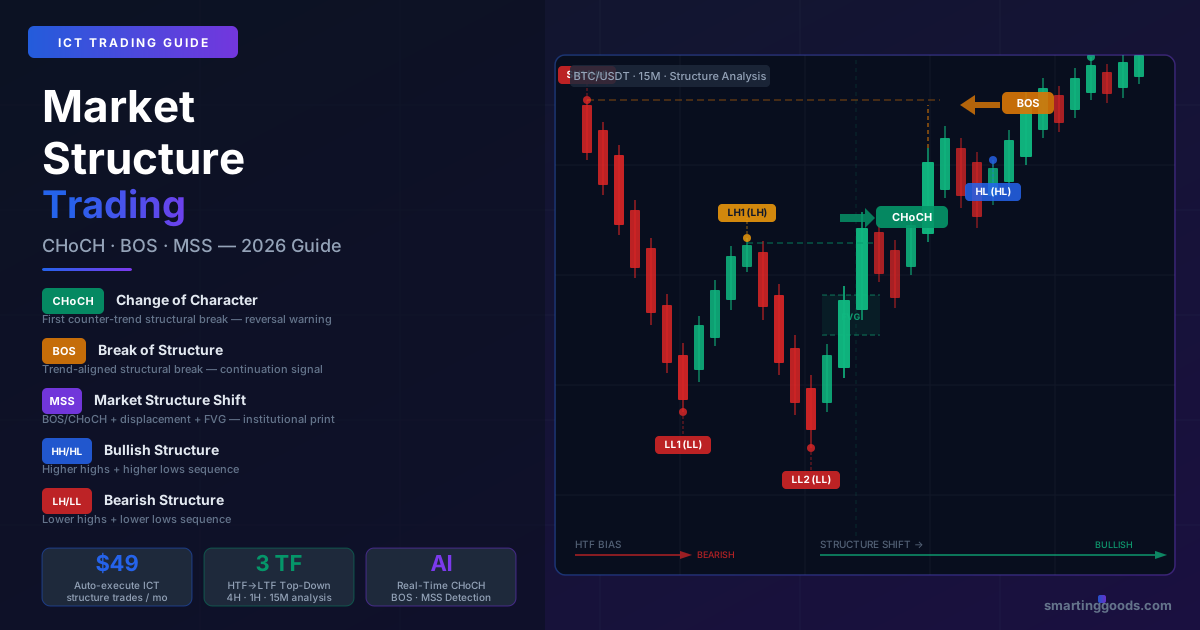
Market Structure Trading: CHoCH, BOS, and MSS Explained (2026)
Market structure trading is the foundation of ICT methodology — understanding where price has been tells you where it's likely going. This guide covers CHoCH, BOS, and MSS with specific rules for reading structure top-down.
Market Structure Trading: CHoCH, BOS, and MSS Explained (2026)
Market structure trading is the single most important skill in the ICT methodology toolkit. Before you trade an Order Block, before you enter at an FVG, before you fade a liquidity sweep — you need to know what the structure says. Structure tells you the directional narrative of the market. Without it, every other confluencing tool is noise without context.
This guide defines the three core structural events — Change of Character (CHoCH), Break of Structure (BOS), and Market Structure Shift (MSS) — and shows exactly how to use them in a top-down analysis framework with specific entry rules. Most articles conflate these terms. Here we'll define each precisely, because the distinction between them drives entirely different trade decisions.
What Is Market Structure in Trading?
Market structure is the sequential pattern of swing highs and swing lows that describes the current directional behavior of price. Every trending market leaves a trail of higher highs and higher lows (bullish) or lower highs and lower lows (bearish). Ranging markets produce a series of equal highs and lows that oscillate within a defined band. Reading that trail accurately is what market structure trading is built on.
The framework comes from the ICT (Inner Circle Trader) methodology, which provides a rigorous vocabulary for structural events. The core premise is that institutional participants — banks, hedge funds, market makers — engineer price to run against retail positions before continuing in the intended direction. Market structure gives you the map of where that engineering is happening and which direction the institutions are actually committed to.
Two types of price swings matter:
- Swing High (SH): A candle high that is higher than both the candle to its left and the candle to its right. The more candles surrounding it, the more significant the swing.
- Swing Low (SL): A candle low that is lower than both the candle to its left and the candle to its right. Same significance rules apply.
These swings are the reference points for every structural event. When price breaks above a swing high, that's a Break of Structure to the upside. When it breaks a swing high for the first time in a downtrend, that's a Change of Character. The labels matter because the trade implications are different. Read more about how these concepts fit into the broader framework in our guide on smart money concepts.
The Three Key Market Structure Shifts: CHoCH, BOS, and MSS
These three terms are routinely mixed up in trading content. Here is the precise definition of each — and why the difference matters for your entries.
Break of Structure (BOS)
A Break of Structure is a candle close (or wick, depending on your definition) beyond a prior swing high or swing low in the direction of the prevailing trend. In a bullish market structure, a BOS occurs when price closes above a prior swing high. In a bearish market structure, a BOS occurs when price closes below a prior swing low.
What BOS means: the existing trend is continuing. Institutions are still committed to the current direction. BOS confirms the trend — it is not a reversal signal. The correct use of a BOS is to look for a pullback into a premium or discount array (OB, FVG) and enter continuation trades in the trend direction.
How to identify BOS:
- The break happens in the direction of the existing sequence of higher highs / higher lows (or lower lows / lower highs)
- The broken swing is a swing high in a bullish trend, or a swing low in a bearish trend
- The break is followed by a retracement — that retracement is your entry window
- A BOS without displacement (slow, grinding close) has a lower follow-through rate than a BOS formed by an impulsive displacement candle
Change of Character (CHoCH)
A Change of Character is the first structural break against the prevailing trend. In a bearish market structure defined by lower highs and lower lows, a CHoCH occurs when price closes above the most recent lower high for the first time. In a bullish market structure, a CHoCH occurs when price closes below the most recent higher low for the first time.
What CHoCH means: the trend's internal logic has been interrupted. This is not confirmation of a reversal — it is the first warning. Think of CHoCH as the market asking a question. The answer comes from the subsequent price action. A CHoCH followed by a retracement into a structural OB or FVG, then continuation in the CHoCH direction, confirms the reversal. A CHoCH followed by immediate reversal back into the prior trend is just a stop hunt.
How to identify CHoCH:
- Map the trend by marking swing highs and swing lows sequentially
- In a downtrend, identify the most recent lower high — a close above that level is a CHoCH
- In an uptrend, identify the most recent higher low — a close below that level is a CHoCH
- Look for displacement on the CHoCH candle: a large-range, impulsive close with an FVG left in its wake is a high-conviction CHoCH
- A CHoCH on a 15m chart confirmed by a 1H directional bias is significantly more actionable than a standalone 15m CHoCH
Market Structure Shift (MSS)
Market Structure Shift is the broader umbrella term. Every CHoCH is an MSS, but not every MSS is a CHoCH. In the ICT framework, MSS specifically refers to a structural break accompanied by a displacement move — a sequence of impulsive, one-directional candles that leave a Fair Value Gap and signal institutional commitment. The displacement component is what separates an MSS from a casual break of a level.
Why the distinction matters: An MSS tells you institutions have committed capital. The displacement candles represent large orders being filled at market, which creates the FVG imbalance. That imbalance will be revisited — and that retest is your primary entry trigger. A CHoCH without displacement may or may not be an MSS. Always check for the three-candle FVG structure in the displacement leg before labeling a structural break as a full MSS.
Summary comparison:
- BOS: Trend continuation. Break of a swing in the direction of the existing trend. Entry = pullback in trend direction.
- CHoCH: First counter-trend structural break. Reversal warning, not confirmation. Entry = retest of CHoCH displacement zone.
- MSS: Structural break WITH displacement move and FVG. Institutional commitment signal. Entry = retest of MSS FVG or OB.
How to Read Market Structure Top-Down (HTF to LTF Analysis)
Single-timeframe market structure analysis is a trap. A CHoCH on the 5-minute chart means nothing if the 4-hour chart is in a strong bearish BOS sequence. The correct approach is top-down: establish directional bias on the higher timeframe, then drill to the lower timeframe for precision entries.
The three-tier framework used in ICT trading strategy works as follows:
Tier 1: HTF Bias (4H / Daily)
On the 4-hour or daily chart, identify the most recent confirmed swing structure. Are you in a sequence of higher highs and higher lows? That's a bullish HTF bias — you should only be looking for long entries until that structure breaks. Are you in lower highs and lower lows? Bearish bias only. This is the directional filter that eliminates counter-trend trades before they cost you money.
Tier 2: Intermediate Structure (1H / 15M)
With the HTF bias established, drop to the 1-hour or 15-minute chart. Here you're looking for the intermediate structure that will deliver price to your entry zone. If the HTF is bullish, look for a completed bearish leg on the 1H (a pullback) followed by a CHoCH or BOS back in the bullish direction. That CHoCH on the 1H, aligned with a bullish 4H, is your setup signal.
Tier 3: Entry Timeframe (5M / 1M)
Drop to the 5-minute or 1-minute chart for entry confirmation. Look for the specific displacement candle, the FVG it creates, and the retest of that FVG. Your entry is at the retest of the LTF structural FVG or OB — within the context set by Tier 1 and Tier 2. Stop loss goes below the last protected swing low (for longs) or above the last protected swing high (for shorts).
The key discipline: if the LTF setup contradicts the HTF bias, do not trade. Wait for alignment. The most expensive trades are the ones where you're right on structure in one timeframe and wrong on every other.
Bullish vs Bearish Market Structure
Correctly classifying the current market structure state — bullish, bearish, or ranging — is the first decision in any market structure trading session. Here is the precise definition of each state:
Bullish Market Structure
A market is in bullish structure when it is producing a consistent sequence of higher highs (HH) and higher lows (HL). Each new swing high must be higher than the previous swing high, and each new swing low must be higher than the previous swing low. This sequence remains bullish until a lower low is formed — that is the invalidation of the bullish structure.
In bullish structure:
- Trade only from discount pricing (below the 50% level of the most recent impulse leg)
- Enter on pullbacks to Bullish OBs, Bullish FVGs, or Bullish Breaker Blocks
- Targets are the most recent swing high (liquidity) or the next premium FVG above current price
- A BOS to the upside confirms continuation — add to longs on the pullback
Bearish Market Structure
A market is in bearish structure when it is producing consistent lower highs (LH) and lower lows (LL). The sequence invalidates when a higher high is formed. In bearish structure, trade only from premium pricing (above the 50% of the most recent leg), entering at Bearish OBs and Bearish FVGs, targeting swing lows and discount liquidity pools.
Ranging Market Structure
When neither a consistent HH/HL nor LH/LL sequence is present, the market is ranging. Equal highs and equal lows define the boundaries. Do not trade inside a range — trade the liquidity raid when price runs the equal highs or equal lows, then fails to follow through. The failure candle after the sweep is your entry in the opposing direction back toward the range midpoint.
Market Structure Trading Strategy: Entry Rules Using CHoCH and BOS
Here is a specific, rule-based entry framework for market structure trading. This is the same logic applied by SmartTrading AI when it detects structural setups on Binance Futures in real time.
CHoCH Entry Framework (Reversal Setup)
- Confirm HTF context: The CHoCH on your entry timeframe must align with a potential reversal zone on the HTF (premium for bearish CHoCH, discount for bullish CHoCH).
- Identify the CHoCH candle: Find the candle that closes beyond the most recent counter-trend swing. Mark the FVG it creates (the gap between candle 1 and candle 3 of the displacement sequence).
- Wait for retracement: Do not enter on the CHoCH break itself. Wait for price to retrace into the FVG or the OB formed at the CHoCH origin.
- Entry trigger: A reaction candle at the FVG/OB — a displacement rejection wick, a bullish/bearish engulfing pattern, or an LTF BOS in the CHoCH direction.
- Stop loss: Below the CHoCH swing low (for longs) or above the CHoCH swing high (for shorts). If using an OB, stop goes beyond the OB by 0.3–0.5% to avoid premature exit on wicks.
- Take profit: TP1 at the most recent swing high/low. TP2 at the next significant liquidity pool beyond that.
BOS Entry Framework (Continuation Setup)
- Confirm trend direction: BOS entries only work in the direction of the confirmed HTF trend. Filter out counter-trend BOS signals entirely.
- Identify the BOS impulse: Find the displacement move that created the BOS. Mark the FVG in that impulse leg and the OB at its origin.
- Wait for pullback: Price will retrace after the BOS. That retracement is your entry window. The deeper into discount/premium it pulls, the better the risk/reward.
- Entry zone: OB at BOS origin → FVG inside the BOS impulse → 61.8–78.6% OTE retracement of the full BOS leg. Priority in that order.
- Stop loss: Below the BOS swing low (for bullish BOS) or above the BOS swing high (for bearish BOS). A BOS that fails to hold on the pullback is a false BOS — take the small loss.
- Take profit: The next liquidity pool in the trend direction — prior swing high (for longs) or prior swing low (for shorts) or a known equal highs/lows cluster.
Common Market Structure Trading Mistakes
Even traders who understand market structure in theory make the same execution errors repeatedly. These are the ones that cost the most money:
- Trading every CHoCH: Most CHoCH signals fail, especially on lower timeframes without HTF alignment. The CHoCH is a warning, not an automatic entry. Filter ruthlessly — only trade CHoCH setups with displacement, FVG, and HTF alignment.
- Entering on the BOS candle itself: The BOS break is not the entry. Institutions need to fill orders — the pullback after the BOS is where smart money adds positions. Chasing the break gets you bought at the top of the impulse, maximum risk.
- Ignoring the HTF context: A bullish CHoCH on the 5-minute chart during a 4H bearish BOS sequence is a dead trade. HTF structure overrides LTF structure every time. Always start your analysis at the top.
- Using closing prices only for structure: On Binance Futures perpetuals, wick-to-wick structure is often more relevant than close-to-close because liquidation clusters create wick-based sweeps. Know which definition you're using and apply it consistently.
- Treating structure as static: Market structure is dynamic. A valid BOS setup from 6 hours ago is irrelevant if three new structural events have occurred since. Always re-mark structure before each session.
- Conflating CHoCH and BOS: As covered above — these are different signals with different trade implications. CHoCH is a reversal warning; BOS is a trend continuation signal. Trading BOS entries on a CHoCH setup (or vice versa) produces systematically poor results.
How SmartTrading AI Detects Market Structure in Real Time
Manual market structure analysis works — but it requires constant attention, consistent markup, and the discipline to re-evaluate structure across three timeframes every session. For Binance Futures BTC/USDT traders who want that structural edge running 24/7 without the manual overhead, SmartTrading AI automates the entire framework.
Here is how the system handles market structure detection in practice:
- Multi-timeframe structure engine: The system tracks swing highs and swing lows simultaneously on the 4H, 1H, and 15M charts. When the 15M fires a CHoCH that aligns with the 4H structural bias, it registers as a high-confidence setup.
- MSS detection with displacement check: Every structural break is checked for displacement — the system requires an FVG to be present in the break leg before classifying it as a confirmed MSS. This eliminates the slow-grind false breaks that trap manual traders.
- Directional filter from HTF structure: The system derives its directional bias from ICT structural analysis rather than indicators. If the 4H is in bearish structure, the system will not fire bullish entries on 15M setups — the HTF filter runs automatically.
- Auto-execution at structural retests: Once an MSS is confirmed, the system places limit orders at the OB or FVG created by the structural break, with dynamic SL/TP calculated from the structural swing points — not arbitrary percentages.
- Real-time structure invalidation: If a BOS setup's invalidation level is breached before the entry triggers, the pending order is cancelled automatically. No need to babysit pending orders against structure breaks.
The result is systematic ICT execution — no emotional override, no missed setups during off-hours, and consistent structural analysis at $49/month. See it live at smartinggoods.com/trading.
Frequently Asked Questions
What is the difference between CHoCH and BOS in market structure trading?
CHoCH (Change of Character) is the first break against the prevailing trend — a reversal warning signal. BOS (Break of Structure) is a break in the direction of the prevailing trend — a continuation signal. Entering long on a BOS in a bullish market is a trend-following trade. Entering long on a bullish CHoCH in a bearish market is a counter-trend reversal trade. The risk profiles, entry mechanics, and stop placement rules differ between the two.
What does MSS mean in ICT trading?
MSS stands for Market Structure Shift. In the ICT framework, MSS refers to a structural break that includes a displacement move — impulsive candles leaving a Fair Value Gap. MSS is a higher-conviction version of CHoCH because the displacement component indicates institutional order flow, not just a casual level break. Every MSS involves a CHoCH, but not every CHoCH is an MSS.
How many swing points do you need to confirm market structure?
You need at minimum two confirmed swing highs and two confirmed swing lows to establish a structural sequence. A single HH and HL does not confirm bullish structure — it takes a second HH above the first and a second HL above the first HL to confirm the pattern. On the 15M chart, use a 3-candle swing definition (one lower candle on each side). On the 4H chart, a 5–10 candle swing definition provides more meaningful reference points.
Can you trade market structure without Order Blocks or FVGs?
Technically yes, but you'll significantly reduce your win rate and risk/reward precision. Structural events (CHoCH, BOS) tell you the direction and timing of the trade. Order Blocks and FVGs tell you the specific price level for your entry. Using structure alone forces you to either enter on the break (poor risk/reward) or use arbitrary retracement levels. Combining structural signals with OB/FVG entry zones is what makes the framework consistently executable. See our smart money concepts guide for a full breakdown of OBs and FVGs.
Does market structure trading work on crypto / Binance Futures?
Yes — and in some respects it works better on Binance Futures BTC/USDT than on forex or equities. The 24/7 market means structural setups complete at all hours. Perpetual funding creates additional liquidity pools that act as engineered stop-hunt targets before structural moves. Liquidation clusters at round numbers behave exactly like the equal highs/lows that ICT structure analysis targets. The core framework translates directly; the adjustments are in threshold calibration for BTC's volatility profile.
How do you avoid false BOS signals?
Three filters eliminate most false BOS signals: (1) Require a candle close beyond the structural level, not just a wick. (2) Require displacement — a large-range impulsive candle, not a slow grind through the level. (3) Require HTF alignment — the BOS on your entry timeframe must be in the direction of the HTF structure. A BOS that passes all three filters has a materially higher follow-through rate than one that fails any of them.
Conclusion
Market structure trading is the foundation that every other ICT concept rests on. Without a clear read of the structural state — bullish, bearish, or ranging — Order Blocks are just rectangles on a chart and FVGs are just gaps. Structure gives every other tool its context and direction.
The framework is precise: BOS confirms continuation, CHoCH signals the first reversal warning, and MSS (with displacement) indicates institutional commitment to a new direction. Read structure top-down from 4H to 1H to 15M, enter on structural retests rather than breaks, and filter every trade through the HTF directional bias. Those rules alone eliminate the majority of losing trades from a typical retail trader's journal.
If you want this running automatically on Binance Futures BTC/USDT — CHoCH detection, MSS confirmation, structural OB/FVG entries with dynamic SL/TP, 24/7 — that is exactly what SmartTrading AI is built to do. Start your trial at $49/month and get institutional-grade market structure analysis executing automatically while you sleep.