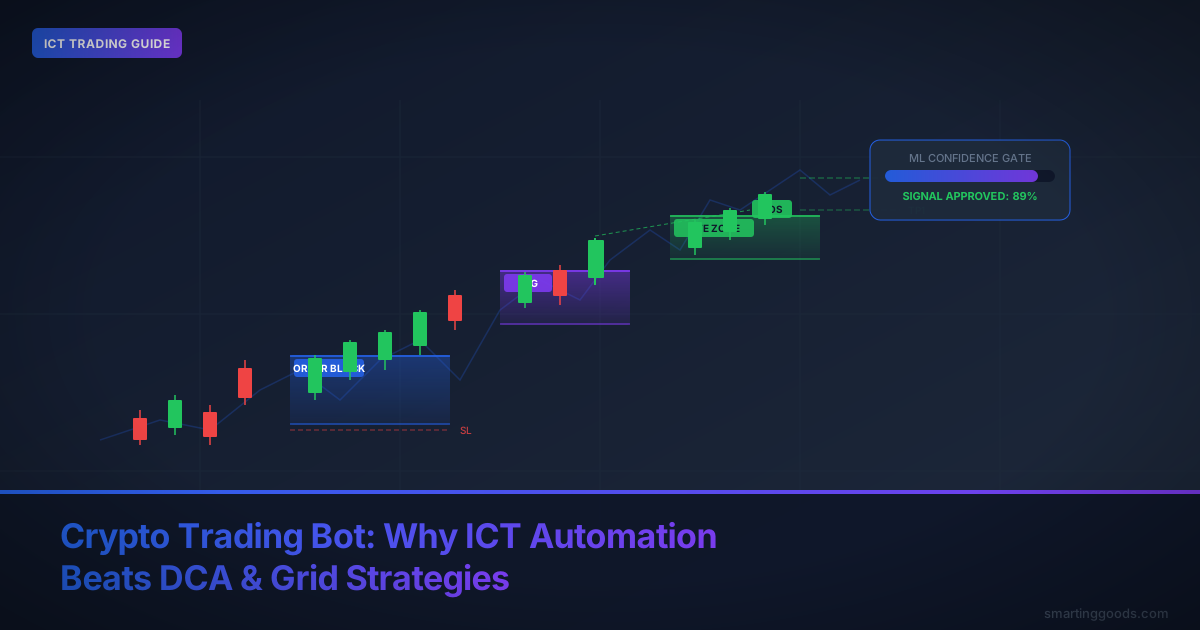
Crypto Trading Bot: Why ICT Automation Beats DCA and Grid
Most crypto trading bots are running retail strategies from 2018. Here is why ICT automation is a different category entirely.
Crypto Trading Bot: Why ICT Automation Beats DCA and Grid in 2026
Most crypto trading bots are solving the wrong problem. They're automating strategies that retail traders invented in 2017 — Dollar Cost Averaging, Grid trading, RSI crossovers — and wrapping them in a dashboard that makes them look sophisticated. The reality is that these bots have no idea where institutional money is positioned, no understanding of market structure, and no concept of what a fair value gap or an order block even is.
The result? A crypto trading bot that chases price instead of anticipating it.
This post is for traders who already understand ICT methodology — who know what Order Blocks, Fair Value Gaps, CHoCH, BOS, OTE zones, and liquidity sweeps actually mean — and who want to know whether it's possible to automate that edge rather than sitting at a screen for 16 hours a day waiting for the setup.
The short answer: it's now possible. We built it. Here's the full picture.
What Is a Crypto Trading Bot (and Why Most of Them Fail)
A crypto trading bot is software that executes trades automatically based on a defined set of rules. The bot connects to an exchange via API, monitors price, and opens or closes positions when certain conditions are met — without manual intervention.
That's the neutral definition. Here's the honest one: the vast majority of crypto trading bots available today are retail-strategy wrappers. They automate entry and exit rules that have been commoditized for years, produce mediocre results in trending markets, and fail systematically in ranging or volatile conditions because they have no awareness of the broader market context they're operating in.
Why most bots fail comes down to three core problems:
Problem 1: Strategy quality. DCA, Grid, and RSI strategies are not edge. They are rules of thumb designed for people who don't want to trade actively. When 50,000 bots are all DCA-buying at the same RSI levels, smart money knows exactly where those orders are — and they sweep them before reversing. You are the liquidity.
Problem 2: No market structure awareness. A bot that buys every 5% dip with no concept of whether the market is in a bullish or bearish phase, whether a Change of Character has occurred, whether Break of Structure has confirmed a new trend — that bot is operating blind. It doesn't know if it's catching a dip or buying into a sustained downtrend.
Problem 3: No institutional context. Retail bots don't know where the big orders are. They can't identify an Order Block where institutional players left unfilled orders. They can't recognize a Fair Value Gap that price is likely to return to fill. They have no concept of BSL/SSL liquidity pools that price is engineered to sweep before reversing.
These aren't minor gaps. They're the reason the $29/month bots on affiliate review sites have backtest results that look decent and live results that erode accounts slowly.
The traders who actually beat the market over time — the ones making consistent, meaningful returns from crypto — are either doing it manually with deep ICT/SMC knowledge, or they're building custom automation. Until now, there was no off-the-shelf solution that bridged those two things.
That's the gap SmartTrading AI fills. But before getting into the product, let's establish exactly why the strategy foundation matters so much.
The Strategy Problem: Why DCA, Grid, and RSI Bots Miss Institutional Moves
To understand why existing crypto trading bots underperform, you need to understand how institutional money actually moves markets — and why retail strategies are specifically designed to be the counterparty to institutional positioning.
DCA Bots: Averaging Down Into Institutional Distribution
Dollar Cost Averaging bots buy fixed amounts at regular intervals or fixed percentage dips. The logic sounds sensible: buy more when price is lower, lower your average cost basis. The problem is structural.
When an asset is in institutional distribution — when smart money is selling to retail — DCA bots are the mechanism through which retail absorbs that distribution. Institutions don't dump all at once. They sell into strength, create pullbacks to attract DCA buyers, then push slightly higher to attract more buyers, then distribute again. The DCA bot doesn't know any of this. It sees a dip and buys. It sees another dip and buys again. The ICT trader watching the same chart sees a Bearish Order Block that has been tested three times with weakening reactions and recognizes it's in a distribution phase.
The DCA bot will eventually be right — unless the asset goes to zero, it will eventually recover — but "eventually" can mean sitting in drawdown for 18 months during a bear market while better setups are happening elsewhere.
Grid Bots: Selling Strength Into Trending Moves
Grid bots place buy and sell orders at regular intervals above and below the current price, capturing small profits from oscillation. They work in tight, choppy, low-volatility markets. They fail badly in two scenarios: strong trending moves and sudden large moves in either direction.
In a genuine ICT trending move — price has broken structure with displacement, created a new Fair Value Gap, and is running to the next liquidity pool — a grid bot is actively fighting that trend. It's selling longs as price moves up (because that's how grids work) and taking small profits while missing the 15% run. Meanwhile it has unfilled buy orders well below the current price waiting to catch the pullback, and if that pullback is actually a market structure shift (CHoCH), it gets trapped in a reversal.
Grid bots have no concept of trend. They treat all price oscillation as equivalent.
RSI Bots: Oversold Is Not a Strategy
RSI-based bots buy when RSI crosses below 30 (oversold) and sell when it crosses above 70 (overbought). This is textbook retail thinking. The RSI indicator was developed in the 1970s for equities markets. It has no awareness of liquidity engineering, market structure, or institutional positioning.
The most dangerous scenario for an RSI bot: oversold in a bearish market structure with institutional distribution overhead. The bot buys because RSI says oversold. ICT traders see a bearish Order Block above current price, recognize that price swept buy-side liquidity to create the oversold RSI reading, and are actually looking short.
More fundamentally: RSI is a lagging indicator derived from price. It tells you what already happened. Order Blocks, Fair Value Gaps, and liquidity sweeps tell you where price is going because they're mapped to actual institutional order flow — the orders that haven't been filled yet.
The Deeper Problem: Retail Strategies Are the Product, Not the Solution
Here's the uncomfortable reality about most crypto trading bot platforms: their revenue model is subscriptions and affiliate commissions. They don't need their strategies to be genuinely profitable — they need them to be easy to explain and good enough that users don't immediately cancel.
DCA and Grid are perfect for this. They work often enough in bull markets to retain subscribers. They fail in bear markets when users are already desensitized to losses. And the platform makes money regardless.
ICT methodology solves a different problem for a different type of trader. It's not designed to be passive or explainable in two sentences. It requires understanding market structure, being selective about setups, and trading with the institutional flow rather than against it. Automating that level of sophistication is genuinely hard — which is why nobody had done it before SmartTrading AI.
What Is ICT Methodology — and Why It's the Edge Professional Traders Use
ICT (Inner Circle Trader) methodology is a framework for understanding price delivery developed by Michael Huddleston. It's built on the observation that markets are not driven by retail supply and demand — they're engineered by institutional participants (banks, market makers, large funds) who need to move enormous quantities of contracts without moving the market against themselves.
ICT methodology teaches traders to read the footprints of that institutional activity and position with it rather than against it. The core concepts:
Order Blocks (OB): The last candle (or cluster of candles) before a large impulsive move. When an institution needs to move price, they leave unfilled orders at a specific zone. Price tends to return to that zone to fill remaining orders before continuing the move. A Bullish OB is a bearish candle immediately before a bullish impulse — institutions were accumulating there. A Bearish OB is a bullish candle immediately before a bearish impulse — institutions were distributing there.
Fair Value Gaps (FVG): A three-candle pattern where the second candle moves so quickly that there's a gap between the high of candle one and the low of candle three (for a bullish FVG). This gap represents inefficiency — price moved too fast for orders to be filled efficiently. Markets tend to return to FVGs because there are still institutional orders sitting there. An unfilled FVG is an open invitation for price to revisit.
Change of Character (CHoCH): The first sign that market structure is reversing. In an uptrend, a CHoCH is when price takes out the previous swing low — breaking the series of higher highs and higher lows that defines an uptrend. CHoCH signals a potential structural shift before it's confirmed. It's the earliest warning.
Break of Structure (BOS): Confirmation that the trend has continued. In an uptrend, a BOS is when price takes out the previous swing high, confirming that higher highs and higher lows are intact. BOS validates continuation; CHoCH signals potential reversal.
Optimal Trade Entry (OTE) Zone: The 61.8%–78.6% Fibonacci retracement of the most recent swing. Named "optimal" because this is where smart money typically re-enters on pullbacks in the direction of the confirmed trend. Price frequently reacts strongly from OTE zones when combined with an OB or FVG confluence.
Liquidity Sweeps: Markets are engineered to reach pools of liquidity before reversing. Buy-Side Liquidity (BSL) sits above swing highs — retail stop losses and breakout orders. Sell-Side Liquidity (SSL) sits below swing lows — retail stop losses and breakout sell orders. Institutions push price to these pools to fill their large orders at good prices, then reverse. A liquidity sweep is not a breakout — it's a trap.
Market Structure: The sequence of swing highs and lows that defines trend. Bullish market structure = higher highs and higher lows. Bearish market structure = lower highs and lower lows. Understanding whether you're in premium or discount pricing relative to the current range tells you whether you should be looking to buy or sell.
These concepts work because they're based on the mechanics of how large orders actually get filled in the market, not on arbitrary indicator readings. That's the edge. And until recently, capturing that edge required a human trader to be at the screen, analyzing charts, waiting for setups that might take hours or days to develop.
SmartTrading AI changes that. If you want to go deeper on the foundation before we get into the automation, read our full ICT Trading Strategy guide and the Fair Value Gap trading deep-dive.
How SmartTrading AI Automates ICT on Binance Futures
SmartTrading AI is a crypto trading bot built specifically to automate ICT methodology on Binance Futures. It is the only product in the market that does this. Every other bot — 3Commas, Cryptohopper, Pionex, Bitsgap, and their competitors — runs DCA, Grid, or signal-copy strategies. None of them have any awareness of Order Blocks, Fair Value Gaps, market structure, or liquidity engineering.
The architecture is built around a multi-layer analysis pipeline that runs continuously on BTC/USDT perpetual futures:
- Multi-timeframe ICT analysis — the bot analyzes the 4H, 1H, 15M, and 5M charts simultaneously to build a complete picture of institutional positioning and market structure
- ICT concept identification — Order Blocks, FVGs, OTE zones, BSL/SSL liquidity pools, CHoCH/BOS events are mapped and scored on each timeframe
- ML confidence gating — identified setups are filtered through machine learning models before any execution decision is made
- Regime detection — the bot knows when market conditions are not suitable for its strategy and goes flat
- Economic calendar blackout — trading is suspended around high-impact news events (FOMC, CPI, NFP, PPI)
- Intelligent limit entry — entries are placed as limit orders at optimal ICT zones, not market orders chasing price
Here's how each core ICT concept is implemented in the automation engine.
Order Blocks and Fair Value Gaps: The Core Engine
Order Blocks and FVGs are the foundation of SmartTrading AI's entry logic. The bot identifies them algorithmically across multiple timeframes and scores each one based on a set of confluence factors.
Order Block detection: The engine scans for the last displacement candle before an impulsive move — the candle that marks institutional accumulation or distribution. It validates the OB based on the subsequent move's magnitude (displacement must be genuine, not noise), checks that the OB hasn't been too deeply mitigated (once an OB is completely filled, it loses its significance), and assigns it a strength score based on how many times price has respected it.
FVG identification: The three-candle FVG pattern is identified algorithmically. The engine calculates the gap between the high of the first candle and the low of the third candle (bullish FVG) or the low of the first candle and the high of the third candle (bearish FVG). FVGs are tracked as "open" until price returns to fill them. The system maintains a live map of all open, partially-filled, and fully-mitigated FVGs on each timeframe.
Confluence scoring: A setup becomes actionable when multiple concepts align. An ideal long setup might look like: bullish 4H OB + 1H bullish FVG above the OB + 15M CHoCH confirming reversal + price in OTE zone. Each confluence factor adds to the setup's score. Only setups above the ML confidence threshold proceed to execution.
The bot places limit orders at the OB or FVG rather than entering at market. This is a critical distinction from retail bots. You get filled at the institutional zone — exactly where smart money is positioned — rather than chasing price after it's already moved.
CHoCH/BOS: Knowing When Structure Has Shifted
One of the hardest things to automate in ICT trading is market structure analysis — specifically, knowing when CHoCH has occurred versus when BOS has confirmed continuation.
SmartTrading AI's market structure engine tracks swing highs and lows across the 4H, 1H, and 15M timeframes in real time. It identifies:
- CHoCH: The first violation of the previous swing point in the opposing direction. This is treated as a directional signal but not yet a confirmed reversal — the bot uses CHoCH to start building a bias without immediately executing.
- BOS: Confirmed continuation — the previous swing point in the trend direction has been broken with close. This validates that the market structure is intact and the bot is trading with the trend.
- Market Structure Shift (MSS): A displacement candle that aggressively breaks through a swing point. MSS is treated as a stronger signal than standard CHoCH — it indicates institutional aggression rather than gradual reversal.
The bot uses HTF (higher timeframe) structure to veto conflicting lower timeframe signals. A bullish 15M CHoCH in the context of a bearish 4H market structure is suppressed — the HTF narrative takes precedence. This prevents the bot from taking counter-trend trades that look good on the lower timeframe but are fighting the dominant institutional flow.
This level of multi-timeframe structural awareness is simply not present in any DCA or Grid bot. Those systems have no concept of whether price is trending or ranging, let alone which direction structure has broken.
OTE Zones: Getting In Where Smart Money Gets In
The Optimal Trade Entry zone — the 61.8% to 78.6% Fibonacci retracement — is where the bot looks for entries when price has pulled back into premium/discount. But OTE alone isn't enough; confluence is required.
SmartTrading AI's OTE detection system:
- Identifies the most recent confirmed swing (the swing that generated the BOS or CHoCH)
- Maps the 50%, 61.8%, 70.5%, 78.6%, and 88.6% levels of that swing
- Checks for ICT zone alignment at the OTE range — is there an OB or FVG inside the 61.8–78.6% zone?
- Assigns a directional confidence score based on the alignment
When a Bullish OTE zone has a Bullish OB sitting inside the 61.8–78.6% retracement range of a confirmed bullish swing, that's a high-probability entry zone. The bot places a limit order at the OB within the OTE zone, capturing the entry with minimal slippage at institutional pricing.
The OTE Opportunity system also includes directional context: if the 1H structure is bullish, the 4H range is at a discount, and price is pulling back into OTE, the system scores this as a Long OTE with a specific confidence percentage. Setups need to clear a minimum confidence threshold before execution is considered.
Liquidity Sweeps: Trading the Trap, Not the Bait
This is where SmartTrading AI diverges most dramatically from retail bots. The system actively identifies and trades liquidity sweeps — moments when price is engineered to take out pools of retail orders before reversing.
The bot maintains a real-time map of BSL (Buy-Side Liquidity) and SSL (Sell-Side Liquidity) pools. BSL sits at swing highs where retail stop losses and breakout buy orders accumulate. SSL sits at swing lows where retail stop losses and breakdown sell orders accumulate.
When the bot identifies that price is approaching a BSL pool in a bearish structure, it doesn't interpret that as a bullish breakout signal — it interprets it as a likely sweep followed by reversal. The bot looks for the sweep (price trading above the swing high briefly) and then the reaction (a displacement candle back below the high) as confirmation that the sweep has occurred and reversal is underway.
Conversely, when the SSL below a key low is swept in a bullish structure, that sweep creates the optimal long entry — price has taken the stop losses of every retail long who set stops below the swing low, and now the institutional bid is ready to drive price higher.
The automation uses pool strength scoring. Liquidity pools with more touches (more retail orders accumulated) generate stronger sweeps and higher-confidence reversals. A pool with five or more tests has significantly more liquidity to sweep than a two-touch pool, and the bot scores them accordingly.
SL and TP placement are also liquidity-aware. Stop losses are placed just beyond the nearest liquidity pool in the unfavorable direction, with buffer based on pool strength. Take Profit 1 is placed at the nearest opposing ICT zone (FVG midpoint or OB midpoint). Take Profit 2 is placed at the next unswept BSL/SSL pool — the next liquidity target where institutional participants are likely pushing price.
This is fundamentally different from placing a 2% stop and a 4% take profit. The bot's SL and TP are anchored to real ICT structure, not arbitrary percentages.
ML Confidence Gates: Why Every Signal Is Filtered Before Execution
ICT analysis produces setups. Machine learning determines which setups are worth trading.
This is a critical distinction. ICT methodology can identify dozens of technically valid setups per day — OBs that get respected, FVGs that get filled, OTE zones that hold. Not all of them are high-probability. Market conditions, volatility regimes, and conflicting signals across timeframes all affect the quality of any individual setup.
SmartTrading AI uses a multi-model ML confidence gate that every identified setup must pass before execution:
LSTM Price Direction Predictor: A Long Short-Term Memory neural network trained on historical BTC futures price data predicts the probability of sustained directional movement following an ICT setup. The model has been trained to recognize when the structural conditions that follow a genuine institutional accumulation/distribution zone differ from the conditions following a false signal.
HMM Regime Detection: A Hidden Markov Model classifies the current market regime into TRENDING, RANGING, or VOLATILE states. This is not a simple volatility filter — it's a probabilistic model that identifies the hidden state driving price behavior. ICT setups are significantly more reliable in TRENDING regimes. In RANGING regimes, the bot applies stricter filters. In VOLATILE regimes (sudden large moves with no clear structure), most setups are suppressed entirely.
Composite Confidence Score: Each potential trade receives a composite score that combines: ICT confluence factors, ML directional probability, regime compatibility, funding rate context, and open interest dynamics. Only setups clearing the minimum threshold proceed to order placement.
What this means in practice: The bot does not trade every setup it identifies. It waits for high-probability alignment between ICT structure, ML predictions, and market conditions. This is the equivalent of a professional ICT trader who waits all day for the one A+ setup rather than trading every time an OB appears on the chart.
The regime gate has a hard block for VOLATILE conditions. No matter how technically valid an ICT setup looks, if the HMM has classified the market as VOLATILE, new trades are not opened. This prevents the bot from getting run over by unexpected news events or sudden de-risking.
Economic Calendar Integration: The bot integrates with a ForexFactory-sourced economic calendar and blocks all new position entries within 15 minutes before and 30 minutes after high-impact USD events: FOMC rate decisions, CPI releases, NFP, and PPI. These events produce price delivery that overrides all technical structure. No ICT setup survives a 3% candle from a surprise FOMC decision.
Live Trade Example: How the Bot Identifies and Executes an ICT Setup
Let's walk through what a complete SmartTrading AI trade looks like from identification to execution to management. This is a composite example based on how the system works — the type of setup the bot is designed to take.
Context: BTC/USDT Perpetual Futures, 15M chart. Current price: $97,400. The 4H timeframe is bullish — higher highs and higher lows intact. The 1H chart shows a recent BOS to the upside. The market is currently in a pullback from the recent high at $98,800.
Step 1 — Multi-TF Structural Analysis
The bot's analyzer has mapped the following structure:
- 4H: Bullish. Most recent BOS at $95,600. HTF OTE range: $96,100–$96,800.
- 1H: Bullish BOS confirmed. Bullish FVG open at $96,500–$96,750.
- 15M: Pullback in progress. SSL pool at $96,300 (previous 15M swing low).
Step 2 — Setup Identification
Price is pulling back from $98,800 toward $96,500. The bot identifies a confluence zone at $96,500–$96,750:
- Bullish 1H FVG: $96,500–$96,750 (open, unmitigated)
- Within 4H OTE range: $96,100–$96,800 (61.8%–78.6% retracement)
- SSL pool at $96,300 — likely sweep target before FVG fill
This is a Bullish FVG + OTE confluence setup. Setup score: 78/100.
Step 3 — ML Confidence Gate
The composite ML score is calculated:
- HMM Regime: TRENDING (favorable — +20 points to composite)
- LSTM directional probability: 71% bullish (above 65% threshold)
- Funding rate: Slightly negative (shorts paying longs — mild tailwind for longs)
- Economic calendar: No events in next 4 hours (clear)
Final composite confidence: 82%. Above the 70% execution threshold. Setup approved.
Step 4 — Entry Placement
The bot places a LIMIT BUY order at $96,620 — the midpoint of the bullish FVG. The logic: price will need to fill the FVG, so an order at the midpoint captures the fill with high probability. If the SSL pool at $96,300 sweeps first (price drops to $96,300 briefly before reversing), the entry at $96,620 still gets filled on the way back through the FVG.
Step 5 — SL and TP Calculation
- Stop Loss: Placed at $95,880 — just below the 4H OTE low and the nearest SSL pool. If price closes below here, the bullish structure is invalidated. Buffer: 0.4% below the pool.
- TP1: $97,650 — midpoint of the nearest Bearish OB above (stable zone-based target, tagged [ZONE-TP1])
- TP2: $98,900 — 0.15% beyond the BSL pool at $98,800 (sweep-through target, tagged [SWEEP-TP2])
Step 6 — Position Monitoring
Price dips to $96,290, briefly sweeping the SSL pool — exactly the liquidity engineering the bot anticipated. The limit order fills at $96,620 as price recovers through the FVG. The bot confirms the fill and activates the SL/TP orders.
Step 7 — Outcome
Price runs to TP1 at $97,650 (partial close), then continues to TP2 at $98,900 before reversing. Total move from entry: approximately 2.3% (TP2). With 5x leverage on Binance Futures and a 0.7% risk (SL distance from entry), the risk/reward on this trade was approximately 1:3.3.
This is one trade. The bot runs this analysis cycle continuously, looking for the next qualified setup while managing any open position.
Binance Futures vs Spot: Why Futures Changes the Game
SmartTrading AI is built specifically for Binance Futures — BTC/USDT perpetual contracts. This is a deliberate product decision, not a limitation. Here's why futures is the right venue for ICT automation:
Leverage. Binance Futures allows up to 125x leverage (the bot operates at conservative, user-configured leverage — typically 3x–10x). This means that the 2–3% ICT moves the bot targets produce significantly amplified returns relative to margin used. A 3% move at 5x leverage is 15% of margin. The same move on spot is 3%.
Two-directional trading. ICT methodology identifies both bullish and bearish setups with equal clarity. On spot, you can only profit from bullish moves. On futures, the bot takes both long and short positions — the full range of ICT setups is available.
Perpetual funding rate dynamics. Perpetual futures have funding rates paid between longs and shorts every 8 hours. When funding is extremely positive (longs paying heavily), it signals overleveraged retail longs — a condition that precedes liquidity sweeps of BSL. When funding is extremely negative, it signals the opposite. The bot uses funding rate data as a signal — negative funding on a long setup is a tailwind; highly positive funding is a warning.
Liquidity. BTC/USDT perpetual on Binance is the highest-liquidity crypto futures market in the world. The bid-ask spreads are tight enough that limit orders fill accurately at ICT zones. On lower-liquidity spot markets, slippage would erode the precision of OB/FVG entries.
Open Interest context. Rising OI with price increase confirms institutional conviction. Falling OI with price increase suggests weak short-covering. The bot incorporates OI dynamics into the composite confidence score — a setup with confirming OI behavior gets a score boost.
One important note: Binance Futures trading involves leverage and carries meaningful risk. SmartTrading AI is not a "set it and forget it" solution for people unfamiliar with futures markets. It's a precision automation tool for traders who understand what they're trading. The risk management parameters — leverage, position size, maximum drawdown limits — are user-configured and require thoughtful setup.
SmartTrading AI vs 3Commas, Pionex, Cryptohopper: Feature Comparison
The honest comparison: SmartTrading AI is not a replacement for 3Commas, Cryptohopper, or Pionex if you want to run DCA or Grid strategies. Those platforms do those things well. SmartTrading AI is a completely different product category — institutional-grade ICT automation for traders who want to stop being the liquidity.
| Feature | SmartTrading AI | 3Commas | Cryptohopper | Pionex |
|---|---|---|---|---|
| Strategy Type | ICT/SMC (Institutional) | DCA / Grid / RSI | DCA / Grid / Signal | Grid / DCA |
| Market Structure Aware | Yes | No | No | No |
| ICT Order Blocks | Yes | No | No | No |
| Fair Value Gaps | Yes | No | No | No |
| CHoCH/BOS Detection | Yes | No | No | No |
| OTE Zone Entries | Yes | No | No | No |
| Liquidity Sweep Detection | Yes | No | No | No |
| ML Confidence Filter | Yes | No | No | No |
| Regime Gate (knows when NOT to trade) | Yes | No | No | No |
| Economic Calendar Blackout | Yes | No | No | No |
| Binance Futures Native | Yes | Partial | Partial | Yes |
| Funding + OI Awareness | Yes | No | No | No |
| Multi-Timeframe Analysis (4H/1H/15M/5M) | Yes | No | No | No |
| Starting Price | $49/mo | $29/mo | $19/mo | Free (exchange fee) |
On the price difference: SmartTrading AI costs more because it does more. The $19–29/month tier on the other platforms gets you a DCA bot. If your DCA bot adds one meaningful trade per month that it would have missed — or avoids one counter-trend loss because it understood market structure — it's paid for itself. The alternative is paying $19/month for a bot that has no idea what an Order Block is.
What 3Commas does better: Multi-exchange support, established track record, large community, copy trading. If you're new to crypto trading and just want to DCA Bitcoin passively, 3Commas is a reasonable choice.
What Cryptohopper does better: Signal marketplace, more visual strategy builder, broader exchange support. Good for traders who want to follow professional signal providers without running their own analysis.
What Pionex does better: It's free (exchange fees only), making it accessible for very small accounts. Grid bots work acceptably in sideways BTC markets.
What SmartTrading AI does that none of them can: Automates ICT methodology with institutional-grade market structure analysis, ML confidence gating, and liquidity-aware execution. If you've spent time learning ICT and want that edge running 24/7 without screen time, there is currently one option.
Who Is This Bot For (and Who It's Not For)
Being direct about this saves everyone time.
SmartTrading AI is built for:
Experienced ICT/SMC traders who want to automate their edge. You know what a Bearish Order Block looks like. You understand why price sweeps liquidity before reversing. You've been manually taking ICT setups and you're either tired of the screen time or want the bot to catch setups you miss while sleeping. This is your product.
Discretionary traders looking for a systematic second opinion. You still want to trade manually but you want an automated system running in parallel — catching setups across timeframes, running overnight, executing the setups you'd take if you were awake. The bot trades what you'd trade; you add your discretionary overlay.
Traders with specific accounts they want to deploy mechanically. Some traders keep one account for discretionary trades and want a second account running a fully systematic approach. SmartTrading AI is the systematic approach.
Those who understand futures risk. Futures with leverage is not for everyone. If you have a clear understanding of margin, liquidation, and position sizing — and you're treating this as part of a managed trading operation, not a passive wealth-building tool — this is the right product.
SmartTrading AI is NOT for:
Complete beginners. If you don't know what a Fair Value Gap is, you will not be able to evaluate whether the bot is performing correctly or incorrectly. ICT methodology has a learning curve. The automation is a tool for practitioners, not a shortcut for people who want returns without understanding the methodology.
People expecting passive income with zero drawdown. There is no trading bot — or trading strategy of any kind — that produces consistent returns without periods of drawdown. Anyone selling you that is lying. SmartTrading AI has months of backtesting data showing performance characteristics, but live trading is not backtesting. Drawdowns will occur. Risk management settings matter.
Traders who want to run DCA or Grid. Use Pionex. It's free and built for that.
Very small accounts (under $500). The leverage-adjusted position sizing and fee structure on Binance Futures make it difficult to run meaningful trades on very small accounts. Practically, accounts under $500 will face challenges with minimum order sizes and meaningful risk/reward.
Anyone looking to "set and forget" without monitoring. The bot runs your strategy autonomously, but no automated trading system should be left completely unmonitored. You should be checking performance weekly, understanding the trades it's taking, and ensuring the market conditions it's designed for are still present.
Frequently Asked Questions
Q: What exactly does SmartTrading AI automate?
A: The bot automates the full ICT analysis and execution pipeline on BTC/USDT perpetual futures on Binance. This includes identifying Order Blocks, Fair Value Gaps, CHoCH/BOS market structure events, OTE zones, and BSL/SSL liquidity pools across the 4H, 1H, 15M, and 5M timeframes. It places limit entries at ICT zones, sets SL/TP based on liquidity structure, and manages position through TP1 (partial close) and TP2 (full close). The ML confidence gate and regime detection layer decide which setups to execute and when to stay flat entirely.
Q: Does it work on coins other than Bitcoin?
A: The current version is focused on BTC/USDT perpetual futures. Bitcoin has the deepest liquidity and the most institutional order flow, making it the ideal instrument for ICT automation. Multi-symbol support for ETH and other high-liquidity pairs is on the roadmap for a future release.
Q: What are the backtest results?
A: We have 62-day BTC backtests available showing strategy performance across TRENDING, RANGING, and VOLATILE regimes. ICT setups perform significantly better in TRENDING regimes — this is expected and by design. We're transparent about the fact that in RANGING markets the bot trades less frequently and at lower win rates. We'll share detailed backtest results with beta users. We don't publish headline win rate numbers without full context on market conditions and sample size.
Q: How is SmartTrading AI different from a signal service?
A: A signal service sends you alerts ("buy BTC now, SL here, TP there") that you execute manually. SmartTrading AI is a fully automated execution engine — it identifies setups, places orders, manages the position, and closes the trade without your involvement. The analysis behind those decisions is ICT-based rather than arbitrary. You configure the risk parameters; the bot handles the rest.
Q: What happens during high-impact news events like FOMC?
A: The economic calendar blackout system blocks all new trade entries 15 minutes before and 30 minutes after scheduled high-impact USD events (FOMC, CPI, NFP, PPI). If the bot has an open position when a news event occurs, position management continues normally — but no new entries are opened until the blackout window clears.
Q: What leverage does the bot use?
A: Leverage is user-configurable. We recommend starting conservatively — 3x to 5x — and adjusting based on your risk tolerance and account size. The bot's risk management logic calculates position size as a percentage of account equity per trade, so regardless of leverage, the dollar risk per trade stays within your configured parameters.
Q: What do I need to get started?
A: A Binance Futures account (with futures enabled), an API key with trading permissions, and a SmartTrading AI subscription starting at $49/month. During the current beta phase, access is limited to ensure the system performs optimally under live conditions. You can join the waitlist at smartinggoods.com/trading.
Q: Can I run this alongside my own manual trading on the same Binance account?
A: Technically yes, but we recommend keeping the bot's funds in a separate sub-account on Binance for clean performance tracking and to avoid unintended conflicts between manual and automated positions. Binance allows sub-accounts with separate API keys, which is the recommended setup.
Q: Is my API key secure?
A: API keys are stored with AES encryption, never exposed in logs or client-facing responses, and we recommend setting your Binance API key permissions to "Trading only" (no withdrawal permission). The bot only needs to place, modify, and cancel futures orders — withdrawal permission is never required.
Q: What happens if the bot takes a bad trade?
A: Every trade has a pre-defined stop loss anchored to an ICT zone. The maximum loss per trade is bounded by your configured risk percentage. If the bot takes a loss, that's part of normal strategy operation — no ICT setup has a 100% win rate. What matters is the expectancy over a series of trades, which requires the SL and TP structure to be calibrated correctly relative to the edge the strategy provides.
Start Automating ICT Today
Every day that ICT traders spend manually watching charts for setups that the bot would catch automatically is an opportunity cost. Every night that price sweeps a key liquidity level, fills an FVG, and runs to TP2 while you're asleep is a trade the automation would have taken.
The technology now exists to automate ICT methodology with institutional-grade precision. Machine learning confidence gates ensure the bot only fires on high-probability setups. Market structure detection ensures it's trading with the trend, not against it. Liquidity-aware execution ensures it's trading the trap, not getting caught in it.
SmartTrading AI starts at $49/month. It is currently in closed beta — access is limited while we validate live performance data across different market conditions. Early beta users get direct input on feature development and grandfathered pricing before the public launch.
If you're a serious ICT trader who wants your edge running 24/7 without screen time — or if you want to be on the waitlist for when beta opens up — visit smartinggoods.com/trading to apply.
Related reading:
Start AI Trading
See how our ICT bot automates Binance Futures trading.
Start AI Trading