Best AI Trading Bot for Crypto 2026: The Complete Guide
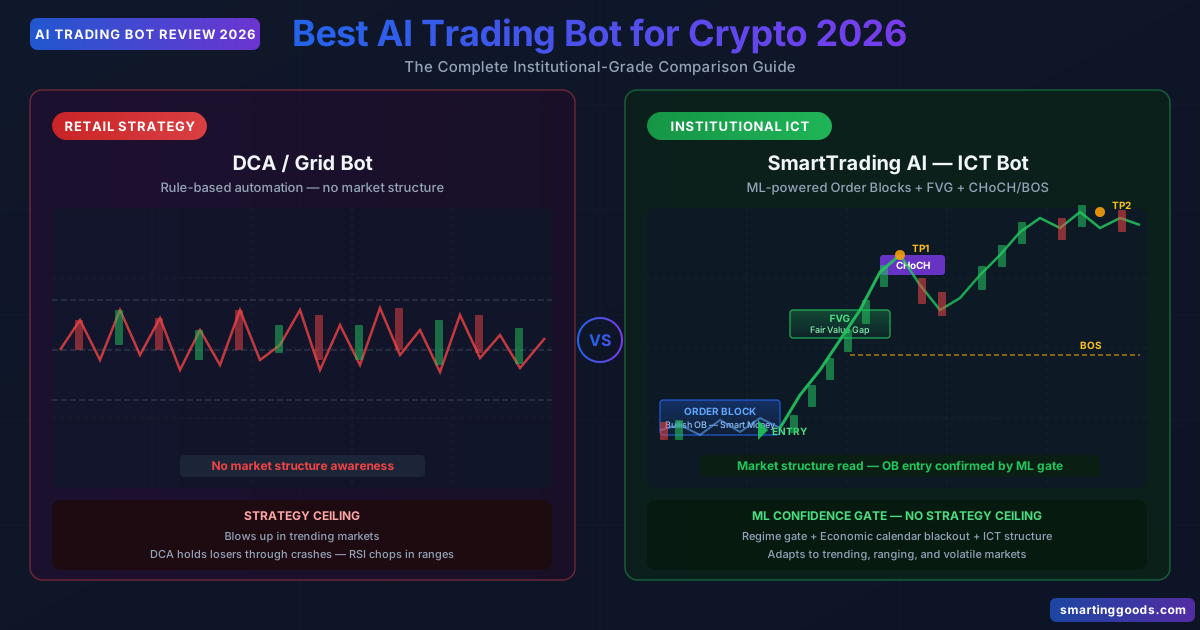
Most 'AI' crypto trading bots are just rule-based automation with a marketing label. Here's what separates real AI-powered market structure trading from the rest.
Best AI Trading Bot for Crypto 2026: The Complete Guide to Institutional-Grade Automation
If you've searched for the best AI trading bot for crypto in 2026, you've already seen the same article thirty times. Coin Bureau, AMBCrypto, Beincrypto — they all rank the same seven bots, slap affiliate links on each one, and call it a review. What none of them tell you is that six of those seven bots are not AI. They are rule-based automation systems with a marketing team that learned the phrase "AI-powered."
This guide is different.
We are going to define what it actually means for a trading bot to be AI-powered. We are going to review every major bot on those lists — honestly, including their strategy ceilings. And we are going to explain why the entire crypto bot industry has a structural blind spot: none of them read market structure.
By the end, you will have a clear framework for evaluating any trading bot, understand the concept of a strategy ceiling, know exactly what ICT methodology is and why it matters for automation, and have a complete comparison table to guide your 2026 decision.
What Makes an AI Trading Bot Actually "AI" (vs Just Automated Rules)
The word "AI" gets applied to crypto trading bots the way "artisan" gets applied to fast food. Liberally, vaguely, and usually inaccurately.
Let's define terms.
Rule-based automation is a system where a human writes explicit if-then conditions, and the bot executes them. If RSI crosses below 30, buy. If price falls 5% from entry, sell. If the 50-day MA crosses the 200-day MA, open a long. These conditions never learn. They never update. They do exactly what a human programmer told them to do three years ago, in market conditions that may no longer exist.
Most crypto trading bots are this. The conditions might be complex. There might be hundreds of them. The interface might show you a "strategy builder" with drag-and-drop logic blocks. But it is still if-then automation. There is no intelligence involved — just code following instructions.
Machine learning (ML) is fundamentally different. An ML model learns patterns from data. It builds internal representations of market structure that no human explicitly programmed. A well-trained neural network identifies correlations between price behavior, volume, volatility regime, and trade outcome that would take a human analyst years to observe, and it does it continuously across millions of historical data points.
The five markers of genuinely AI-powered trading:
Trained models — The system contains ML models (neural networks, gradient boosting, reinforcement learning agents, etc.) that were trained on historical data and produce probabilistic outputs, not deterministic rule matches.
Confidence gates — The AI outputs a confidence score, not just a signal. A trade is only executed when confidence exceeds a threshold. This filters low-quality setups that a rule-based system would blindly take.
Regime awareness — The bot knows what kind of market it is in (trending, ranging, volatile) and adjusts behavior accordingly, or pauses trading entirely. Rule-based bots run the same logic regardless of conditions.
Adaptive thresholds — Parameters that self-adjust based on recent performance or volatility changes, rather than staying fixed at human-set values.
Structural pattern recognition — The ability to identify market structure concepts (swing highs/lows, order flow, liquidity zones) rather than just reacting to lagging indicators like moving averages or oscillators.
By these five criteria, the vast majority of bots marketed as "AI" fail on at least three counts.
The honest way to evaluate any bot: ask the vendor where their machine learning models are, what they were trained on, and what confidence thresholds gate their entries. If they pivot to talking about their backtester, they are not an AI trading bot — they are a backtesting platform with an execution engine.
The 2026 Benchmark: What Separates Elite Bots from Basic Automation
The crypto market in 2026 has matured considerably from the 2021 bull run era when grid bots printed money in every direction. Volatility regimes have become more sophisticated. Institutional participation on Binance Futures has increased. Whale-driven liquidity sweeps are more deliberate and more destructive to retail positions.
In this environment, the bar for "good enough" automation has risen significantly. Here is the 2026 benchmark framework — what separates elite bots from basic automation:
Baseline (table stakes, not a differentiator):
- Order execution on major exchanges
- Basic backtesting
- Stop-loss and take-profit management
- DCA or Grid strategy execution
Mid-tier (better than average, still pattern-based):
- Multi-exchange support
- Signal marketplace or copy trading
- Volatility-adjusted position sizing
- Multiple concurrent bots
Elite tier (genuinely separating institutional from retail):
- Machine learning confidence gates on every entry
- Market structure awareness (swing highs/lows, structural breaks)
- Regime detection (trending vs. ranging vs. volatile)
- Liquidity zone identification (where stops are clustered)
- Economic calendar integration (avoid major news events)
- Order block and fair value gap recognition
- Break of Structure (BOS) and Change of Character (CHoCH) detection
- Position management that adapts to post-entry structure shifts
Every bot at the baseline and mid-tier level is trading against each other, fighting for the same retail edge. Elite-tier bots are trading with institutional logic — which means they are positioned on the same side as the smart money that moves markets.
That distinction is worth understanding deeply before spending money on any subscription.
The 7 Most Popular Crypto AI Bots Reviewed
Here is an honest assessment of the bots that dominate every review article. None of these bots claim to use ICT methodology, because none of them do. The review reflects what they actually are — and where their strategy ceiling sits.
3Commas — Strategy Ceiling: Medium Trend Markets
3Commas is one of the oldest and most established crypto bot platforms. It connects to over 18 exchanges and offers three core strategies: SmartTrade (manual-assisted execution), DCA bot (averaging into positions), and Grid bot (buying and selling within a price range).
The DCA bot is 3Commas' flagship product and genuinely useful for accumulation in choppy or moderately trending markets. You set a base order, a safety order size, a safety order step (how far the price must drop before the bot averages down), and the bot manages the rest.
What it actually does: DCA bots assume that if a position goes against you, the right response is to buy more at a lower price to reduce your average cost. This works beautifully in markets that eventually recover. It catastrophically fails in sustained downtrends — the bot keeps averaging down as the price falls, and by the time you realize the trend isn't reversing, you are significantly over-allocated to a losing position.
"AI" claim analysis: 3Commas does not contain machine learning models. Their signal marketplace allows third-party signal providers to push entries into your bot — but the bot itself is not generating AI signals. It is executing rule-based DCA logic on signals that may or may not be AI-generated by someone else.
Pricing: Starts at $29/month. Free plan available with limited bot access.
Strategy ceiling: Medium-trend markets where price action is oscillating with an upward bias. DCA bots break down in clear downtrends and sustained low-volatility ranging where the spread between orders never triggers properly.
Verdict for 2026: Solid execution infrastructure. Not AI. Will underperform in high-volatility trending conditions.
Cryptohopper — Strategy Ceiling: Sideways Markets
Cryptohopper takes a different approach from 3Commas: rather than DCA-focused, it centers on signal-based trading and a marketplace where you can buy pre-built strategies from other traders. The core bot uses technical indicator combinations (RSI, MACD, Bollinger Bands) to generate entries and exits.
Their "AI" marketing refers to a feature called "AI strategy creation" — a tool that backtests various indicator combinations and recommends the one with the best historical performance. That is not machine learning in any meaningful sense. It is parameter optimization on a fixed indicator set, which every platform with a backtester can do.
What it actually does: The bot runs indicator-based entry and exit signals, augmented by whatever signal provider you subscribe to in their marketplace. Position sizing is static or percentage-based. There is no structural awareness and no confidence gating.
"AI" claim analysis: Cryptohopper's AI feature is a backtesting optimizer, not a machine learning system. It tests combinations of indicator parameters and selects the best-performing settings — a process traders have been doing manually for twenty years. Calling it AI is a marketing decision, not a technical one.
Pricing: Starts at $19/month. Limited free plan.
Strategy ceiling: Sideways markets with oscillating price action, where RSI and MACD produce reliable overbought/oversold signals. In strongly trending markets, every "overbought" RSI reading fires a short into a bull trend and loses.
Verdict for 2026: Good for simple indicator-based automation. The marketplace adds flexibility. Not AI. Will thrash in trending or volatile conditions.
Pionex — Strategy Ceiling: Low Volatility Range Environments
Pionex stands apart from the others in one key way: it is a built-in exchange with bots natively integrated, rather than a third-party layer connecting to external exchanges. This gives it extremely low latency and zero API connection issues. Its core product is the Grid Trading Bot.
The Grid Trading Bot places buy and sell orders at evenly spaced price levels within a defined range. When the price oscillates between those levels, the bot collects the spread repeatedly. In low-volatility, range-bound markets, this generates consistent small profits.
What it actually does: Mechanical grid placement. The bot doesn't read anything about the market — it simply creates a grid of orders between two price levels you define, and executes them as price crosses each level. The "AI-suggested grid parameters" feature uses historical volatility data to recommend range boundaries — again, this is statistics, not machine learning.
"AI" claim analysis: Pionex's AI Grid Bot uses backtested statistics to suggest parameters. There are no trained ML models. No confidence gates. No structural awareness.
Pricing: Free — Pionex earns from trading fees (0.05% maker/taker).
Strategy ceiling: Low-volatility range environments where price stays within a predictable band. When volatility spikes — which it does regularly in crypto — the grid gets broken and the bot holds losing positions at the grid's extreme edge.
Verdict for 2026: Best free option for range trading. The zero cost is genuinely attractive. Not AI. Completely helpless in trending markets.
Bitsgap — Strategy Ceiling: Range-Bound Markets
Bitsgap offers Grid, DCA, and COMBO bots across 25+ exchanges with a clean interface and solid portfolio tracking features. Their COMBO bot attempts to combine grid and DCA logic — running a grid within a range while DCA-ing into the position if price breaks out of that range.
The platform's SmartOrder tool provides conditional order entry with trailing stops, which is genuinely useful for manual traders. The automated bots, however, follow the same grid-and-DCA logic as competitors.
What it actually does: Grid logic within a range, with DCA fallback when price breaks range boundaries. The COMBO strategy is a clever hybridization of two rule-based approaches, but it is still entirely rule-based. There are no ML models making decisions.
"AI" claim analysis: Bitsgap uses "AI" in marketing copy but their platform documentation is refreshingly honest — it describes strategies as algorithm-based without claiming machine learning inference. Their backtester lets you test parameter combinations.
Pricing: Starts at $28/month.
Strategy ceiling: Range-bound markets. The COMBO bot adds some resilience versus pure grid bots, but when price trends decisively in one direction, both the grid and the DCA components work against each other.
Verdict for 2026: Polished interface and solid exchange coverage. Not AI. The COMBO strategy is a thoughtful product but has the same structural ceiling as every grid-based approach.
WunderTrading — Strategy Ceiling: Signal Quality Dependent
WunderTrading focuses on signal-based automation and copy trading. The platform acts as a relay between signal providers (TradingView alerts, third-party signal services, manual traders) and your exchange accounts. It doesn't generate its own signals.
What it actually does: The bot receives signals via webhook, Telegram, or TradingView integration and executes them in your account. The intelligence is entirely outsourced to whoever is providing the signal. WunderTrading itself is an execution layer, not a strategy layer.
"AI" claim analysis: WunderTrading doesn't heavily market itself as AI. It is a copy trading and automation platform. Some signal providers in their marketplace may use ML models, but WunderTrading's own system does not.
Pricing: Free tier available. Paid plans from ~$9.95/month.
Strategy ceiling: Entirely dependent on signal source quality. The system is only as good as the signals it receives. Latency between signal generation and execution can be an issue for fast-moving setups.
Verdict for 2026: Useful infrastructure if you have a high-quality signal source to plug in. Not a trading intelligence system in its own right.
Coinrule — Strategy Ceiling: Logic Complexity Limit
Coinrule targets traders who want to automate custom strategies without writing code. It provides an "if-this-then-that" rules builder with a library of over 200 pre-built templates. You can chain conditions, add timing triggers, and combine multiple indicators.
The platform's "Automated Portfolio" feature generates rule sets based on your risk appetite — it is closer to a questionnaire-driven template selector than a learning system.
What it actually does: Explicit rule execution. The more complex your rule chain, the more brittle it becomes — adding conditions to try to cover edge cases creates logical conflicts and over-fitting to historical behavior.
"AI" claim analysis: Coinrule uses terms like "smart automation" and "intelligent rules," but the system is pure if-then logic with no machine learning components. Their template library is rule-based.
Pricing: Free plan with 3 rules. Paid from $29.99/month.
Strategy ceiling: The ceiling here is logic complexity — you cannot encode market structure awareness into if-then rules. You can approximate it, but the more rules you layer, the more maintenance burden you create and the more likely edge cases break the system.
Verdict for 2026: Good for simple automation. The no-code interface is genuinely accessible. But there is a hard ceiling on sophistication when you are limited to explicit rule construction.
TradeSanta — Strategy Ceiling: Flat Markets
TradeSanta is a straightforward DCA and grid bot platform with mobile-first design and a simple setup flow. It targets newer traders who want to run basic bots without significant configuration complexity.
What it actually does: Long and short DCA bots with configurable safety orders. Connects to major exchanges. Basic technical filters (MACD, RSI, Bollinger Bands) available as signal triggers.
"AI" claim analysis: TradeSanta does not make significant AI claims. It is honest about being a DCA and grid automation tool.
Pricing: Starts at $25/month.
Strategy ceiling: Flat or mildly trending markets. The DCA logic requires price to eventually return to breakeven or better, which fails in sustained trends.
Verdict for 2026: Simple, clean, functional. Exactly what it says. Not AI.
Why Every Bot on That List Uses the Same 3 Strategies
You may have noticed a pattern: DCA, Grid, and indicator-based signals. That is not a coincidence. It is not laziness. It is a structural limitation of what is buildable without machine learning and market structure analysis.
Here is why.
DCA (Dollar Cost Averaging) is simple to implement, intuitive to understand, and easy to sell. "If price drops, we buy more." Any junior developer can build this in a week. It backtests well on bull markets because the assumption "crypto goes up long-term" has been correct. It requires no understanding of market structure — just price levels and order sizes.
Grid trading is similarly mechanical. Place orders at regular intervals. Collect the spread when price oscillates. The math is transparent and the visualization is clean. It backtests beautifully in ranging conditions.
Indicator-based signals (RSI, MACD, Bollinger Bands) have been the language of retail technical analysis since the 1980s. Every platform has them because every trader asks for them. They are simple to implement, easy to explain, and famously exploitable by institutional traders who know exactly where retail stops cluster around these levels.
The deeper issue is this: all three strategies assume price is random within a range. DCA bets on mean reversion. Grid profits from oscillation. Indicators identify statistical extremes. None of them attempt to understand why price moved, who moved it, or where the next purposeful move will go.
The strategy ceiling concept is the key insight here.
Every bot has a market condition where its core strategy breaks down. The ceiling is not a flaw in the implementation — it is inherent to the strategy itself:
- Grid bots' ceiling: Trending markets. When price trends strongly in one direction, the grid keeps firing opposing orders against the trend, accumulating a losing position at the extreme edge of the range.
- DCA bots' ceiling: Sustained downtrends. DCA assumes recovery; if the asset doesn't recover, you are averaging into a loss indefinitely.
- RSI/MACD bots' ceiling: Trending markets. "Overbought" in a bull trend fires short entries. "Oversold" in a bear trend fires long entries. The indicator is reacting to the trend, not predicting reversal.
- Grid + DCA COMBO bots' ceiling: Volatile breakouts. Both systems are designed for range behavior and both work against each other when directional momentum is strong.
These ceilings explain why most retail traders rotate between bots that "worked for a while" and then stopped working. The bot didn't change. The market regime changed, and the bot hit its ceiling.
The question for 2026 is: what does a bot look like that has no strategy ceiling?
The answer is a bot that reads market structure — and adjusts its behavior to what the market is actually doing, not what a fixed rule set expects it to do.
The Missing Layer: ICT Methodology and Institutional Market Structure
ICT — Inner Circle Trader — is a methodology developed by Michael J. Huddleston (The Inner Circle Trader) over two decades of studying how institutional participants move price. It has become the dominant framework for serious technical traders over the last five years, with millions of practitioners worldwide.
The core insight of ICT is that markets are not random within ranges. Price moves are deliberate. Institutions need to accumulate and distribute large positions, and to do that efficiently, they need retail traders positioned on the wrong side so they can take the other side. The entire methodology is built around identifying where that institutional activity leaves visible footprints in price structure.
For a more complete breakdown of ICT methodology and how to trade it manually, see our ICT Trading Strategy guide and Smart Money Concepts explained.
Here, we focus on what matters for automation: the specific ICT concepts that can be systematically detected and acted upon by a properly architected bot.
What Professional Traders Know That Retail Bots Don't
Retail trading bots operate on the assumption that price is a series of data points obeying statistical patterns. RSI is high, therefore price will revert. Price hit a Bollinger Band, therefore it will mean revert. A moving average crossed, therefore a trend is beginning.
Professional traders — and institutions — know that price is the result of deliberate order flow. Large participants need counterparty liquidity to execute. That means:
- Before a major up move, price must sweep the sell stops below a key low to trigger retail longs into closing and create the sell-side liquidity institutions need to buy against.
- Before a major down move, price must sweep the buy stops above a key high to trigger retail shorts into closing and create the buy-side liquidity institutions need to sell against.
- After sweeping liquidity, price returns to fill imbalances (Fair Value Gaps) and often revisits the origin of the move (Order Blocks) before continuing in the intended direction.
No RSI reading tells you any of this. No grid bot captures this. DCA doesn't know that a sweep just happened and a reversal is imminent.
This is the missing layer — and it is completely absent from every bot reviewed in the previous section.
Order Blocks: Where Smart Money Leaves Footprints
An Order Block (OB) is the last opposing candle before a significant displacement move. When institutions accumulate a large long position, the final bearish candle before the impulsive up move represents that accumulation activity. Price tends to return to that candle — the Order Block — before continuing higher, because institutions need to fill the remainder of their position at the same price they started accumulating.
Identifying Order Blocks requires:
- Detecting displacement moves (strong impulse candles breaking structure)
- Identifying the last opposing candle before that displacement
- Tracking whether the OB has been mitigated (price has returned and continued)
- Weighting OBs based on their confluence with other ICT concepts
This is a spatial, structural pattern recognition problem. It cannot be expressed as an RSI threshold. It requires the bot to maintain a running model of market structure — tracking swing highs and lows, displacement events, and mitigation status — across multiple timeframes simultaneously.
For a complete breakdown of how to trade Order Blocks manually, see our Order Block Trading Strategy guide.
Fair Value Gaps: The Imbalance That Always Gets Filled
A Fair Value Gap (FVG) is a three-candle pattern where a strong impulse candle creates a gap between the high of the first candle and the low of the third candle. This gap represents an area of price imbalance — the market moved so fast that two-sided participation didn't occur.
Price has a strong tendency to return to FVGs before continuing in the original direction. Why? Because unfilled orders at those price levels create a "magnet" effect — orders placed at the price range during the fast move are still waiting to be filled, and the market's auction process drives price back to fill them.
For automation, FVG detection requires:
- Real-time identification of three-candle imbalance patterns
- Classification of bullish vs. bearish FVGs
- Tracking whether FVGs have been fully or partially filled
- Weighting FVG confluence with OBs and structural context
Again — none of this is accessible to indicator-based systems. RSI doesn't know about FVGs. A grid bot doesn't care. For a deep-dive into FVG trading mechanics, see our Fair Value Gap Trading Strategy guide.
Liquidity Sweeps: How Institutions Trap Retail Before Moving
Every retail trader who has placed a stop-loss below a recent swing low has contributed to a liquidity pool. Those stops represent unfilled orders sitting in the market. Institutions know they're there. Before executing a large long position, they have an incentive to drive price down through those stops — triggering them, collecting the liquidity, and then reversing.
This is a liquidity sweep (also called a stop hunt). Recognizing it requires:
- Identifying buy-side liquidity (BSL) above swing highs where breakout traders have stops
- Identifying sell-side liquidity (SSL) below swing lows where long traders have stops
- Detecting when price pierces and then immediately reverses from a liquidity pool
- Using that sweep confirmation as an entry trigger rather than the naive breakout
A bot that detects a stop hunt and enters on the reversal is trading with institutional intent. A grid bot that places an order at the breakout gets stopped out with everyone else.
CHoCH and BOS: Reading the Footprint of Institutional Intent
Break of Structure (BOS) is the confirmation of trend continuation. When price breaks through the previous swing high in an uptrend (or through a previous swing low in a downtrend), it is confirming that the current structural trend remains intact. Position management and entry timing should align with the structural break direction.
Change of Character (CHoCH) is the first signal of trend reversal. When price makes a lower high in an established uptrend (or a higher low in a downtrend), it signals that the dominant structural flow is weakening and a reversal may be forming. CHoCH does not confirm reversal — it warns of it. BOS in the new direction then confirms.
The combination of CHoCH + BOS is the purest signal in ICT methodology for identifying high-probability reversal entries. No moving average crossover captures this. No RSI divergence reliably identifies it. Both are lagging derivations of what the raw structure is showing in real time.
A bot that tracks swing structure, identifies CHoCH, waits for BOS confirmation, and then enters at an Order Block or FVG in the reversal zone is executing what the most sophisticated manual traders do — but systematically, without emotional interference, across 24/7 markets.
SmartTrading AI: The Only Bot That Automates Institutional ICT Logic
SmartTrading AI was built specifically to solve the problem identified throughout this guide: every existing trading bot uses retail strategies with retail ceilings, and none of them read market structure.
It is, to our knowledge, the only trading bot that automates the complete ICT methodology on Binance Futures — including Order Block detection, Fair Value Gap entry, CHoCH and BOS structural analysis, OTE zone calculation, liquidity sweep identification, and BSL/SSL tracking.
Here is how the system works under the hood:
Multi-timeframe ICT Analysis Engine
The bot runs a continuous ICT analysis cycle across 15-minute, 1-hour, and 4-hour timeframes simultaneously. It maintains a live model of market structure — tracking swing highs and lows, identifying Order Blocks and their mitigation status, cataloging active FVGs, and monitoring BSL/SSL pool depths.
This structural model is not static. As each new candle prints, the model updates. Order Blocks that were mitigated are removed. New FVGs are tagged. When a CHoCH is detected on the 15-minute chart against a 4-hour structure, the system flags potential reversal context. When BOS confirms on the 1-hour, the system begins actively seeking entry.
Machine Learning Confidence Gates
Every potential entry generated by the ICT analysis engine passes through a multi-layer ML confidence stack before an order is placed:
- LSTM Price Direction Predictor: A long short-term memory neural network trained on historical BTC Futures price sequences. It generates a directional probability score for the next N candles.
- Random Forest Volatility Predictor: Trained to classify current volatility regime and predict near-term volatility expansion or contraction.
- Reinforcement Learning Entry Timing Agent: A DQN-trained agent that has processed thousands of historical ICT setups and learned to distinguish high-probability entry timing from structurally valid but poorly-timed entries.
- FinBERT Sentiment Analysis: Monitors crypto news sentiment as a secondary filter for major narrative-driven moves.
Only when the composite ML confidence score exceeds the configured threshold (adjustable from conservative to aggressive) does the system execute. This means the bot doesn't just identify a valid ICT setup — it confirms that the ML models agree the timing is right.
Regime Gate
A Hidden Markov Model (HMM) runs continuously to classify the current market regime: TRENDING, RANGING, or VOLATILE. Each ICT strategy has regime-specific thresholds — strategies that perform well in trending conditions are suppressed in ranging markets, and vice versa. This means the bot knows when not to trade, which is arguably more valuable than knowing when to trade.
Economic Calendar Blackout
High-impact USD economic events — FOMC decisions, CPI prints, NFP releases, PPI — trigger automatic trading blackouts. The system suppresses new entries 15 minutes before the event and for 30 minutes after, until volatility normalizes. Most bots run straight through these events and take chaotic stop hunts as legitimate market structure signals.
ICT-Precise Position Management
Stop-losses are placed below the relevant Order Block or above the nearest BSL/SSL pool — not at a fixed percentage. Take-profit targets are set at the next liquidity pool (TP2) or the nearest opposing Fair Value Gap midpoint (TP1). When the market takes TP1, the position is partially closed and the stop-loss is moved to breakeven, letting the remaining position run to TP2 without risk.
When a CHoCH or new BOS prints against the open trade before TP is reached, the Invalidation Exit Manager evaluates whether to close early — protecting capital when structure has genuinely shifted, rather than holding through a reversal and hoping price recovers.
Proactive Entry System with OTE
The Optimal Trade Entry (OTE) zone — the 61.8% to 78.6% Fibonacci retracement of a structural move, coinciding with an Order Block or FVG — is the highest-probability ICT entry. The bot's Proactive Entry System actively monitors for price approaching OTE zones and places limit orders in advance of price reaching the zone, catching the reversal before it begins rather than chasing after confirmation.
Starting price: $49/month. Access at SmartTrading AI.
The Six ICT Strategies Running Inside SmartTrading AI
The platform is not a single-strategy bot. It runs six distinct ICT strategies simultaneously, each specialized for a different market structure context. The StructureRouter ranks each active proposal by composite score and selects the best entry at any given moment.
1. OTE Retracement Strategy
Watches for price to retrace into the Optimal Trade Entry zone (61.8%–78.6% Fibonacci of the most recent structural move) with confluence from a nearby Order Block or FVG. Requires 1-hour to 4-hour structural alignment. This is the highest-conviction strategy — when HTF structure is clearly trending and price pulls back to an OTE zone with a bullish OB below (for longs), the ML confidence gate typically fires with high composite scores because the structural context is clean.
2. CHoCH/BOS Strategy
Specifically designed for reversal identification. Monitors 15-minute structure for Change of Character signals — a lower high in an uptrend or higher low in a downtrend. When CHoCH is followed by a Break of Structure in the new direction, the strategy places a limit entry at the last bullish/bearish OB or FVG before the BOS candle. This is the primary reversal entry strategy, and it generates the tightest stop-losses because the structural invalidation level is precisely defined.
3. Order Block Rejection Strategy
Monitors for price returning to a previously identified Order Block and showing rejection behavior — a wick or small displacement candle that printed at the OB level. The OB's bullish or bearish classification determines the trade direction. The strategy tracks mitigation status continuously — once an OB is fully mitigated (price has passed through it), it is removed from the active pool and no longer generates entries.
4. Displacement FVG Strategy
Specifically targets Fair Value Gaps created by displacement candles — large, impulsive candles with minimal wicks that create a measurable imbalance in the three-candle structure. When price returns to the FVG, the strategy enters in the direction of the original displacement. The entry is refined to the 50% level of the FVG (the equilibrium point), which has empirically shown better fill rates and tighter initial stop placement.
5. MSS Pullback Strategy
After a Market Structure Shift (MSS) — a strong break that establishes a new directional bias — the strategy waits for the first pullback to identify an ICT entry zone. MSS is a stronger signal than CHoCH alone because it implies institutional participation in the directional move. The pullback entry typically targets the first FVG or OB created during the MSS impulse.
6. Structure Composite Router
This is not a standalone strategy but an intelligent meta-layer that evaluates all active strategy proposals simultaneously. Each proposal is scored using a composite function that weighs market structure quality, ML confidence, current regime, funding rate context, and economic calendar status. The router selects the highest-scoring proposal for execution and can dynamically switch preferred strategy as conditions evolve — naturally preferring OTE strategies in trending conditions and CHoCH/BOS strategies when structure is transitioning.
How SmartTrading AI Handles Losing Streaks
Every trading system has losing periods. The question is not whether the system will ever lose — it is how the system behaves during drawdown.
SmartTrading AI has three mechanisms specifically designed for losing streak management:
1. Regime Gate Tightening: When the HMM regime classifier detects sustained RANGING or VOLATILE conditions, entry thresholds automatically tighten. In RANGING conditions, only the highest-confidence setups are taken — the ML confidence threshold adjusts upward, requiring stronger structural alignment before any order is placed. In VOLATILE (chaotic) conditions, the system can pause entirely.
2. Adaptive Confidence Thresholds: The system tracks a rolling win rate over the most recent 20 completed trades. If the rolling win rate drops below a configurable floor, the confidence threshold tightens automatically — the system becomes more selective, not less, during a losing streak. This is the opposite of what human traders do (lowering standards to recoup losses).
3. Economic Calendar Priority Overrides: No matter what the structural or ML analysis shows, if a high-impact economic event is within the blackout window, the system does not enter. This prevents the most common source of chaotic stop-outs for automated systems — the initial volatility spike around FOMC and CPI releases that looks like a structural move but is actually event-driven noise.
Real Performance: ICT Signal Accuracy vs Conventional Bot Strategies
Performance comparison between trading systems is inherently difficult to do honestly, because backtest conditions rarely match live market conditions, and forward test periods are always limited. With that caveat stated clearly, here is what the data shows for ICT-based analysis versus conventional approaches.
ICT Signal Quality Metrics (SmartTrading AI internal testing, 62-day BTC backtest):
The ICT strategies within SmartTrading AI are individually validated. Order Block entries — when filtered through the full ML confidence stack — show a significantly higher win rate than unfiltered entries from the same structural setup. The ML gate's primary value is not improving win rate on clean setups; it is suppressing entries on setups that look valid on structure alone but are poor in timing context.
Conventional bot performance in trending markets (industry data):
Grid bots in trending markets generate consistent small profits on the winning side of the grid but accumulate large unrealized losses on the losing side. In BTC's March 2024 move from $52K to $73K over three weeks, grid bots running $55K-$65K ranges were consistently profitable within the range but left significant capital trapped above $65K when price blew through the upper grid boundary.
DCA bots during the FTX collapse (November 2022) averaged down into a falling knife. By definition, a DCA bot that was accumulating BTC at $20K then $18K then $16K had capital committed at every level on the way to $15.5K — and the "eventual recovery" thesis required holding through months of drawdown.
The core difference: ICT-based systems are designed to be wrong quickly and right for longer. Stop-losses placed below structural levels (Order Blocks, swing lows) are precise and tight. When wrong, the loss is defined and contained. When right, the position rides to liquidity pool targets that often represent 3x to 5x the initial risk.
DCA and grid systems are designed to be right eventually and wrong for longer. The initial loss may be small, but averaging down or holding a grid extreme commits capital without a defined exit thesis.
Understanding Risk-to-Reward in ICT vs Conventional Bots
Risk-to-reward ratio is one of the most underweighted metrics when traders evaluate bot platforms. The focus is typically on win rate — understandably, because a high win rate is emotionally appealing. But a system's profitability is determined by win rate multiplied by average win divided by average loss, not by win rate alone.
A DCA bot might have a high apparent win rate on individual "round trips" — buy low, sell slightly higher, repeat. But each of those wins is small (the spread between DCA levels), and every time a trend invalidates the assumption, the loss is large (the full drawdown before a recovery, or a forced close at a loss).
An ICT-based system has a different profile: stop-losses placed at structural invalidation levels are typically 0.4%–0.8% from entry on BTC (based on SmartTrading AI's current configuration using ATR-scaled distance caps). Take-profit targets at liquidity pools are typically 1.5%–4% from entry for TP1, and 3%–6% for TP2. This gives a baseline risk-to-reward profile of approximately 2:1 to 5:1 per trade.
At a 2:1 risk-to-reward ratio, a system only needs to be right 34% of the time to be profitable (before fees). At 3:1, the break-even win rate is 25%. This means an ICT system can afford more losing trades than a DCA system with the same capital preservation, because each winner recovers multiple losers.
The practical implication: a DCA bot that appears to work with a 70% win rate may actually be unprofitable because the 30% losing trades each cost 5x what the winning trades earn. An ICT bot with a 45% win rate and a consistent 3:1 reward-to-risk ratio is structurally more profitable.
What the Backtests Show About Strategy Selection
SmartTrading AI's 62-day BTC backtest using the AMD (Accumulation/Manipulation/Distribution) strategy — which maps the ICT daily bias framework — shows meaningful differentiation across regime types. The system is not equally effective in all regimes, which is exactly correct behavior: an honest strategy is selective, not universal.
In clearly trending market conditions, the OTE Retracement and MSS Pullback strategies perform best. Structure is clear, HTF alignment is clean, and the ML confidence gate fires with high composite scores because multiple signals agree.
In transitional conditions — where the market is shifting from one structural phase to another — the CHoCH/BOS strategy provides the earliest entries on reversals, often catching the initial impulsive move before it is confirmed by lagging indicators.
In ranging conditions, the system reduces activity significantly. This is a feature, not a bug. The economic cost of a "quiet" session is zero. The cost of forcing entries in poor conditions is cumulative losses that erode the gains from good sessions.
Binance Futures Integration: Why Leverage + ICT Is a Powerful Combination
SmartTrading AI operates natively on Binance Futures — not Binance Spot. This is a deliberate architectural decision, and it matters significantly for strategy performance.
Why futures over spot for ICT trading:
First, leverage. ICT methodology identifies high-probability entries at precise levels with tight stop-losses. This precision allows the use of moderate leverage (3x-5x) to amplify returns on winning trades while maintaining tight risk management. On spot markets, the same setup with the same 0.5% stop-loss produces a fraction of the dollar return.
Second, short capability. ICT identifies both bullish and bearish setups with equal analytical rigor. On spot markets, you can only profit from up moves (or expensive margin lending). On futures, bearish Order Blocks and bearish FVGs are just as actionable as bullish ones — the system trades the full structure of the market, not just one direction.
Third, funding rates. Futures funding rates create additional signal context — extreme funding rates in either direction are an input to the squeeze detection gate, which adjusts position sizing and entry urgency based on the current funding and open interest environment.
Fourth, liquidity. BTC/USDT perpetual futures on Binance is among the most liquid trading markets in the world. ICT methodology requires that entries and stops can be executed at precise price levels without significant slippage. On smaller spot markets, the depth is insufficient for precise ICT execution.
Risk management note: The system defaults to conservative position sizing and does not use leverage beyond what the configured risk per trade allows. The leverage is in the product; the risk management is in the configuration. Users set their maximum risk per trade as a percentage of account equity, and position sizes are calculated accordingly.
The Funding Rate and Open Interest Layer
One advantage of operating natively on Binance Futures that most bots ignore entirely: funding rates and open interest data are rich sources of market context that directly influence the probability of institutional moves.
SmartTrading AI integrates a Funding and Open Interest (OI) Squeeze Gate that monitors:
- Funding rate: When funding is extremely positive (longs paying heavily), the market is overly leveraged long. This creates the conditions for a long squeeze — institutions push price down, triggering cascading long liquidations. The system uses this context to either avoid new long entries or weight short setups more favorably.
- Open interest vs. price divergence: When price is rising but OI is declining, it suggests trend-following longs are closing positions rather than new money entering. This weakens the structural case for continuation. When price rises alongside rising OI, new capital is entering the trend — a stronger structural signal.
- OI × funding composite: The combination of extreme funding and expanding OI in one direction creates "squeeze potential" — a high-probability setup for a sharp reversal as the overleveraged side gets liquidated. The gate provides a squeeze score that adjusts the confidence threshold for directional entries accordingly.
No DCA bot, grid bot, or RSI-based system accesses this layer. They have no architectural concept of leverage dynamics or institutional positioning. They treat every price level the same regardless of the funding and positioning context that determines how violently price will react to structural triggers.
Setting Up Binance Futures API for SmartTrading AI
The API connection process is designed for security-first configuration. SmartTrading AI supports read and trade permissions only — it never requires withdrawal permissions. The recommended Binance Futures API setup:
- Create a dedicated API key in your Binance account (Binance Futures section, not Spot)
- Enable "Enable Futures" and "Enable Trading" permissions
- Whitelist your IP address if you run the system from a static IP
- Do not enable withdrawal permissions — the system does not need them and you should never grant withdrawal access to any third-party bot
- Enter the API credentials in SmartTrading AI's secure credential vault — credentials are stored encrypted per-user and are never visible in plaintext after initial entry
The system confirms the API connection with a read-only balance check before activating the trading engine. If the connection fails (common with IP whitelisting misconfigurations), a diagnostic message identifies the failure mode.
The Complete 2026 Comparison Table: SmartTrading AI vs Every Major Bot
| Feature | SmartTrading AI | 3Commas | Cryptohopper | Pionex | Bitsgap | WunderTrading | Coinrule | TradeSanta |
|---|---|---|---|---|---|---|---|---|
| Actual ML Models | Yes — LSTM, DQN, RF, FinBERT | No | No | No | No | No | No | No |
| Strategy Type | ICT/SMC (Institutional) | DCA/Grid/Signal | DCA/Grid/Signal | Grid/DCA | Grid/DCA/Combo | Signal/Copy | Rule-Based | DCA/Grid |
| Order Block Detection | Yes | No | No | No | No | No | No | No |
| Fair Value Gap Entry | Yes | No | No | No | No | No | No | No |
| CHoCH/BOS Awareness | Yes | No | No | No | No | No | No | No |
| Liquidity Sweep Detection | Yes | No | No | No | No | No | No | No |
| OTE Zone Entry | Yes | No | No | No | No | No | No | No |
| ML Confidence Filter | Yes | No | No | No | No | No | No | No |
| Regime Gate (HMM) | Yes | No | No | No | No | No | No | No |
| Economic Calendar Gate | Yes — FOMC/CPI/NFP blackout | No | No | No | No | No | No | No |
| Multi-timeframe ICT Analysis | Yes (15m/1h/4h) | No | No | No | No | No | No | No |
| Adaptive SL/TP (structure-based) | Yes | Static % | Static % | Static % | Static % | Static % | Static % | Static % |
| Binance Futures Native | Yes | Partial | Partial | Yes | Yes | Partial | No | Partial |
| Strategy Ceiling | None (adapts to structure) | Medium trend | Sideways | Low volatility | Range-bound | Signal dependent | Logic complexity | Flat markets |
| Starting Price | $49/month | $29/month | $19/month | Free | $28/month | ~$10/month | $29.99/month | $25/month |
| ICT/SMC Automation | Yes — the only one | No | No | No | No | No | No | No |
How to Choose the Right Crypto Bot for Your Situation in 2026
The honest answer is that the right bot depends on what you are actually trying to accomplish. Not every trader needs ICT automation. Here is a decision framework based on trading goals.
You should use a DCA bot (3Commas, TradeSanta) if:
- Your primary goal is accumulating BTC or ETH over a 12–24 month horizon
- You want to deploy capital on a schedule regardless of market conditions
- You are comfortable with the strategy ceiling (sustained downtrend risk)
- You do not want to monitor positions actively
- Your time preference for capital is long-term (years, not months)
DCA bots are not unintelligent choices for accumulation investors. They are unintelligent choices for active traders who want to profit from market structure rather than time-in-market averaging.
You should use a grid bot (Pionex, Bitsgap) if:
- You have identified a specific asset trading in a tight range
- You have manually analyzed the range boundaries and believe they will hold
- You want to deploy capital in a low-attention strategy
- You have a clear thesis for why the range will persist (consolidation phase, specific technical level)
The critical caveat: you must monitor grid bots for range breakouts and have a plan for closing the position if the range fails. Automated grid bots that run indefinitely without monitoring are how traders accumulate significant unrealized losses in trending conditions.
You should use SmartTrading AI if:
- You understand ICT methodology (at minimum, you know what Order Blocks, FVGs, CHoCH, and BOS are)
- You are trading BTC/USDT on Binance Futures
- You have capital you want to actively grow rather than passively accumulate
- You want to remove the emotional and time-commitment costs of manual ICT trading
- You understand that a 40%–55% win rate with 2:1–4:1 risk-to-reward is a profitable system
- You are prepared to configure the system conservatively at first and adjust as you understand its behavior
The system is not a "set it and forget it" product in the sense that no configuration is required. You are expected to understand your risk per trade setting, understand what each ICT strategy is doing, and monitor performance over the first 30 days to calibrate confidence thresholds to your risk tolerance.
You should use a signal marketplace (WunderTrading, Cryptohopper) if:
- You have identified a high-quality signal provider with a verified track record
- You want to automate execution of manually generated signals
- You don't want to manage a bot's strategy parameters directly
Signal-relay platforms are as good as their signal source. If you have found a genuinely skilled signal provider, automating their signals is a legitimate use of these platforms. The risk is signal provider dependency — if the provider stops operating or their edge degrades, your results degrade with it.
The 30-Day SmartTrading AI Onboarding Path
For traders starting with SmartTrading AI, here is the recommended approach for the first month:
Week 1 — Study and paper trade: Connect your Binance Futures API in read-only mode. Watch the system's analysis output without executing trades. Verify that you understand why it identifies each Order Block and FVG. Compare its structural analysis to your own manual analysis to build confidence in the system's accuracy.
Week 2 — Live trades, minimal size: Switch to live trading with the minimum viable position size — 0.5%–1% risk per trade. This is real money but small enough that a 10-trade losing streak (which is statistically normal for any system at some frequency) does not have meaningful capital impact. The goal is experiencing live fills, actual slippage, and real position management behavior.
Week 3–4 — Calibrate and optimize: Review the trade log. Identify which ICT strategies are performing best in the current regime. If the system is taking many low-confidence entries that lose (a sign that the confidence threshold is too low), tighten it. If the system is barely entering (missing cleanly valid ICT setups), consider loosening the threshold slightly. Most traders find their optimal configuration within 30–45 days.
Verdict: Best AI Crypto Trading Bot for 2026 If You Want Institutional-Grade Logic
The conclusion from this analysis is not subtle: if you want genuine AI-powered trading automation in 2026, only one bot actually qualifies.
Every other bot on this list — 3Commas, Cryptohopper, Pionex, Bitsgap, WunderTrading, Coinrule, TradeSanta — is a rule-based automation tool. They are useful tools. Some of them are well-built. A few of them are genuinely good at what they do. But they are not AI. They do not read market structure. They have hard strategy ceilings that the market will hit at some point, and when it does, they perform poorly.
If your goal is to run a DCA accumulation strategy on an asset you believe in long-term: 3Commas or Coinrule work fine. Use them. Dollar cost averaging into BTC over a 12-month period is a legitimate strategy that doesn't need ML models.
If your goal is to run a passive grid bot on a stable pair that you expect to range: Pionex is free and well-built. For low-volatility range trading in a pair you've analyzed manually, it does the job.
If your goal is to actually trade — to take high-probability entries on market structure, manage positions with institutional logic, and remove emotional decision-making from a sophisticated strategy: Those tools cannot help you. They don't have the architecture to support it.
SmartTrading AI is built for that second category. It is designed for traders who already understand ICT methodology and want to automate it — or who want to trade institutional-grade strategies without having to sit at a screen 24 hours a day.
At $49/month on Binance Futures, the math makes sense if a single captured OTE entry covers the monthly subscription. For traders running $10K+ in capital with moderate leverage on BTC/USDT, that threshold is reached in the first week of a functioning setup.
The Competitive Moat That No One Else Has
It is worth being direct about why no competitor has built what SmartTrading AI has built.
Building a rule-based DCA or grid bot takes a competent development team weeks. Building a signal marketplace takes months. Building a genuinely ML-powered ICT automation system takes years — and requires deep domain expertise in both machine learning engineering and institutional trading methodology that very rarely coexist in the same organization.
The ICT analysis engine requires maintaining live multi-timeframe structural models. The ML training pipeline requires thousands of labeled historical ICT setups with verified outcomes. The regime detection system requires HMM modeling calibrated to crypto's unique volatility profile. The economic calendar integration requires reliable data pipelines and tested blackout logic. The position management requires ICT-specific logic for OB-based SL placement and liquidity-pool-based TP targeting.
Every competitor reviewed in this guide has focused on building the easiest version of the bot infrastructure: DCA and grid strategies that any competent developer can implement quickly, with polished interfaces that attract and retain subscribers. None of them have tackled the hard problem of ICT automation because the hard problem is genuinely hard.
That difficulty is the moat.
Who SmartTrading AI Is Built For
The honest target audience: ICT traders who are currently trading manually and are frustrated by the time commitment and emotional toll of watching charts, or who want to capture opportunities while they sleep or work.
If you have been trading ICT methodology manually — watching for Order Blocks, marking FVGs, waiting for CHoCH followed by BOS, placing OTE limit entries — then you already understand the edge. You know it works. You have experienced the frustration of missing a clean setup because you were not at your desk. You have experienced the emotional cost of watching a valid structure setup and second-guessing your entry.
SmartTrading AI removes those costs. The analysis runs 24/7. The entries are placed at the exact structural levels the methodology identifies. The position management follows the ICT rules without emotion. The ML confidence gate filters out the setups that look clean but are statistically poor in their broader context.
If you are not yet familiar with ICT methodology, the path is clear: start with the ICT Trading Strategy guide, study the Smart Money Concepts framework, understand Fair Value Gaps, and then evaluate whether automating that knowledge is worthwhile. The educational resources required to understand ICT are free. The automation of that knowledge is $49/month.
Frequently Asked Questions
Q: What is the best AI trading bot for crypto in 2026? A: If you want a bot that uses actual machine learning models (not just rule-based automation), SmartTrading AI is the only option that combines ML confidence gates with institutional ICT methodology — Order Blocks, Fair Value Gaps, CHoCH/BOS structural analysis, and liquidity sweep detection. Other popular bots like 3Commas, Cryptohopper, and Pionex use DCA and Grid strategies with no ML components.
Q: Are crypto trading bots actually AI, or is it just marketing? A: Most are marketing. A genuine AI trading bot uses trained machine learning models that produce probabilistic outputs — not if-then rules. SmartTrading AI uses LSTM neural networks, Random Forest models, DQN reinforcement learning agents, and FinBERT sentiment analysis. Most other bots called "AI" are backtesting optimizers or indicator-based rule engines with no trained models.
Q: What is a strategy ceiling and why does it matter? A: Every trading strategy works well in certain market conditions and breaks down in others. That breakdown point is the strategy ceiling. Grid bots hit their ceiling in trending markets. DCA bots hit it in sustained downtrends. RSI-based bots hit it in strong trends. ICT methodology adapts to market structure — it trades what the market is doing, not what a static rule set expects it to do — which means the ceiling is significantly higher than any indicator-based approach.
Q: What is ICT methodology and why can't other bots do it? A: ICT (Inner Circle Trader) methodology identifies how institutional participants move price by studying Order Blocks, Fair Value Gaps, liquidity sweeps, and structural breaks (CHoCH/BOS). It requires maintaining a live model of multi-timeframe market structure — tracking swing highs and lows, mitigation status of OBs and FVGs, and BSL/SSL pool locations. This is a fundamentally different architecture from indicator-based bots, which react to lagging mathematical derivations of price rather than reading the structure directly. Building this requires specialized ML training and ICT-specific pattern recognition code that no existing bot platform has developed.
Q: Does SmartTrading AI work on exchanges other than Binance Futures? A: Currently, SmartTrading AI is optimized for Binance Futures (BTC/USDT perpetual). The ICT strategies are calibrated for BTC's specific volatility profile, and Binance Futures provides the liquidity depth needed for precise ICT entry execution. Support for additional symbols and exchanges is on the roadmap.
Q: What happens if I'm new to ICT methodology — can I still use SmartTrading AI? A: Yes, but we recommend reading the foundational guides first. Start with the ICT Trading Strategy overview, then the Smart Money Concepts explainer, and the Fair Value Gap trading guide. Understanding the logic behind what the bot is doing makes you a significantly better user — you will know why it enters and exits where it does, which helps you configure risk parameters appropriately.
Q: What is the minimum account size to use SmartTrading AI effectively? A: There is no enforced minimum, but ICT methodology uses tight, structure-based stop-losses that require enough capital to survive normal price oscillations. A practical minimum for Binance Futures is $1,000-$2,000 USDT, with conservative position sizing (1-2% risk per trade). This allows the strategy to operate through a normal drawdown sequence without depleting capital before the edge plays out.
Q: How does the ML confidence gate work in practice? A: Every ICT setup identified by the structural analysis engine is scored by the ML model stack — LSTM direction predictor, RF volatility predictor, and DQN timing agent. The outputs are combined into a composite confidence score. If the composite score is below the configured threshold (adjustable in settings), the trade is skipped even if the ICT structure looks clean. This suppresses setups where the market structure is valid but the broader context (volatility, timing, momentum) is unfavorable — significantly reducing false positives versus pure ICT execution.
Q: How is the stop-loss placed in an ICT bot compared to conventional bots? A: Conventional bots place stop-losses as a fixed percentage from entry (e.g., "2% below entry"). SmartTrading AI places stop-losses below the structural level that would invalidate the trade — specifically, below the Order Block being traded, or below the nearest BSL/SSL liquidity pool that anchors the trade's structural logic. If the market trades through that level, the trade thesis is invalid and the position is closed. This makes stops tighter when structure is tight and wider when structure is looser — dynamically calibrated to the market's current behavior rather than a static percentage.
Q: Can I run SmartTrading AI alongside a DCA bot on the same Binance account? A: Technically possible, but not recommended without careful position sizing management. SmartTrading AI operates in Binance Futures (perpetual contracts), while DCA bots typically operate in Spot. If you want to run both, ensure the futures positions from SmartTrading AI do not create margin pressure that forces the platform to liquidate your DCA spot positions. Use separate margin allocations and monitor total account exposure.
Q: What happens to open positions when SmartTrading AI is offline or disconnected? A: All orders placed by SmartTrading AI are resting Binance Futures limit orders — they exist on Binance's infrastructure, not on our servers. If the bot disconnects, existing stop-loss and take-profit orders remain active on Binance. New entries will not be placed until connectivity is restored. We recommend reviewing all open positions manually whenever a disconnection occurs to ensure the orders are consistent with current market structure.
Q: How many trades per day does SmartTrading AI typically take? A: Trade frequency depends heavily on market conditions and your confidence threshold configuration. In strongly trending conditions with clear ICT structure, the system may generate 2–4 trade signals per day on BTC/USDT. In RANGING or transitional conditions with tightened thresholds, it may take 0–1. The system is not optimized for frequency — it is optimized for signal quality. Traders who want high-frequency activity should understand that the ICT methodology is inherently selective.
Q: Is there a free trial for SmartTrading AI? A: Yes. SmartTrading AI offers access at $49/month. Visit SmartTrading AI for the current pricing and trial terms. Given the pre-beta stage, early adopters have the opportunity to provide direct feedback that shapes feature development — a meaningful advantage over later users who join an already-mature platform.
Q: What is the difference between SmartTrading AI and just using TradingView alerts with ICT Pine Script indicators? A: TradingView Pine Script indicators require you to manually receive alerts and execute trades. You are still making the entry decision, managing the position, and placing orders by hand. SmartTrading AI is fully automated — it executes, manages, and closes positions without human intervention. Additionally, Pine Script indicators identify ICT concepts but do not use ML confidence gates, regime detection, or composite structural scoring. They are visualization tools; SmartTrading AI is an execution system with intelligence built in.
Conclusion: The Only Bot That Reads Institutional Market Structure
The search for the best AI trading bot for crypto in 2026 ends at the same conclusion for any trader who cares about what "AI" actually means: most bots on the market are not AI. They are automation platforms running strategies that were invented before machine learning existed, wearing the AI label as a marketing upgrade.
The distinction matters because strategy type determines performance ceiling. Grid bots will always blow up in trending markets. DCA bots will always hold losing positions in downtrends. RSI bots will always fire against the trend in strong moves. These are not bugs. They are the fundamental nature of the strategy, and no amount of interface polish or parameter optimization changes that.
ICT methodology represents a different philosophy: trade with the institutions, not against them. Read what the market's structure is actually communicating — where smart money accumulated, where imbalances need to be filled, where retail stops are clustered and about to be swept. Position accordingly, manage precisely, and let the institutional flow carry the trade.
Automating that methodology with machine learning confidence gates is the next evolution. The ML layer doesn't replace the ICT analysis — it validates it. It confirms that the structural signal is appearing in a context where the models expect it to perform.
That combination — ICT structure + ML confirmation + regime awareness + economic calendar intelligence — is what separates a genuine AI trading bot from a rule engine wearing a marketing label.
If you are ready to trade with institutional logic on Binance Futures, start your SmartTrading AI free trial at $49/month. The only bot that automates the complete ICT methodology — Order Blocks, Fair Value Gaps, CHoCH/BOS, liquidity sweeps, OTE entries, and ML confidence gates — in a single platform.
Start AI Trading
See how our ICT bot automates Binance Futures trading.
Start AI Trading