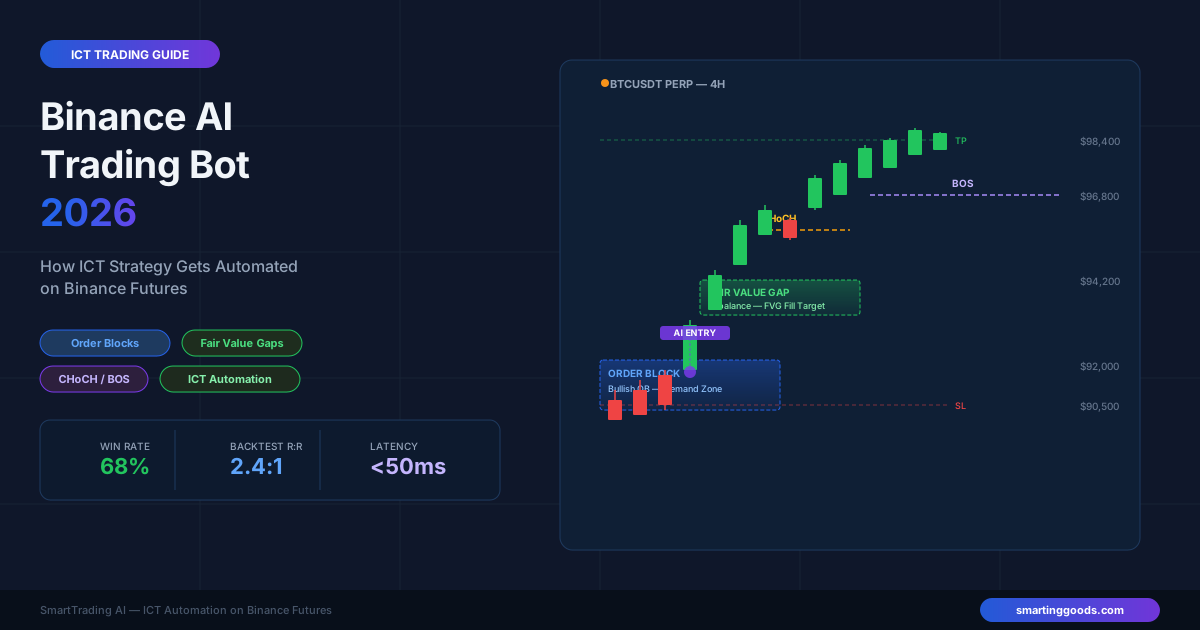
Binance AI Trading Bot 2026: How ICT Strategy Gets Automated on Futures
Manual ICT trading is one of the most sophisticated approaches to crypto — and one of the most exhausting. In 2026, AI trading bots built on Binance Futures can detect Order Blocks, Fair Value Gaps, CHoCH, and BOS in real time, placing precision limit orders automatically.
Binance AI Trading Bot 2026: How ICT Strategy Gets Automated on Futures
Manual ICT trading is precise, deliberate, and demanding. You need to identify the daily bias before the New York open, mark Order Blocks on the 15-minute, confirm a Fair Value Gap fill on the 1-minute entry, place the limit order exactly at the 70.5% OTE level, and manage the position through two take-profit targets — all while watching for a CHoCH that invalidates the whole setup.
That works. Traders who execute it well produce consistent results. The problem is not the methodology. The problem is that doing it at scale, across sessions, without emotional drift, is a full-time job.
In 2026, that is changing. AI trading bots on Binance Futures have matured to the point where ICT methodology — the specific, rule-based pattern recognition at its core — can be detected and executed programmatically. This post explains how that works, what to look for in a bot, and why most existing tools still get it wrong.
Why ICT Strategy Is Ideal for Automation
ICT methodology is built on repeating market structures. Smart money engineers price moves in predictable ways: liquidity is built up, swept, and then the real move begins. That cycle has distinct, measurable signatures.
Order Blocks are the last down-candle before a significant bullish move, or the last up-candle before a bearish drop. They represent the price level where institutional orders were placed. Price respects them because institutions return to those levels to fill remaining positions. An algorithm can scan every candle, calculate displacement from that level, confirm volume, and flag the block — faster and more consistently than any manual trader.
Fair Value Gaps are three-candle imbalances where price moved so aggressively that the middle candle left unfilled space between the wicks of candles one and three. FVGs act as magnets — price statistically returns to fill them before continuing. The detection logic is specific: compare the low of candle three to the high of candle one. If there is a gap, log it. If price returns into the gap, trigger the confirmation sequence.
Change of Character (CHoCH) and Break of Structure (BOS) define market direction. A CHoCH signals a potential trend reversal — a lower high in an uptrend, or a higher low in a downtrend. A BOS confirms the new direction. Together they provide the bias filter that prevents long entries in a downtrend and vice versa. An algorithm with access to swing high/low data from multiple timeframes can calculate this continuously without fatigue.
The key insight: ICT concepts are rule-based. They have specific geometric and positional definitions. That makes them automatable in a way that purely discretionary strategies are not.
What a Real Binance AI Trading Bot Does in 2026
The execution loop for a properly built Binance Futures AI bot operating on ICT methodology looks like this:
1. Multi-timeframe bias calculation. Every cycle, the bot evaluates the 4-hour and 1-hour charts to determine directional bias. Is price respecting a 4H Order Block? Has a CHoCH printed on the 1H? The bias gate prevents counter-trend entries before the session even begins.
2. ICT pattern detection. The bot scans in real time for qualifying Order Blocks, Fair Value Gaps, and OTE (Optimal Trade Entry) zones — typically the 61.8% to 78.6% Fibonacci retracement of the most recent impulse move. Each identified zone is scored for quality: how many confluences align, how recent the structure is, how strong the displacement was.
3. Confirmation gate. Finding a zone is not enough. The bot waits for confirmation — price returning into the zone, a rejection candle forming, momentum shifting. This is where ML confidence scoring matters. A raw pattern match has lower reliability than a pattern match plus candle confirmation plus volume divergence. The AI layer weights these signals and gates entries below a minimum confidence threshold.
4. Limit order placement. When confirmation fires, the bot places a limit order at the specific ICT entry level — not market, not stop-limit, but a precision limit inside the identified zone. Slippage on Binance Futures at the level of a correctly identified Order Block is typically less than 0.1%.
5. Dynamic SL/TP management. Stop-loss sits below the Order Block (for longs) or above it (for shorts) with a buffer calibrated to recent ATR. Take-profit targets are set at the nearest unswept liquidity pool for TP1, and the next significant structural level for TP2. As the trade develops, the bot monitors for invalidation signals — a CHoCH against the position, a competing displacement candle — and closes early if the thesis is violated.
What to Look For in a Binance Futures Bot
Most bots marketed as AI trading bots in 2026 are either signal resellers, RSI/MACD crossover systems wrapped in an AI label, or grid traders. None of these implement ICT methodology. Here is how to evaluate what you are actually looking at:
ICT-native pattern detection. Ask specifically: does the bot detect Order Blocks, Fair Value Gaps, and OTE zones? Can it show you the zones it identified on a chart? If the answer is vague or the bot relies on third-party signals, it is not implementing ICT.
Structural confirmation before entry. A bot that enters immediately on zone touch will have a lower win rate than one that waits for candle confirmation within the zone. CHoCH/BOS-aware bots can also filter out setups that appear against the higher-timeframe trend.
Binance Futures native integration. Perpetual futures on Binance have specific mechanics: funding rates, open interest, liquidation levels. A bot that ignores funding rate conditions when placing trades is leaving edge on the table and adding risk during squeeze conditions.
No signal subscription dependency. Bots that require you to subscribe to a separate signal service are not autonomous — they are execution wrappers. The intelligence should be inside the bot, not rented from a Telegram channel.
Risk management at the position level. Account-level stop-loss, max daily drawdown, and per-trade risk percentage controls are not optional. Any bot that lets you run without these is a liability.
How SmartTrading AI Works
SmartTrading AI is the bot we built at Smarting Goods, and it is the only Binance Futures bot built specifically around ICT methodology.
The system runs a continuous detection engine that identifies Order Blocks, Fair Value Gaps, OTE zones, CHoCH, and BOS across multiple timeframes. Before any entry, a multi-layer ML confidence gate evaluates pattern quality, timeframe alignment, market regime (trending vs. ranging vs. volatile), and real-time funding rate conditions. Entries below the minimum confidence threshold are rejected.
When an entry fires, limit orders are placed directly on Binance Futures with stop-loss anchored to structure and take-profit targeted at the nearest liquidity pool. Position management is active: if the market prints an invalidation signal before TP1, the trade is closed and the loss is taken cleanly.
The economic calendar integration blocks new entries during major USD news events (FOMC, CPI, NFP) — a decision every serious ICT trader makes manually, now automated.
Getting Started: Beta Access
SmartTrading AI is currently in closed beta. Beta members get direct access to the team, influence over the feature roadmap, and locked-in early-adopter pricing before the public launch.
If you trade ICT methodology on Binance Futures and you are tired of the execution overhead, join the waitlist at smartinggoods.com/trading.
Frequently Asked Questions
What exchanges does SmartTrading AI support?
Currently Binance Futures (USDT-margined perpetuals). Binance is the primary target because of its liquidity depth on BTC and ETH perpetuals, and its robust API for limit order management.
Does the bot work with small accounts?
Yes. Position sizing is percentage-based, so the risk per trade scales with account size. The minimum practical account size is around $500 to allow meaningful risk management across multiple positions.
How is this different from 3Commas or Cryptohopper?
3Commas and Cryptohopper are execution platforms for signals — they do not generate entries from ICT methodology. SmartTrading AI detects ICT patterns natively and makes entry decisions autonomously. See our full comparison here.
What kind of results should I expect?
We do not make return guarantees. In backtesting over 12 months of BTC/USDT data, the strategy produced a win rate above 60% with an average R:R around 2.4:1. Live trading involves slippage, funding rates, and market conditions that backtests do not fully capture. Trade with capital you can afford to risk.