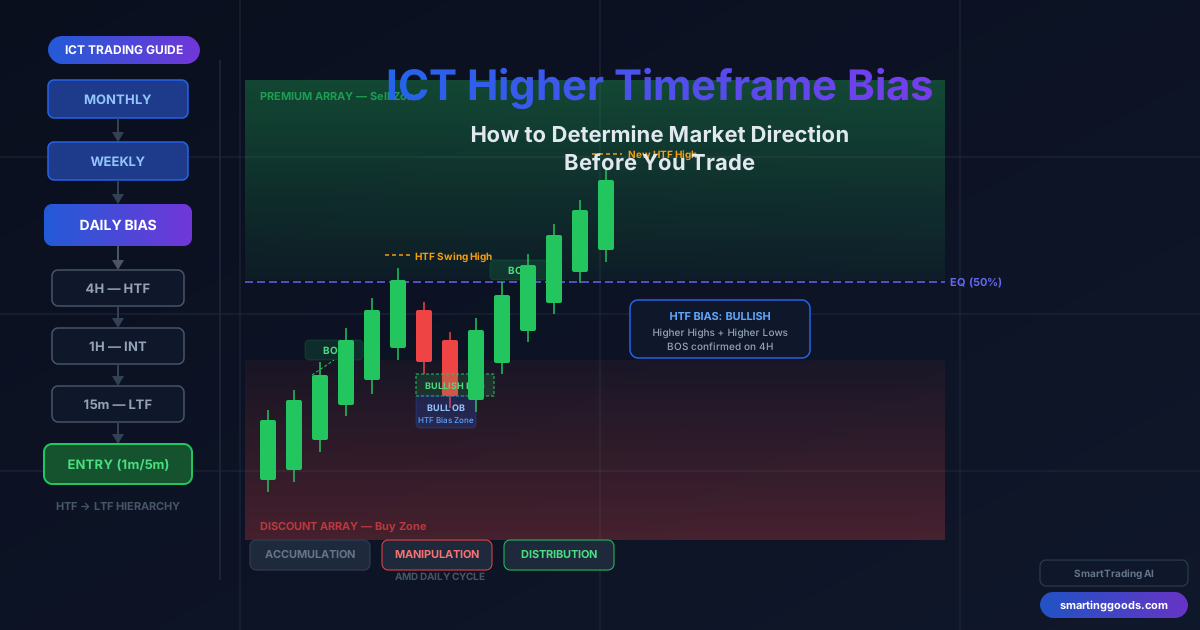
ICT Higher Timeframe Bias: How to Determine Market Direction Before You Trade
Trading against the higher timeframe bias is the #1 reason ICT traders lose money. Learn the exact top-down process — Monthly to Weekly to Daily to 4H — for determining HTF bias before every trade, and how SmartTrading AI automates it on Binance Futures.
ICT Higher Timeframe Bias: How to Determine Market Direction Before You Trade
If you have been losing trades using ICT methodology, there is a high probability you are entering without confirming your higher timeframe bias first. This is not a beginner mistake — it is the most common mistake made by intermediate ICT traders who already understand Order Blocks, Fair Value Gaps, and OTE entries. They execute at the right zone, with the right structure, and still get stopped out. The reason is almost always the same: they traded against the HTF bias without realizing it.
Higher timeframe bias is not optional in ICT. It is the filter that separates high-probability trades from coin flips. This guide covers the exact process ICT teaches for determining bias on monthly, weekly, and daily charts before dropping into a lower timeframe to execute.
What Is Higher Timeframe Bias in ICT?
Higher timeframe bias (HTF bias) is the directional lean of the market on a timeframe significantly above your entry timeframe. In ICT methodology, "higher" is always relative: if you enter on the 1-minute chart, your HTF is the 15-minute, 1-hour, and 4-hour. If you enter on the 15-minute, your HTF is the daily and weekly.
Bias is not just trend direction. It is the institutional narrative — which side of the market is smart money positioned on right now, and which direction are they likely to deliver price toward during today's session. ICT defines this through market structure: a market making higher highs and higher lows on the daily chart has a bullish HTF bias. A market making lower highs and lower lows has a bearish bias. The nuance comes in when the market is at an inflection point — transitioning from one bias to another after a Change of Character (CHoCH).
A confirmed HTF bias answers one question before you ever look at the 1-minute chart: Is smart money currently delivering price up or down?
The ICT Timeframe Hierarchy
ICT uses a top-down analysis approach with a specific hierarchy. Each timeframe provides context for the one below it:
- Monthly: Macro direction. Which direction is price traveling over the last 3–6 months? Is the overall range bullish or bearish?
- Weekly: Intermediate narrative. Where is the weekly candle closing relative to prior highs and lows? What premium/discount array is price reacting to?
- Daily: The primary HTF bias timeframe. This is where ICT's daily bias engine operates. What did price do during the prior day's session? Where is price likely to reach for today?
- 4-Hour: Confirmation of daily bias. The 4H structure should agree with the daily before you drop to a lower timeframe for entry.
- 1-Hour: Refinement. The 1H shows you the entry window — which kill zone presents the setup in alignment with the daily and 4H bias.
- 15-Minute / 5-Minute: Entry refinement. The ICT-model entry is triggered here — OTE, OB retest, or FVG fill — only when all higher timeframes agree.
- 1-Minute: Precision entry only. Never use the 1-minute to determine bias.
The cascade is non-negotiable. You read top-down, every time. If the daily is bearish but the 1-hour shows a bullish OB, that bullish OB is a counter-trend trap, not an entry.
How to Read HTF Bias Using Market Structure
ICT reads bias through three primary structural signals:
1. Break of Structure (BOS)
A BOS occurs when price takes out a prior significant high (bullish BOS) or prior significant low (bearish BOS) with a candle close beyond that level. On the daily chart, a bullish BOS confirms that price has broken above a prior daily high, indicating institutional buying pressure. This shifts or confirms a bullish HTF bias. The opposite is true for bearish BOS. BOS events on higher timeframes are the foundation of determining which direction smart money is currently pushing price.
2. Change of Character (CHoCH)
A CHoCH signals a potential shift in the existing bias. In a bullish market, a CHoCH occurs when price takes out a prior higher low — suggesting the bullish structure may be failing. In a bearish market, taking out a prior lower high signals a potential bullish reversal. CHoCH does not instantly flip your bias; it is a warning signal. You need to see a BOS in the new direction on the HTF before confirming the bias has changed.
3. Premium and Discount Arrays
ICT divides the range between a significant HTF swing high and swing low into premium (top 50%) and discount (bottom 50%). In a bullish bias, smart money buys in the discount zone — at or below the equilibrium (50% level), ideally at the 62–79% retracement level (the OTE zone). In a bearish bias, they sell in the premium zone. Your HTF bias tells you which arrays are relevant for the current session. If the daily is bullish and price is in discount, you look for long entries. If the daily is bullish but price is in premium, you wait — there is no high-probability long setup until price retraces.
The ICT Daily Bias Engine
ICT's daily bias process is a structured pre-market ritual that traders run before the New York session opens. The goal is to identify, before any trade is taken, what the likely direction of price delivery is for the current trading day. Here is the process:
- Identify the prior day's range. Mark the prior day's high, low, open, and close. Note which side of the prior day's range saw the most displacement — was there a bullish or bearish impulse candle?
- Check HTF order flow. On the weekly and daily charts, are we making higher highs and higher lows (bullish bias) or lower highs and lower lows (bearish bias)?
- Identify the draw on liquidity. Where is price most likely to reach for today? Is there a pool of buy-side liquidity (BSL) above — equal highs, prior swing highs — that price is likely to sweep before reversing? Or is there sell-side liquidity (SSL) below — swing lows, equal lows — that price will hunt?
- Align with the time of day. The daily bias is delivered during kill zones: the London open (2–5 AM EST) and the New York open (7–10 AM EST). During the Asian session, price often accumulates, setting up the next session's manipulation and distribution move.
- Confirm with the 4H. Before entering, verify that the 4H structure agrees. If the daily is bullish but the 4H just broke bearish structure, wait for the 4H to re-establish bullish order flow before trading long.
This process eliminates the impulse to trade every setup that appears on lower timeframes. Most ICT setups on the 1-minute and 5-minute charts are noise. The daily bias filter removes 60–70% of potential entries — and the entries that remain are substantially higher quality.
The AMD Cycle and Its Relationship to HTF Bias
The AMD cycle — Accumulation, Manipulation, Distribution — is ICT's model for how price moves within a single daily session. Understanding it in the context of HTF bias is critical:
- Accumulation: Smart money builds a position quietly. On the chart, this looks like a consolidation, often during the Asian session or the early hours of a session. Price moves sideways without clear direction.
- Manipulation: Price makes a false move against the HTF bias to sweep liquidity — buy-side for a bearish daily, sell-side for a bullish daily. This is the "stop hunt." Retail traders get triggered into the wrong direction or stopped out of correct positions. On a bullish daily bias day, the manipulation phase often looks like a brief dip below the prior session low before reversing sharply upward.
- Distribution: The real move. Price delivers in the direction of the HTF bias, often with significant speed and momentum. This is the phase you want to be positioned for before it begins.
When you know the HTF bias, you can anticipate the AMD cycle: the manipulation phase is not a reversal signal — it is a liquidity sweep creating the entry opportunity. Traders without HTF bias context see a bearish impulse during the manipulation phase and enter short, only to be caught in the distribution leg against them.
How SmartTrading AI Calculates HTF Bias Automatically
Manually running through the HTF bias process before every trade takes discipline and time. For traders who want to automate ICT methodology without compromising on the structural rigor it requires, SmartTrading AI's daily bias engine does this calculation automatically before every entry consideration on Binance Futures.
Here is what the system evaluates before placing any trade:
- 4H market structure: The bot reads Break of Structure and Change of Character events on the 4-hour chart, determining whether the current 4H order flow is bullish or bearish.
- 1H order flow confirmation: The 1H structure must align with the 4H before a trade signal is generated. If the 4H is bullish but the 1H just printed a bearish CHoCH, the system holds — it waits for the 1H to re-establish bullish structure or for the setup to invalidate.
- Premium/discount zone detection: The system identifies the current equilibrium between the most recent HTF swing high and swing low. It only considers long entries when price is at or below equilibrium on the 4H, and short entries when price is at or above equilibrium.
- AMD phase identification: Using time-of-day logic and price behavior during kill zones, the system identifies whether price is in the accumulation, manipulation, or distribution phase — and only executes during or just after the manipulation sweep, targeting the distribution leg.
- Regime gate: A hidden Markov model classifies the current market regime as trending, ranging, or volatile. Entries are only taken in trending regimes that align with the HTF bias — the system refuses to trade during ranging or high-volatility conditions that lack directional institutional commitment.
The result is a bot that does not trade against the 4H trend. Every limit order placed by SmartTrading AI is downstream of a confirmed HTF bias — the same analysis you would run manually, executed in milliseconds before every entry window.
If you have been manually running ICT methodology and want to stop second-guessing your bias reads, SmartTrading AI automates the entire HTF bias engine on BTC/USDT Perpetual Futures.
Common Mistakes: Trading Lower Timeframe Entries Against the 4H Trend
The single most costly mistake in ICT trading is taking a 1-minute or 5-minute entry that looks valid in isolation but is counter-trend on the 4-hour chart. Here is what this looks like in practice:
The 4H trend is bearish — lower highs, lower lows, bearish BOS confirmed. Price pulls back to a 4H discount zone and prints what looks like a bullish Order Block on the 1-hour chart. A trader without HTF context sees an OB retest, an FVG above, and a bullish CHoCH on the 15-minute. They enter long. The trade runs a few hundred dollars in profit, then reverses hard as the 4H bearish distribution leg resumes. Stopped out for a full loss.
Every element of that trade was technically correct on the lower timeframe. The setup was invalid because it traded against the institutional narrative on the 4H. ICT's framework is explicit: lower timeframe entries must be in the direction of the higher timeframe bias, always.
Related reading: AMD Framework ICT Trading: Accumulation, Manipulation, Distribution — understanding the full daily cycle context helps you avoid entering in the wrong AMD phase.
Frequently Asked Questions
Q: What timeframe should I use to determine my ICT HTF bias?
A: For most intraday traders, the daily and 4-hour charts are the primary HTF bias timeframes. The daily tells you the macro direction for the session; the 4H confirms that the intermediate structure agrees before you drop to the 1H for your entry window. The weekly chart adds additional context, especially around major premium/discount arrays.
Q: How do I know when my HTF bias has changed?
A: A bias change requires two confirmations on the HTF: first, a CHoCH (Change of Character) where price takes out a prior structural point in the new direction, followed by a BOS (Break of Structure) that confirms the new order flow. A CHoCH alone is a warning, not a confirmed flip. Wait for the BOS before trading the new bias.
Q: Can I trade against the HTF bias if the LTF setup is very strong?
A: ICT methodology does not recommend it. No matter how clean the lower timeframe setup appears, a counter-trend trade on the 4H carries significantly lower probability and a much higher risk of being caught in the distribution leg of the AMD cycle going against your position. If you have FOMO on a setup that is counter-trend, the correct answer is to wait for the next aligned setup.
Q: How does the daily bias relate to the AMD cycle?
A: They are the same concept at different resolutions. The AMD cycle describes how price accumulates, manipulates (sweeps liquidity), and distributes in the direction of the HTF bias within a single session. Knowing your daily bias tells you which direction the distribution leg will run — and that tells you which direction the manipulation sweep will come from before the real move starts.
Q: Does SmartTrading AI enforce HTF bias alignment before every trade?
A: Yes. SmartTrading AI's bias engine evaluates 4H and 1H market structure on every analysis cycle. It will not generate a buy signal if the 4H order flow is bearish, and it will not generate a sell signal if the 4H order flow is bullish. This structural filter is one of the primary mechanisms that distinguishes it from grid and DCA bots that trade without directional context.
Conclusion
Higher timeframe bias is the foundation that every other ICT concept rests on. Order Blocks, Fair Value Gaps, OTE entries, and kill zone timing are all tools for executing in the direction of the bias — not for finding trades independently. Without a confirmed HTF bias, you are not trading ICT methodology. You are trading random patterns that happen to use ICT terminology.
The process is: Monthly and Weekly for macro context → Daily for session bias → 4H for intermediate confirmation → 1H for entry window → 15m/5m/1m for precision entry. Every timeframe below must align with every timeframe above. Break that rule and you are gambling.
If you are ready to automate this entire process on Binance Futures — the daily bias engine, 4H structure reads, AMD phase detection, and precision OTE entry execution — SmartTrading AI is the only bot built specifically for ICT methodology. No indicators. No signals. Pure ICT logic, automated.