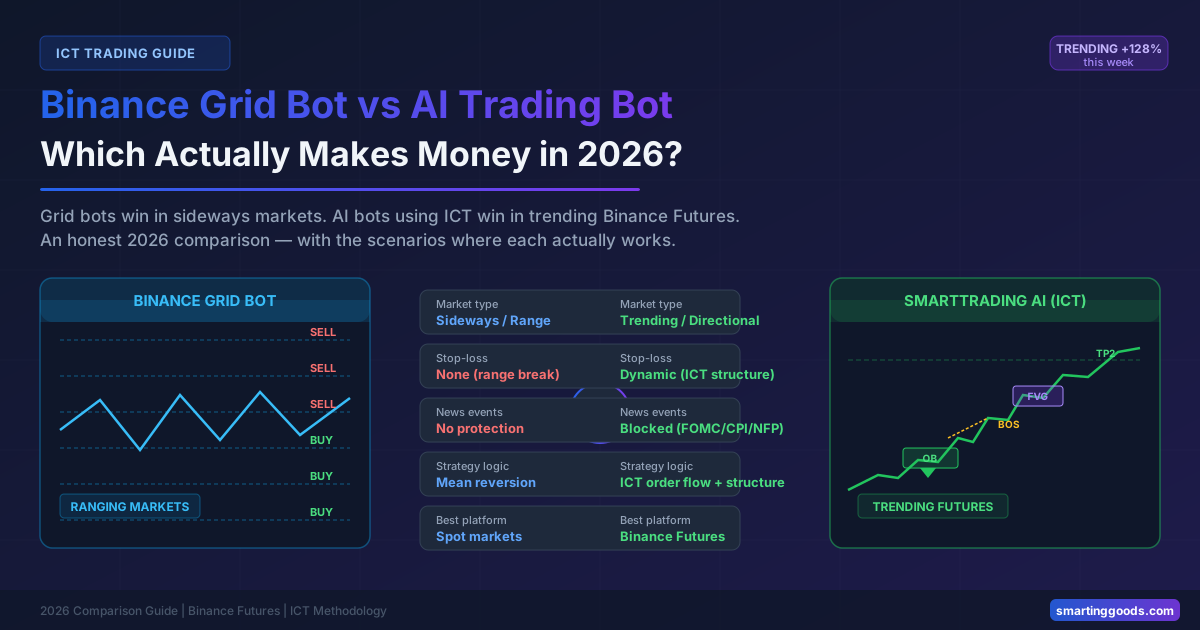
Binance Grid Bot vs AI Trading Bot: Which Actually Makes Money in 2026?
Grid bots work in sideways markets — but they bleed in trends. AI trading bots using ICT methodology detect market structure on Binance Futures and only trade in the trend's direction. Here's an honest head-to-head in 2026.
Binance Grid Bot vs AI Trading Bot: Which Actually Makes Money in 2026?
If you've ever set up a Binance grid bot and watched it churn through fees while BTC dumped 20% in a week, you already know the answer — but let's make it concrete. Grid bots and AI trading bots are built on fundamentally different assumptions about markets, and the wrong tool in the wrong market condition doesn't just underperform: it loses money systematically.
This is an honest comparison. Grid bots do have a legitimate use case. AI bots aren't magic. But after running both on Binance Futures in 2025–2026, the performance gap in trending conditions is wide enough to matter a lot to your P&L.
What Is a Binance Grid Bot and How Does It Work?
A grid bot divides a price range into evenly-spaced levels — the "grid" — and automatically places buy orders below the current price and sell orders above it. Every time price bounces between levels, the bot collects the spread as profit.
The built-in Binance grid trading bot lets you set:
- Upper and lower price bounds — the range the bot operates within
- Number of grid levels — more levels = smaller profits per trade, more trades
- Investment amount — capital split across the grid
- Spot or Futures mode — futures grids add leverage risk
The math works beautifully in a ranging market. If ETH oscillates between $3,200 and $3,600 for six weeks, a grid bot collects that spread on every up-and-down cycle, 24/7, without you touching anything.
The problem is what happens when price breaks the range and keeps going. The bot has accumulated a full position on one side of the grid — all buys when price fell — and then watches it fall further with no mechanism to exit. Grid bots have no stop-loss logic by default. They assume mean reversion. Markets don't always cooperate.
What Is an AI Trading Bot (ICT-Based)?
An AI trading bot built on ICT methodology works from a completely different starting point: market structure. Instead of assuming price will oscillate in a range, it reads where institutional money is positioned — and trades in that direction.
Specifically, an ICT-based AI bot like SmartTrading AI looks for:
- Order Blocks (OBs) — the last opposing candle before a significant impulse move, where institutions entered
- Fair Value Gaps (FVGs) — imbalances in price delivery that act as magnets for price to revisit
- Change of Character (CHoCH) and Break of Structure (BOS) — signals that the higher timeframe trend has shifted or confirmed
- Liquidity sweeps — engineered stop hunts above/below obvious swing highs/lows that precede real moves
The bot only enters trades when multiple ICT confluences align in the direction of the higher timeframe trend. Entries use limit orders at precision levels — not market orders that eat slippage. And it blocks entries entirely during major USD news events: FOMC, CPI, NFP, PPI — the macro events that invalidate technical structure temporarily.
Where a grid bot is market-neutral by design, an AI bot is directional by design. That's the core difference.
Head-to-Head Comparison: Binance Grid Bot vs AI Trading Bot
| Factor | Binance Grid Bot | AI Trading Bot (ICT-Based) |
|---|---|---|
| Market type it works in | Ranging / sideways | Trending (bull or bear) |
| Market type it loses in | Strong trends (directional breakdown) | Choppy, news-driven chop |
| Strategy logic | Mean reversion — buy low, sell high in a fixed range | Momentum + structure — trade with institutional order flow |
| Entry type | Limit orders at fixed grid levels | Limit orders at ICT precision zones (OB, FVG, OTE) |
| Stop-loss | None by default (range break = open loss) | Dynamic SL below/above key structure |
| Take profit | Fixed grid spread | Scaled — TP1 at opposing FVG/OB, TP2 at liquidity pool |
| Works on spot? | Yes — designed for spot | Optimized for Binance Futures (directional leverage) |
| Works on futures? | Technically yes — but trend risk is amplified by leverage | Yes — primary use case |
| News event handling | None — keeps trading through volatility spikes | Blocks entries 15 min before / 30 min after FOMC, CPI, NFP |
| Setup complexity | Low — set range, levels, capital, start | Medium — configure timeframe, risk per trade, connect Binance API |
| Best for | Passive income in stable, range-bound alt markets | Traders who understand ICT and want automation |
When the Binance Grid Bot Actually Wins
Grid bots are not broken — they're just misapplied in trending conditions. Here's where they genuinely outperform:
Ranging Spot Markets
If you're holding a mid-cap alt that's been consolidating in a 15% range for two months, a grid bot generates consistent yield on that sideways price action without you lifting a finger. Think ETH between $3,100–$3,600 during a low-volatility consolidation phase. The bot collects spread on every bounce, you accumulate more ETH, and your cost basis drops.
Stablecoin Arbitrage
USDT/USDC/BUSD pairs or stable-adjacent pairs (USDT/DAI) are natural grid bot territory. Extremely tight range, near-zero trend risk, compound yield from tight spreads. Not exciting, but reliable.
DCA Augmentation
Some traders use a wide grid bot as a systematic DCA engine — lower grid levels buy more BTC as price dips. If you're a long-term holder who doesn't care about short-term directional swings, a grid bot automates your accumulation strategy without requiring constant monitoring.
The honest caveat: if you run a Binance grid bot on Futures with 5-10x leverage during a trend, the accumulated loss on the wrong side of the grid gets amplified by the same leverage that was supposed to boost your profits. This is where most grid bot horror stories come from.
When the AI Trading Bot Wins — and Why It's Not Close on Futures
2024 and 2025 demonstrated exactly what happens to grid bots in trending crypto markets: BTC went from $40K to $108K in two legs, with multiple 20-30% corrections in between. A grid bot set for sideways got demolished in each leg. An ICT-based bot reading market structure caught both the bullish continuation setups and the corrective short trades.
Trending Markets on Futures
This is the AI bot's native habitat. When the 4H chart has made a clean BOS above a major swing high, and price is pulling back into a bullish Order Block with a Fair Value Gap sitting inside it — that's a high-probability long setup. An ICT bot identifies that in real-time, places a limit order at the OB, sets a stop below the structure, and targets the next liquidity pool above. The grid bot, meanwhile, is selling into the very pullback that's setting up the next leg higher.
High-Impact News Events
Grid bots keep running through CPI prints and FOMC announcements. A 200-pip wick on a news spike can sweep an entire grid's buy side, fill all your orders at the bottom, then reverse back up — leaving you holding max bags at the worst price with no profit mechanism until price recovers. SmartTrading AI's news blackout window (15 min before, 30 min after major USD events) avoids this entirely.
Capital Efficiency
A grid bot ties up capital across every grid level simultaneously. An AI bot deploys capital only when a high-confidence ICT setup fires — the rest sits as margin buffer. On Binance Futures with responsible leverage, a properly structured AI bot can generate more absolute profit with less capital exposed at any given moment.
Does the Binance Grid Bot Actually Work in 2026?
Short answer: yes, in the right conditions. It works exactly as described — it generates consistent small profits in ranging markets. The question is whether those conditions exist often enough in crypto to justify the exposure during the trend phases that inevitably come.
Crypto is not the forex or index futures market where a 2-5% daily range is the norm and genuinely tight consolidations last for months. BTC and major alts regularly deliver 15-40% directional moves with limited warning. In that environment, a market-neutral tool is fighting the nature of the asset class.
The traders who use grid bots successfully in 2026 are typically:
- Running them on spot only (not futures), accepting they're an accumulation tool rather than a profit engine
- Setting very wide ranges to survive large moves without getting fully stuck
- Running them on stable/stable or stable/BTC pairs where the range risk is minimal
- Treating the yield as a bonus on holdings they planned to keep regardless
If you're hoping a Binance grid bot running on BTCUSDT Perpetual Futures at 5x leverage will replace active trading income, the math doesn't support it — and the risk profile is significantly worse than it appears on the setup screen.
Frequently Asked Questions
Is the Binance grid bot profitable in 2026?
In ranging, low-volatility conditions on spot pairs — yes, consistently. In trending markets or on Futures with leverage — it's a systematic loser because losses from the trending side compound while grid profits stay small. Profitability depends almost entirely on market conditions, not bot quality.
What's the difference between a grid bot and an AI trading bot?
A grid bot is market-neutral: it profits from price oscillating within a fixed range and has no trend-detection capability. An AI trading bot reads market structure — trend direction, Order Blocks, Fair Value Gaps — and only places directional trades when a high-probability setup is confirmed. They solve different problems.
Can I run a Binance grid bot on Futures safely?
With caution and tight risk management: set the grid range very wide (wider than any realistic consolidation), use low leverage (2-3x max), and set a hard stop for the whole bot if price breaks your outer bounds by more than X%. Many traders run into trouble by under-sizing the range or over-leveraging in expectation of the range holding. Futures grid bots require active monitoring — they're not truly passive.
Does SmartTrading AI work on Binance Futures specifically?
Yes — SmartTrading AI is built exclusively for Binance Futures and trades BTCUSDT Perpetual by default. It connects via your Binance API key, runs ICT analysis on the 15M/1H/4H timeframes, and places limit orders at identified Order Blocks and Fair Value Gaps. Entries only fire when the higher timeframe structure aligns with the trade direction.
Which bot is better for a beginner?
The Binance grid bot is simpler to set up — it requires no understanding of market structure, just a price range and an investment amount. The AI bot requires basic familiarity with ICT concepts (Order Blocks, FVGs, market structure) to understand what it's doing and why. If you're brand new to trading, start with a grid bot on a stable pair to learn the mechanics, then graduate to an AI bot once you understand directional market analysis.
Which One Should You Run in 2026?
If you're trading ranging spot markets with a "set and forget" mentality and you're happy accumulating yield on crypto you'd hold anyway — the Binance grid bot is a legitimate tool. Run it on spot, keep leverage out of the equation, and don't expect it to outperform in the next BTC bull leg.
If you're trading Binance Futures with real capital and you want your bot to actually read the market — understand where price is going before it places orders — an ICT-based AI bot is a fundamentally different class of tool. It won't take every trade. It won't run 24/7. But when it trades, it's trading with the structure, not against it.
SmartTrading AI is currently in closed beta. It automates the full ICT methodology on Binance Futures: Order Block detection, FVG entries, CHoCH/BOS confirmation, smart money liquidity analysis, and news event blackouts — with ML confidence gates that filter low-quality setups before they hit your account.
Join the waitlist at /trading — beta spots are limited and onboard in order of signup.
Start AI Trading
See how our ICT bot automates Binance Futures trading.
Start AI Trading