Does Binance Have Trading Bots? (2026 Complete Answer)
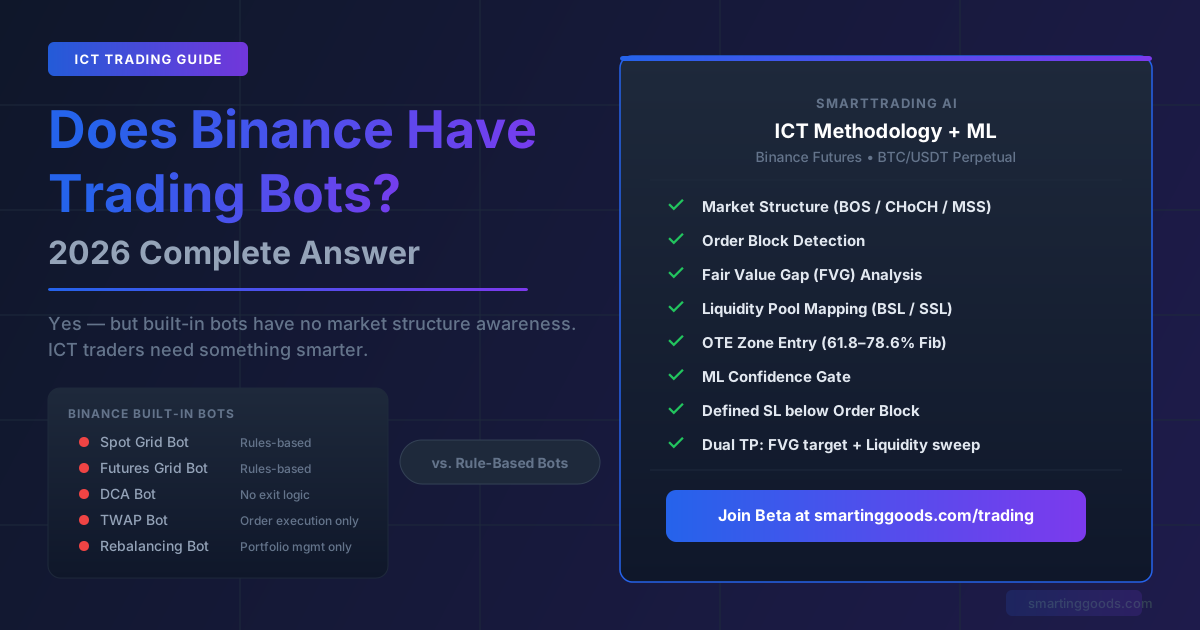
Binance has five built-in trading bots — Spot Grid, Futures Grid, DCA, TWAP, and Rebalancing. But they're rule-based with no market structure analysis. Here's the full breakdown, plus why serious ICT traders choose third-party bots like SmartTrading AI.
Does Binance Have Trading Bots? (2026 Complete Answer)
Yes — Binance has built-in trading bots. But if you're asking because you actually want to automate a serious trading strategy, the more important question is: are Binance's native bots good enough? For most disciplined traders, the answer is no. Here's the full picture.
Binance's Built-In Trading Bots: What They Are
Binance launched its native bot suite in 2021 and has since expanded it to five main bot types, available directly from the Binance dashboard — no API keys, no third-party account required.
1. Spot Grid Bot
Places buy and sell limit orders at fixed price intervals within a defined range. Profits from price oscillation inside the grid. Best suited for ranging, sideways markets. If price breaks out of the grid range, the bot stops working until you reset it.
2. Futures Grid Bot
Same grid logic applied to Binance Futures. Supports leverage, which amplifies both gains and losses. Has a long/short/neutral mode. Still entirely rules-based — it has no awareness of trend direction, market structure, or whether the current moment is even appropriate for a grid strategy.
3. DCA Bot (Dollar-Cost Averaging)
Buys a fixed dollar amount of an asset at scheduled intervals, regardless of price. Reduces timing risk over long periods. Not a trading strategy — it's an accumulation strategy. Offers no exit logic beyond a target take-profit percentage.
4. TWAP Bot (Time-Weighted Average Price)
Splits a large order into equal slices and executes them at fixed time intervals. Designed to reduce market impact when entering or exiting a large position. Used by institutions to avoid moving the market with a single order. Not useful for retail active trading.
5. Rebalancing Bot
Maintains a fixed percentage allocation across a portfolio of assets. When one asset drifts above its target weight, the bot sells some; when it drifts below, it buys. A portfolio management tool, not a trading strategy.
The Fundamental Limitations of Binance's Native Bots
Binance's bots are rules-based. They execute mechanical logic: if price hits X, do Y. They have no model of why price is moving, no understanding of market structure, and no ability to distinguish a valid setup from a low-probability trap.
Here's what none of Binance's built-in bots can do:
- Read market structure. No concept of Break of Structure (BOS), Change of Character (CHoCH), or Market Structure Shift (MSS) — the foundational signals that tell you whether price is trending or reversing.
- Identify institutional order flow. No Order Block detection, no Fair Value Gap analysis, no liquidity pool mapping. These are the zones where Smart Money actually enters — and without them, your entries are essentially random.
- Adapt to regime. Grid bots work in ranging markets and lose in trending ones. Binance's bots have no volatility regime detection. They will grind losses in a trend just as confidently as they profit in chop.
- Apply ML confidence gating. No machine learning layer that evaluates whether a setup meets a minimum probability threshold before committing capital.
- Trade ICT methodology. Inner Circle Trader concepts — OTE zones, AMD (Accumulation/Manipulation/Distribution) cycles, Optimal Trade Entry — are not implemented anywhere in Binance's native tools.
For casual, set-it-and-forget-it investors, the native bots are fine. For traders who study price action, who know what an order block is, who track liquidity sweeps — Binance's bots are essentially useless as a trading tool.
Third-Party Binance Bots: What the Market Offers
Third-party bots connect to Binance via API keys (read/trade permissions, never withdrawal). The main players in 2026:
3Commas
The largest third-party bot platform by user count. Offers DCA bots, grid bots, and signal-based bots. Supports TradingView webhooks for strategy-triggered entries. Strong on portfolio management. Weakness: the underlying strategies are still rule-based. No market structure awareness. The "signals" come from third-party providers of varying quality.
Cryptohopper
Cloud-based bot with a marketplace for buying strategies. Visual strategy builder, backtesting tools, and paper trading mode. Broad exchange support. Similar limitation: strategy quality depends entirely on whatever indicator logic you or a marketplace seller configured. No institutional-grade analysis under the hood.
SmartTrading AI
Built specifically for traders who use ICT methodology and Smart Money Concepts — and who want to automate it without writing a single line of code. This is a different category entirely from grid bots and DCA tools.
How SmartTrading AI Connects to Binance Futures
SmartTrading AI connects to your Binance Futures account via read + trade API keys (withdrawal permission is never required or requested). Once connected, it runs a continuous analysis loop on BTC/USDT perpetual futures and executes entries when a high-confidence ICT setup forms.
Under the hood, it's doing what a disciplined ICT trader does manually — but in real time, on every 15-minute, 1-hour, and 4-hour candle:
- Market Structure Analysis: Detects BOS, CHoCH, and MSS to determine the current directional bias on the higher timeframe. No trade is taken against the prevailing structure.
- Order Block Identification: Maps bearish and bullish order blocks — the last down-candle before an up-move and vice versa. These are the zones where institutional orders are stacked, and where price tends to react.
- Fair Value Gap Detection: Identifies imbalances (gaps between candle wicks) that price tends to return to fill. Used as both entry zones and targets.
- Liquidity Pool Mapping: Locates buy-side liquidity (BSL) and sell-side liquidity (SSL) — equal highs, equal lows, old swing points. Understands that price is drawn to these pools before making its real move.
- OTE Zone Calculation: Calculates the Optimal Trade Entry zone (61.8–78.6% Fibonacci retracement) of the most recent impulse move. Entries inside the OTE on a return to an order block are the highest-probability setups in ICT methodology.
- ML Confidence Gate: A machine learning model evaluates each setup before execution. If the composite confidence score doesn't clear the threshold, the bot stays flat. This is what separates it from every rule-based bot on the market — it can say "not yet."
The result is a bot that doesn't trade constantly. It waits for the setup. When everything aligns — structure, zone, OTE, ML confidence — it enters with a defined stop loss (below the order block) and two take-profit levels (TP1 at the nearest FVG or opposing structure, TP2 at the liquidity pool beyond).
If you're serious about automating an ICT-based strategy on Binance Futures, SmartTrading AI is now in beta — join the waitlist here.
How to Connect a Third-Party Bot to Binance (General Steps)
Regardless of which third-party bot you choose, the connection process is the same:
- Create an API key in Binance. Go to your Binance account → API Management → Create API. Give it a label (e.g., "SmartTrading Bot").
- Set permissions. Enable "Enable Reading" and "Enable Futures" (or Spot, depending on your bot). Never enable "Enable Withdrawals." A legitimate bot does not need withdrawal access.
- Restrict by IP (recommended). Binance lets you whitelist specific IP addresses. If your bot runs on a cloud server with a fixed IP, add it here. This prevents your API key from being used from any other location even if stolen.
- Copy the API Key and Secret. The Secret is shown only once — copy it immediately and store it securely.
- Paste into your bot platform. The third-party platform stores this server-side (encrypted) and uses it to place orders on your behalf.
Is It Safe to Use Third-Party Bots on Binance?
The safety question has two dimensions: exchange-level risk and platform-level risk.
Exchange-level: Binance explicitly supports API-based third-party bots. Using them does not violate any terms of service. The API key permission model is designed for this use case.
Platform-level: This is where you need to be careful. Evaluate any third-party bot on these criteria:
- Does it request withdrawal permissions? (It should not. Walk away if it does.)
- Is the team identifiable? Is there a real company behind it?
- Is your API key stored encrypted, or are you asked to paste it into a browser form that you can't audit?
- Does the platform have a track record, or is it a six-month-old project with no audit history?
SmartTrading AI operates on read + trade permissions only, stores API keys encrypted at rest, and never touches your withdrawal functionality. The bot is auditable — you can see every order it places directly in your Binance order history.
Frequently Asked Questions
Does Binance have a trading bot built in?
Yes. Binance offers five native bots: Spot Grid, Futures Grid, DCA, TWAP, and Rebalancing. All are accessible directly from the Binance app or website with no setup beyond configuring the parameters. None of them use AI or market structure analysis.
Can I use a trading bot on Binance Futures?
Yes — both Binance's own Futures Grid bot and third-party bots like SmartTrading AI support Binance Futures. Third-party bots connect via API keys with futures trading permission enabled.
What is the best trading bot for Binance in 2026?
It depends on your strategy. For simple grid or DCA strategies, Binance's native bots are free and sufficient. For traders who use ICT methodology, Smart Money Concepts, or want ML-powered entry logic, SmartTrading AI is the only bot built around these concepts.
Is Binance bot trading profitable?
Grid bots can be profitable in ranging markets and lose money in strong trends. Profitability depends entirely on market conditions and your parameter choices — not on any intelligence in the bot itself. Third-party bots with adaptive strategies can perform better across different market regimes, but results depend on the quality of the underlying strategy.
How do I start using SmartTrading AI on Binance Futures?
Create your API key on Binance with read and futures trading permissions, then connect it to your SmartTrading AI account. The bot handles the rest — structure analysis, entry detection, order placement, and position management. Join the beta here to get started.
Bottom Line
Binance does have trading bots, and they're a legitimate starting point for new traders who want simple automation. But they are mechanical tools with no market intelligence. They don't know what an order block is. They don't care about market structure. They can't distinguish a high-probability ICT setup from random noise.
If you've put in the work to learn ICT methodology — if you know how to read a BOS, identify a fair value gap, and locate the OTE zone — you don't want a grid bot. You want a bot that trades the way you trade, with the same discipline and structure-awareness, running 24/7 without you sitting at a screen.
That's what SmartTrading AI is built for. Join the beta and connect your Binance Futures account today.