Candle Range Theory (CRT): The ICT Concept Most Traders Miss
Candle Range Theory (CRT) is one of ICT's most powerful — and most overlooked — concepts. Learn how price sweeps candle highs and lows to grab liquidity before reversing, and how to trade CRT setups with precision using FVG and Order Block confluence.
Candle Range Theory (CRT): The ICT Concept Most Traders Miss
Most traders who study ICT methodology can identify an Order Block or a Fair Value Gap. Far fewer understand Candle Range Theory (CRT) — and that gap is exactly where the edge lives. CRT explains a specific type of engineered liquidity sweep that plays out inside a single higher-timeframe candle. Once you see it, you cannot unsee it. And once you trade it, you will stop being the liquidity that gets taken.
This guide is for traders who already know the ICT basics. We are going deeper.
What Is Candle Range Theory (CRT) in ICT?
Candle Range Theory is an ICT concept that describes how price manipulates the high and/or low of a specific higher-timeframe (HTF) candle before reversing in the opposite direction. The theory holds that institutional order flow uses the extremes of a candle's range as liquidity targets — sweeping those levels to trigger retail stop orders, grab resting buy-stops or sell-stops, and then distribute into the resulting imbalance.
In plain terms: the high and low of a meaningful candle (typically a 1H or 4H candle) act as liquidity pools. Price will often break above the high or below the low — appearing to confirm a breakout — then snap back and run in the true direction. That false move is not random. It is deliberate, measurable, and repeatable.
CRT sits within the broader ICT framework of accumulation → manipulation → distribution, but it gives that framework a precise, candle-level context that makes setups far easier to identify and time.
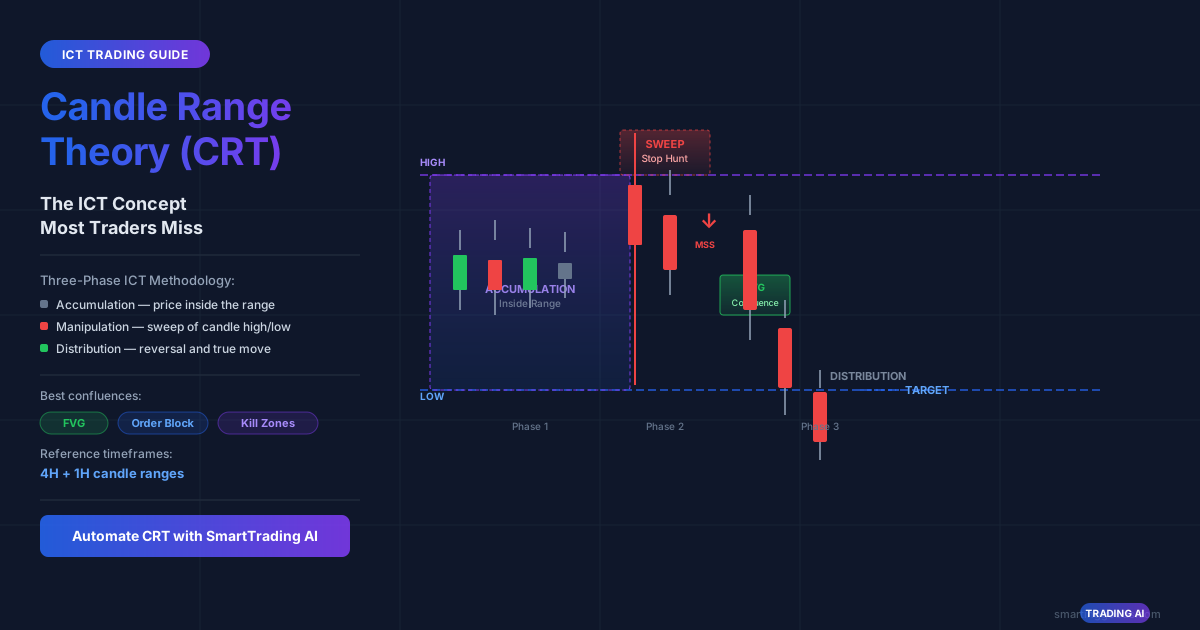
The Three Phases of a CRT Setup
Every CRT setup moves through three distinct phases. Understanding each one is what separates traders who profit from CRT from those who get caught on the wrong side of the sweep.
Phase 1 — Accumulation (Inside the Range)
Price consolidates within the body and wick range of the reference candle. Volume is relatively low. The market is in equilibrium. Retail traders see a range and either fade it or wait for a breakout. This is the setup phase where smart money is quietly building a position or preparing to execute an engineered move.
Phase 2 — Manipulation (The Sweep)
Price breaks above the candle's high or below its low — often aggressively, convincingly, even closing a lower-timeframe candle beyond the level. This is the engineered stop hunt. Retail buy-stops sitting above the high or sell-stops sitting below the low get triggered. Breakout traders enter in the direction of the sweep. Liquidity is delivered to the institutional side that needs it.
Key tell: the sweep is usually sharp and short-lived. There is no follow-through. Price does not accelerate — it stalls or immediately rejects. This is the fingerprint of a CRT manipulation phase.
Phase 3 — Distribution (The Reversal)
After grabbing the liquidity above or below the reference candle's range, price reverses and moves in the opposite direction — usually with strong displacement and conviction. This is the true move. Traders who identified the CRT setup are now entering on the reversal while the retail crowd who chased the breakout scrambles to cut losses.
The distribution phase often produces a significant move, frequently targeting the opposite side of the reference candle's range or beyond, and commonly leaving a Fair Value Gap or breaching an Order Block on the lower timeframe during the reversal displacement.
How to Identify CRT Setups on the Chart
CRT identification is a multi-step process. Here is the exact sequence:
- Select the reference candle. Start on the 1H or 4H chart. Look for a candle whose high or low aligns with a significant level — a prior liquidity pool, a consolidation high/low, or the boundary of a larger dealing range. Candles adjacent to HTF Order Blocks or near session highs/lows (London open, New York open) work best.
- Mark the reference candle's high and low. These are your liquidity targets. Price needs to reach one of these levels for a CRT sweep to trigger.
- Drop to a lower timeframe (15M or 5M). This is where you will watch the sweep and reversal unfold in real time. The HTF candle that looks like a single bar is actually dozens of lower-timeframe candles playing out the three phases.
- Identify the sweep. Watch for price to exceed the reference candle's high or low. On the lower timeframe, this often looks like a wick, a brief close beyond the level, or a rapid spike.
- Confirm the rejection. Look for immediate price action reversal — a strong bearish or bullish candle closing back inside the reference candle's range. A Market Structure Shift (MSS) on the lower timeframe during this reversal is a high-confidence signal.
- Enter on the confirmation. The entry comes after the sweep and MSS, not during the sweep. Entering during the sweep is still being the liquidity.
Best Timeframes for CRT
CRT is a multi-timeframe concept. The reference candle lives on the higher timeframe; the entry is executed on the lower timeframe.
- 4H reference candle + 15M entry — Best for swing setups and overnight positions. The 4H range is large enough to produce meaningful sweeps and clear reversals.
- 1H reference candle + 5M entry — Best for intraday setups, particularly during the New York open or London session. The 1H CRT aligned with a kill zone is one of the highest-probability setups in the ICT playbook.
- Daily reference candle + 1H entry — Used for larger swing trades. The daily candle's high or low becomes a multi-day liquidity target. This requires patience but produces the cleanest setups.
The 15M and 5M are execution timeframes only. Never use the 1M for CRT entry — the noise overwhelms the signal and you will get chopped out before the reversal materializes.
CRT + Fair Value Gap Confluence
The most powerful CRT setups combine with a Fair Value Gap (FVG) created during the manipulation or distribution phase. Here is how the confluence works:
When price sweeps the reference candle's high and then reverses with displacement, that displacement displacement candle almost always leaves an FVG on the lower timeframe. This FVG is fresh, created in the direction of the true move, and typically unmitigated. It acts as both a magnet for price (price returns to fill it) and a secondary entry point for traders who missed the initial reversal.
The trading approach: after confirming the CRT reversal, mark the FVG left by the displacement candle. If price pulls back into that FVG rather than running immediately, that pullback entry offers a better risk-to-reward ratio than chasing the initial reversal close. Your stop sits above the FVG (for shorts) or below it (for longs), and your target is the opposite extreme of the reference candle or the next liquidity pool beyond it.
CRT + Bearish FVG (short setup) or CRT + Bullish FVG (long setup) is the combination that produces sub-1% risk entries on multi-percent moves. This is what ICT traders mean when they talk about asymmetric setups.
CRT + Order Block Confluence
When the CRT sweep occurs at or near an Order Block, the reliability of the reversal increases significantly. The logic is layered:
- The OB provides the institutional price level where the original imbalance was created.
- The CRT sweep grabs the liquidity resting above or below that OB.
- The reversal back into and through the OB confirms that the OB is still valid and that the liquidity grab was the engineered entry for the next leg.
On the lower timeframe, this often looks like: price wicks above a bearish OB (grabbing buy-stops), then closes back below with a strong bearish candle. That close back below the OB body, combined with the CRT sweep of the reference candle's high, is a two-layer confluence entry. Stop above the OB wick. Target the next significant SSL pool or demand zone below.
Common Mistakes Traders Make With CRT
CRT trips up a lot of traders, even experienced ones. These are the mistakes that cost the most:
- Entering during the sweep. The manipulation phase is designed to look like a breakout. Entering with the sweep puts you on the wrong side. Wait for the reversal confirmation — an MSS or a strong displacement candle closing back inside the reference range.
- Using the wrong reference candle. Not every candle on a 1H chart produces a CRT setup. The reference candle needs to sit at a meaningful liquidity level. Random candles in the middle of a range produce random results.
- Ignoring higher-timeframe bias. CRT setups that go with the HTF trend have much higher win rates than counter-trend CRT. A bearish CRT (sweep of the high, then short) taken in a daily downtrend is far more reliable than the same setup against a bullish daily trend.
- Holding through the distribution phase without a defined target. CRT is a liquidity-to-liquidity trade. Define your target before entering — the opposite extreme of the reference candle, the next unswept pool, or the nearest FVG on the HTF. Running trades without a target turns a high-probability setup into a guessing game.
- Overusing CRT on low-timeframe candles. CRT loses effectiveness below the 1H reference candle in most market conditions. The noise-to-signal ratio on the 15M or lower as a reference timeframe is too high for consistent application.
How SmartTrading AI Incorporates CRT Pattern Detection
Understanding CRT manually is one thing. Monitoring it across multiple timeframes and symbols simultaneously — without missing a setup — is another problem entirely. This is exactly what SmartTrading AI was built to solve.
The platform's ICT detection engine continuously analyzes 1H and 4H candle ranges across BTC/USDT Futures on Binance. When a reference candle's high or low is approached, the system flags the level as a live CRT watch zone. If price sweeps the level and a Market Structure Shift is confirmed on the lower timeframe within the same candle period, the engine generates a CRT signal — complete with the sweep level, the MSS price, the nearest FVG confluence zone, and a suggested entry range.
The signal is filtered through a composite confidence gate that checks HTF trend alignment, regime classification (trending vs. ranging), and economic calendar blackout windows (no new entries 15 minutes before high-impact USD events). Only setups that score above the confidence threshold reach the execution layer.
The result: you get the CRT setups that meet ICT criteria, surfaced in real time, without having to stare at four charts across two timeframes simultaneously. The bot does not replace understanding — you still need to know what CRT is to validate and manage the trade. But it removes the surveillance burden that causes traders to miss setups or act too late.
See how SmartTrading AI detects CRT and other ICT setups in real time.
Frequently Asked Questions
What is Candle Range Theory (CRT) in ICT?
Candle Range Theory is an ICT concept explaining how price manipulates the high or low of a specific higher-timeframe candle to grab resting liquidity (stop orders) before reversing in the opposite direction. It follows a three-phase structure: accumulation inside the range, manipulation via a sweep of the candle's extreme, and distribution as price runs in the true direction.
What timeframes work best for CRT setups?
The most reliable CRT setups use a 4H candle as the reference and the 15M as the entry timeframe, or a 1H candle as the reference with a 5M entry. Daily CRT setups exist but require more patience. Avoid using candles below 1H as the reference timeframe — the signal quality drops significantly.
How is CRT different from a regular stop hunt?
All CRT setups are stop hunts, but not all stop hunts are CRT. CRT is specifically framed around the high and low of a defined HTF candle. The candle's range provides the structural context — accumulation inside, sweep of the candle's extreme, reversal back through the range. A generic stop hunt lacks this candle-level framework and is harder to define and plan around in advance.
Can CRT be combined with other ICT concepts?
Yes — CRT is most powerful when combined with other ICT tools. The highest-probability combinations are CRT + Fair Value Gap (FVG created by the reversal displacement), CRT + Order Block (sweep occurs at or inside an OB), and CRT + Kill Zone timing (New York open or London open CRT setups have strong institutional alignment). Using CRT in isolation, without HTF bias and confluence, reduces its reliability considerably.
Does SmartTrading AI trade CRT setups automatically?
SmartTrading AI detects CRT patterns as part of its ICT analysis engine and generates signals when setups meet the confidence threshold. The platform is currently in closed beta on Binance Futures (BTCUSDT). CRT signals are one component of the composite signal stack, alongside Order Block, FVG, OTE zone, and liquidity pool analysis. You can join the waitlist at /trading to get early access.
Start Trading CRT Setups With Automation
Candle Range Theory is not a beginner concept — but it is not as complex as it first appears. The core logic is consistent: price targets the extremes of a meaningful candle range to grab liquidity, then reverses. The three phases are always present. The entry comes after the sweep, not during it. And the best setups have FVG or OB confluence confirming the reversal.
If you are already trading ICT and want to add CRT to your methodology, start by marking every 1H and 4H candle's high and low during active sessions. Watch for sweeps. Watch for what comes after the sweep. You will start seeing the pattern within days.
If you want the detection automated so you never miss a CRT setup during the New York open again, SmartTrading AI runs the ICT analysis engine 24/7 on Binance Futures — including CRT pattern detection, FVG confluence scoring, and composite signal generation with ML-powered confidence gates.