Binance Futures Trading Bot: Complete Setup Guide for 2026
Running a trading bot on Binance Futures is not the same as running one on spot markets. This guide covers API setup, risk management, funding rate awareness, and how SmartTrading AI automates ICT methodology on USDT-margined perpetuals.
Binance Futures Trading Bot: Complete Setup Guide for 2026
Running a trading bot on Binance Futures is not the same as running one on spot markets. The leverage, liquidation risk, and funding rate mechanics change everything, and most bots are not built to handle them. This guide covers what to look for in a Binance futures trading bot, how to set up API keys correctly, how to manage risk, and why most bots blow up on futures while a structure-aware bot survives.
The short answer: SmartTrading AI is the only bot built specifically for ICT methodology on Binance USDT-margined perpetuals. But let us earn that claim by giving you the full picture first.
Binance Futures vs Spot: Why Bots Behave Differently
Spot trading is simple: you buy an asset, you hold it, it goes up or down. Futures trading adds three mechanics that fundamentally change how a bot must operate.
Leverage and Liquidation
Binance USDT-margined futures let you trade with up to 125x leverage on BTC/USDT. A 0.8% adverse move at 125x wipes your entire position. Most bots are calibrated for 1-5% stop distances — fine on spot, suicidal on high-leverage futures. A Binance futures trading bot must either enforce its own leverage cap or be told explicitly what leverage the account is running so it can size positions correctly.
Liquidation cascades differently on futures. On spot, a bad trade costs you the position. On futures, if your margin account drops below maintenance margin, Binance auto-liquidates and charges a liquidation fee on top of the loss. A bot that does not account for the relationship between leverage, stop distance, and margin balance will eventually hit this wall.
Funding Rates
Every 8 hours on Binance Futures, traders on one side of the market pay the other side a funding rate. When funding is highly positive, longs pay shorts. When deeply negative, shorts pay longs. If your bot holds a long position through a 0.15% funding window three times a day, that is 0.45% daily drag against any edge.
A bot that ignores funding is leaving measurable returns on the table and occasionally adding cost to already-losing positions.
Short-Side Access
On spot you can only profit from price going up unless you are using margin. On futures, your bot can go long or short on equal terms. This is an advantage only if the bot has a reliable method for determining directional bias. A bot that goes both directions randomly based on signals will win approximately 50% of trades and slowly bleed to fees and spread.
What to Look for in a Binance Futures Bot
The market is full of bots that claim to work on Binance Futures. Most fall into three categories: grid bots, signal-following bots, and strategy-specific bots.
Grid Bots
Binance has its own built-in grid bot. Grid bots place buy and sell orders at fixed price intervals and profit from oscillation. They work in ranging markets and blow up in trending markets. On futures with leverage, a strong trend in the wrong direction can liquidate a grid bot stack. A grid bot has no directional bias, no structure analysis, and no way to know when price is trending versus ranging.
Signal-Following Bots
These bots consume signals from a Telegram channel, TradingView alert, or external service and execute them via Binance API. The problem is the signal source. Most public signal providers have no audited track record, use hindsight-biased backtests, and have no mechanism to gate entries during unfavorable conditions. You are outsourcing both the edge and the risk management to an unknown third party.
Structure-Aware Strategy Bots
A structure-aware bot analyzes market structure on multiple timeframes, identifies where smart money is positioned, and only enters when a high-probability setup is forming — not just when an indicator crosses. It also knows when not to trade: during high-impact news events, when the trend is ambiguous, or when the current structure does not support the direction.
This is the standard SmartTrading AI holds itself to. Every entry requires ICT structure confirmation across three timeframes before the ML gate will approve it.
How to Set Up API Keys on Binance for a Futures Bot
Here is the exact process for creating safe, properly scoped API keys on Binance.
- Log into Binance and navigate to API Management in your account menu.
- Create a new API key using System generated. Name it something identifiable like SmartTrading AI Bot.
- Set permissions correctly:
- Enable Read Info — required for all bots to fetch balance, positions, and order status.
- Enable Enable Futures — required to place and manage futures orders.
- Do NOT enable Enable Withdrawals. A bot never needs to withdraw funds. Enabling this creates unnecessary risk if the key is ever compromised.
- Optionally enable Restrict access to trusted IPs only and whitelist the bot server IP. Strongly recommended for production bots.
- Save the API key and secret immediately. Binance only shows the secret once. Store it in a password manager — never in plain text or version control.
- Test the connection in your bot dashboard before enabling live trading.
If you are running multiple bots or strategies, Binance allows sub-accounts with separate API keys. This isolates margin and makes it easier to track performance per strategy.
Risk Management for Futures Bots
This section separates accounts that survive from accounts that do not.
Position Sizing
A well-run futures bot should risk no more than 1-2% of total account equity per trade. At 10x leverage, a 1% risk allocation means your stop loss should be 0.1% from entry — very tight. More practically, run lower leverage (3-5x) and use a 0.5-1% stop from entry, giving you 0.1-0.33% risk per trade at that leverage. This is survivable over a drawdown series.
Bots that use fixed lot sizes are dangerous. If your account grows or shrinks, a fixed lot becomes either too small to matter or too large to survive. Always use percentage-based position sizing.
Maximum Drawdown Limits
Set a hard drawdown limit — typically 15-20% of account value — at which the bot pauses trading and alerts you. This is circuit-breaker logic. A bot that keeps trading through a 30-40% drawdown is compounding its mistakes.
Leverage Caps
For automated futures bots, keep leverage between 3x and 10x unless you have a very high-confidence, short-duration scalping strategy. At 5x leverage, a 20% account drawdown requires a 10% move against your position. At 20x, a 10% adverse move equals liquidation.
SmartTrading AI defaults to 5x leverage and requires explicit configuration to change it. This is intentional.
Why Most Bots Fail on Binance Futures
The failure mode is almost always the same: the bot has no directional bias. It sees an RSI cross, MACD crossover, or moving average touch and enters a trade. On futures, the same signal fires on both sides of the market indiscriminately — long in a downtrend, short in an uptrend — and leverage amplifies every losing trade.
The second failure mode is no awareness of market structure. A bot that enters a long after a bearish ICT displacement candle is fighting the structure. Without understanding where the inducement is, where the order block is, and where smart money placed its orders, the bot is guessing.
The third failure mode is no news filter. A bot that opens a position 5 minutes before a FOMC announcement is gambling on a binary event. High-impact news creates liquidity voids and spread spikes that invalidate any technical setup.
SmartTrading AI blocks new entries during the 15 minutes before and 30 minutes after scheduled high-impact USD events. You can read more about the methodology in our posts on AMD Framework ICT Trading and Liquidity Sweep Trading.
How SmartTrading AI Works on Binance Futures
SmartTrading AI connects to Binance USDT-margined perpetuals via API and executes ICT-based setups algorithmically. Here is what happens on every potential entry.
Multi-Timeframe Bias Engine
The Daily Bias Engine analyzes the 4H and Daily structure to determine whether price is in an expansion leg, retracement, or ranging phase. This bias gates all lower-timeframe signals. If the daily structure is bearish and a 15-minute long signal fires, it gets blocked. The bot only trades in the direction of confirmed higher timeframe structure.
ICT Pattern Detection
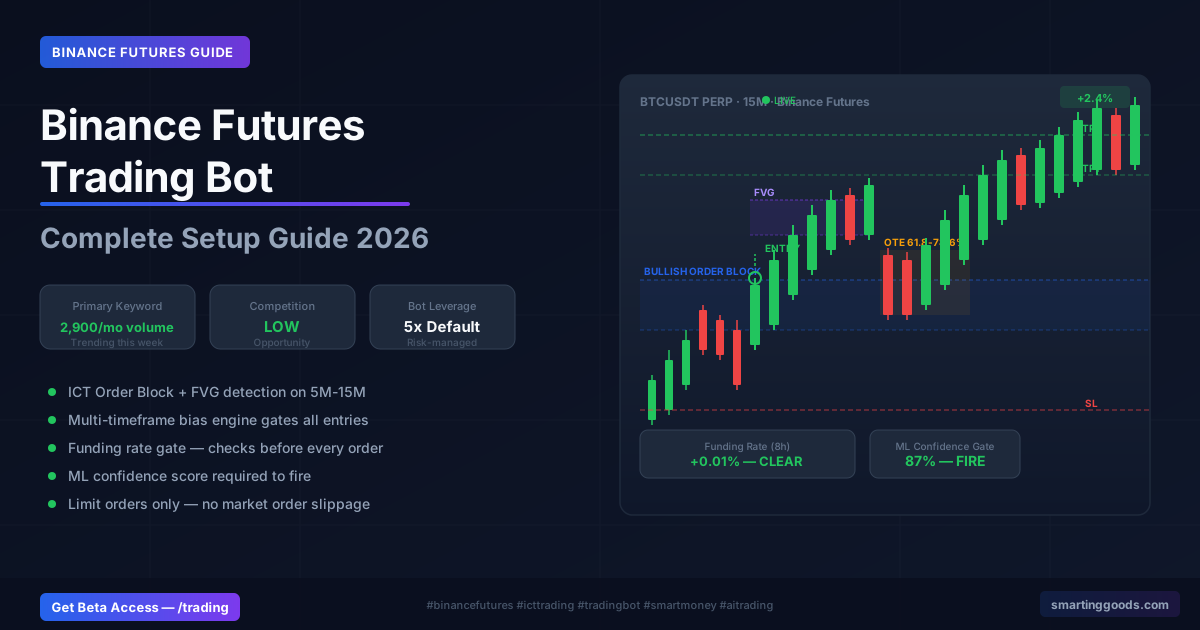
On the entry timeframe (5M-15M), the bot detects Order Blocks, Fair Value Gaps, Optimal Trade Entry zones in the 61.8-78.6% Fibonacci range, Break of Structure, Change of Character, and Liquidity Pool sweeps. These are structural features of price action that represent institutional order flow — identified the same way an experienced ICT trader would, without the screen time.
See our SmartTrading AI vs 3Commas vs Cryptohopper comparison for how this differs from signal-based bots.
ML Confidence Gate
Before any order is placed, a machine learning model trained on historical ICT setups scores the current setup quality. Only setups above the confidence threshold get executed. This gate filters out lower-quality setups during unfavorable conditions — high volatility regimes, ambiguous structure, or conflicting timeframe signals.
Limit Order Execution
SmartTrading AI uses limit orders, not market orders. Entry is placed at the identified ICT zone price — typically an Order Block midpoint or FVG fill — so the bot benefits from maker rebates on Binance Futures rather than paying taker fees. Over hundreds of trades, this is a meaningful cost reduction.
Funding Rate Awareness
Before entering a position, the bot checks the current and predicted next funding rate. If funding is extremely positive and the setup is long, entry is delayed to after the funding settlement. This avoids paying the funding cost on a position that has not yet moved in the intended direction.
Funding Rate Awareness: Why Your Bot Should Check It
Funding rates on Binance Futures settle every 8 hours: at 00:00, 08:00, and 16:00 UTC. The rate is positive when longs outweigh shorts (longs pay shorts) and negative when shorts dominate.
For a trading bot, funding rate matters in two ways:
- Direct cost: Holding a long position when funding is +0.1% means paying 0.1% of position value every 8 hours — 0.3% per day, 9% per month. Even on overnight holds, funding compounds.
- Sentiment signal: Funding above +0.1% or below -0.1% signals extreme sentiment. Historically, extreme positive funding precedes long squeezes. A bot that reads this and avoids long entries during extreme funding conditions has a measurable edge.
SmartTrading AI Funding and OI Squeeze Gate combines funding rate, open interest change, and price action to identify squeeze setups and either block or boost entries based on the confluence.
Frequently Asked Questions
Is it legal to use a trading bot on Binance Futures?
Yes. Binance explicitly supports automated trading via its API and even offers its own bot products. Using third-party bots via API is permitted under Binance terms of service, provided the bot does not engage in manipulative practices like wash trading or spoofing.
How much capital do I need to run a futures bot?
The practical minimum for meaningful risk management is $500-$1,000. Below this threshold, the $5 minimum notional order size on Binance Futures starts to constrain position sizing flexibility. A $1,000 account at 5x leverage gives you $5,000 in buying power and allows proper 1-2% risk-per-trade discipline.
What is the difference between a Binance futures bot and a Binance spot bot?
Three differences: leverage (futures allows 3-125x, spot is 1:1 without margin), directional flexibility (futures bots can short without borrowing), and cost structure (futures has funding rates every 8 hours, spot does not). A spot bot ported to futures without recalibration is a significant risk.
Does SmartTrading AI work on altcoins or only BTC?
The current Phase 1 beta focuses on BTC/USDT perpetuals on Binance Futures. Multi-symbol support for ETH and major altcoins is on the roadmap for Phase 2. ICT methodology applies across all liquid markets — expansion is a matter of threshold calibration and backtesting per symbol.
Can I run SmartTrading AI alongside my manual trading?
Yes. SmartTrading AI operates on its own isolated sub-account (recommended) or a dedicated API key with separate margin. Your manual trading account and the bot account are completely separate. The bot will not interfere with positions you open manually, and you can pause it at any time from the dashboard.
Get Started with SmartTrading AI on Binance Futures
SmartTrading AI is currently accepting beta applications. Phase 1 supports BTC/USDT perpetuals with ICT pattern detection, multi-timeframe bias analysis, ML confidence gating, and full risk management controls built in.
Setup takes under 10 minutes: create your Binance API key with futures permissions, connect it to SmartTrading AI, set your leverage and risk parameters, and the bot handles the rest. No TradingView alerts to configure, no signal channels to subscribe to, no manual execution required.
Apply for beta access at SmartTrading AI — beta spots are limited during Phase 1.