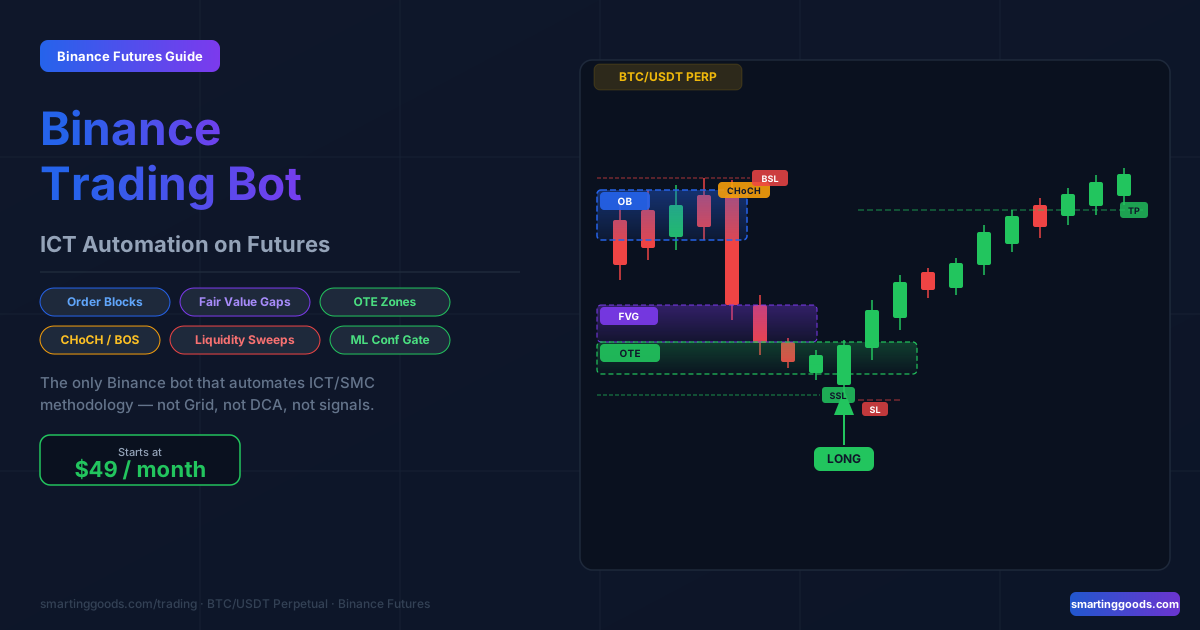
Binance Trading Bot: The Only One That Runs ICT on Futures
Every Binance trading bot in 2026 runs on grid, DCA, or signals. SmartTrading AI is the first to automate ICT methodology on BTC/USDT perpetual.
Binance Trading Bot: The Only One That Runs ICT Methodology on Futures
If you're searching for a Binance trading bot, you already know what Binance is and you probably already have an account. You're past the "what is crypto" phase. What you want is a bot that actually trades well — not one that paperclips together a grid strategy and calls itself AI.
The Binance trading bot market in 2026 has a strategy problem. Every major option — whether it's Binance's own built-in bots or third-party platforms like 3Commas, Bitsgap, and Pionex — runs on the same handful of retail strategies: grid trading, DCA (dollar-cost averaging), and signal-following. These work in certain market conditions. They fail badly in others.
This guide breaks down what each type of Binance bot actually does, where the strategy ceiling is, and why the most sophisticated methodology in retail trading — ICT (Inner Circle Trader / Smart Money Concepts) — has never been automated on Binance Futures until now.
What Is a Binance Trading Bot (and How Does It Actually Work)
A Binance trading bot is software that connects to your Binance account via API keys and places orders on your behalf according to a predefined strategy. You set the parameters; the bot executes without you needing to watch a screen.
The connection works through Binance's official REST API and WebSocket feeds. The bot uses:
- REST API — to place, cancel, and query orders
- WebSocket streams — to receive real-time price data and candlestick updates
- Binance Futures API — specifically for perpetual contracts (BTC/USDT PERP, ETH/USDT PERP, etc.)
The API connection requires two keys: an API key (public) and a secret key (private). A well-configured bot requests only the permissions it needs — typically "Read + Trade" on Futures, never "Withdraw."
What bots can do on Binance:
- Execute limit and market orders at any time, including while you sleep
- Manage open positions — adjust stop-losses, take profit levels, move entries
- React to price changes in milliseconds (far faster than manual trading)
- Apply the same strategy consistently without emotional override
What bots cannot do by themselves:
- Read market structure (they can only read price data if the logic is explicitly coded)
- Understand whether a setup is high-quality or noise — unless a confidence filter is built in
- Adapt to changing market regimes — unless regime detection logic exists
That last point is where most Binance bots fall apart. They apply a static strategy to a dynamic market. A grid bot running during a strong BTC trend does not adapt — it just accumulates losing positions.
Binance's Built-In Bots: Spot Grid, Futures Grid, DCA — What Each Is For
Binance launched its own native bot suite and they're worth understanding before jumping to third-party options. They're free, directly integrated, and zero-latency — but they're also strategy-limited.
Spot Grid Bot
The Spot Grid bot divides a price range into equal sections and places buy and sell orders at each level. When price oscillates, it collects small profits on each completed grid cycle.
When it works: BTC ranging in a narrow band, like a multi-week consolidation between $85,000 and $90,000.
When it fails: Any strong directional move. In a trending market, the grid fills its buy orders as price drops, and you end up holding increasing BTC exposure as price continues lower. A grid bot running during the 2022 bear market would have turned a $10,000 position into concentrated losses very fast.
Futures Grid Bot
Same concept as Spot Grid but applied to perpetual futures contracts with leverage. All the same mechanics — now amplified by your chosen leverage multiple. A 5x grid bot in a trending market loses 5x faster.
Binance's Futures Grid requires you to set a price range manually. If price leaves that range, the bot stops. You have to reset it. In practice this means significant manual oversight for a "set it and forget it" tool.
DCA (Dollar-Cost Averaging) Bot
The Spot DCA bot buys a base asset at regular intervals or on price drops, averaging down your entry cost. It's a long-only accumulation strategy — useful for long-term holders, not active traders.
It does not trade Futures. It does not short. It does not respect market structure.
The Key Takeaway on Binance's Native Bots
These tools are well-built for what they are: simple, mechanical strategies for sideways or trend-following accumulation. If that's your goal, they're free and reliable. But they have no concept of:
- Market structure (higher highs, lower lows, break of structure)
- Institutional order flow
- Supply and demand zones derived from price action
- Regime awareness (is BTC trending or ranging right now?)
They run the same logic regardless of what the market is doing.
Why the Built-In Binance Bots Have a Strategy Ceiling
To understand the ceiling, you need to understand what drives BTC price at a structural level.
BTC futures are dominated by institutional participants — large funds, market makers, prop trading firms. These participants operate on a logic called smart money flow: they don't buy at retail support levels and sell at retail resistance levels. They create the conditions that trap retail traders, then move price in the opposite direction.
The clearest example: a BTC grid bot places buy orders at round numbers like $80,000 and $82,000 because those look like support. Institutional flow deliberately pushes price below $80,000 to trigger all those buy orders (and the stop-losses sitting just below them), collect the liquidity, and then reverse price upward. The grid bot got trapped precisely at the point the institutional algorithm wanted it to be.
This is not conspiracy — it's mechanics. Every large order needs a counterparty. Market makers create that counterparty through engineered liquidity pools.
Binance's native bots — and most third-party bots — have zero logic to detect, avoid, or trade with this institutional flow. They don't know what a liquidity pool is. They don't know what a fair value gap is. They set buy orders where retail traders set buy orders, and they get taken out by the same mechanisms that take out retail traders.
The strategy ceiling is the point at which mechanical simplicity stops being a feature and starts being a liability.
Third-Party Binance Bots Compared: 3Commas, Bitsgap, Pionex, WunderTrading
The third-party Binance bot ecosystem has matured significantly. These platforms go beyond Binance's native tools by offering more strategy flexibility, portfolio management, and integrations. But they share the same strategic DNA.
3Commas
3Commas is the largest third-party Binance bot platform. It offers DCA bots, Grid bots, a signal marketplace, and basic Smart Trade order management. The DCA bot is particularly popular — it averages into positions and uses a "safety orders" system to reduce average entry on drops.
Binance Futures support: Partial. 3Commas supports Futures for some strategies, but the platform is primarily designed around Spot trading.
Strategy type: DCA, Grid, Signal (from external providers via TradingView webhooks or their marketplace).
Price: Starts at $29/month.
What it lacks: Market structure awareness, regime detection, ICT methodology, ML filtering. Signal bots are only as good as the signal provider — and most signal providers use technical indicators like RSI, MACD, and moving averages. These are lagging indicators derived from price; they don't explain why price moves.
Bitsgap
Bitsgap is a portfolio management and bot platform that focuses on grid and DCA strategies. The interface is polished, the backtesting is functional, and the COMBO bot (grid inside DCA) is unique.
Binance Futures support: Partial — DCA Futures mode exists.
Strategy type: GRID, DCA, COMBO (hybrid).
Price: Starts at $28/month.
What it lacks: Same as 3Commas. No structure-based entries, no order block or FVG detection, no regime gate. The COMBO bot is clever but still mechanical — it doesn't know what kind of market it's operating in.
Pionex
Pionex is unique because it's a Binance broker with built-in bots — 16 bot types included for free. The Grid Bot, Leveraged Grid, and Martingale Bot are popular. Free tier is genuinely useful.
Binance Futures support: Yes, via Leveraged Grid and Futures Grid bots.
Strategy type: Grid, DCA, Martingale, TWAP, Arbitrage.
Price: Free (Pionex takes a 0.05% maker/taker fee).
What it lacks: Pionex bots are entirely rule-based and static. The Martingale bot in a persistent downtrend compounds losses aggressively. Free doesn't mean risk-free.
WunderTrading
WunderTrading specializes in copy trading and signal-based bots. It integrates with TradingView, supports Binance Futures, and lets you follow other traders' bots automatically.
Binance Futures support: Yes.
Strategy type: Signal-based, Copy trading.
Price: Starts at $19/month.
What it lacks: The strategy is entirely dependent on the signal source. WunderTrading has no native analysis engine — it's a trade execution relay. If your signal provider's TradingView strategy uses RSI divergence to enter, WunderTrading places that order. It doesn't validate the signal against current market structure.
The Common Thread
All four platforms — 3Commas, Bitsgap, Pionex, WunderTrading — are execution infrastructure built on top of retail strategies. They make it easier to run those strategies at scale. What none of them do is apply the methodology that professional traders actually use on Binance Futures: price action structure, institutional order flow, and supply/demand zones derived from how market makers actually position.
The Strategy Nobody Talks About: ICT Methodology on Binance Futures
ICT (Inner Circle Trader) methodology, also known as Smart Money Concepts (SMC), is the framework that explains why price moves — not just that price moved.
It was developed and popularized by Michael J. Huddleston and has become the dominant methodology among serious retail traders over the last five years. The core idea: price is engineered by institutional participants to collect liquidity, create imbalances, and deliver to areas of value. Every major move in BTC has a structural explanation within the ICT framework.
ICT works particularly well on BTC futures for a specific reason: BTC is the most liquid, most traded crypto perpetual on Binance. That means institutional footprints are clearest on BTC. High-frequency market makers leave Order Blocks and Fair Value Gaps in BTC/USDT PERP that are textbook-clean compared to lower-liquidity altcoin pairs.
Here are the core ICT concepts and why each one is directly relevant to BTC Futures bot trading.
Order Blocks — Why Binance BTC Price Always Reacts to Them
An Order Block (OB) is the last candle before a significant price move in the opposite direction — specifically, the last bearish candle before a strong bullish move (Bullish OB), or the last bullish candle before a strong bearish move (Bearish OB).
Why does price react to Order Blocks? Because that candle represents where institutional buy or sell orders were placed. Large orders don't execute instantly — they're placed as limit orders at specific price levels. When price returns to an Order Block, it's returning to an area where unfilled institutional orders likely remain.
On BTC/USDT PERP, Order Blocks are visible on the 15-minute, 1-hour, and 4-hour timeframes. A bot that can identify and trade from valid OBs has an institutionally-anchored entry point — not a moving average crossover.
SmartTrading AI's OB detection identifies the last opposite-colored candle before a displacement move and validates it against displacement (the strength of the move away from the OB) and confluence with other ICT structures.
Fair Value Gaps — The Imbalances That Always Get Filled
A Fair Value Gap (FVG) is a three-candle pattern where the wicks of the first and third candles do not overlap, leaving an imbalanced price zone in the middle candle's body.
FVGs represent inefficiency — price moved so fast through a zone that not all orders were filled. The market has a statistical tendency to return to these gaps and "fill" them, offering high-probability entry points.
On BTC Futures, FVGs are most actionable when:
- They align with the current market structure (bullish FVG during uptrend, bearish FVG during downtrend)
- They exist on a higher timeframe (1H or 4H) but price is retesting on a lower timeframe (15m or 5m)
- They sit inside or near an Order Block — stacked confluence
Manual ICT traders spend hours marking FVGs across multiple timeframes. An automated bot can scan all relevant FVGs across all timeframes simultaneously, rank them by confluence score, and execute only at the highest-probability zones. See our detailed FVG trading strategy guide for the full mechanics.
Change of Character (CHoCH) and Break of Structure (BOS)
Market structure is the sequence of swing highs and lows that defines whether price is trending or reversing. Two key structural events:
BOS (Break of Structure): Price breaks a previous swing high (in an uptrend) or swing low (in a downtrend). This confirms the current trend is continuing. A bot should trade in the direction of confirmed BOS, not against it.
CHoCH (Change of Character): Price breaks a previous swing low during what appeared to be an uptrend (or swing high during downtrend). This is the first structural signal that a trend may be reversing. CHoCH often precedes the displacement candle that creates a new Order Block — making it the entry trigger for a reversal trade.
For a Binance bot, CHoCH detection is critical because it filters out counter-trend entries. A grid bot or DCA bot has no concept of CHoCH — it will keep buying into a bearish CHoCH sequence because the price "looks cheap." A structure-aware bot knows that a CHoCH means the trend has flipped and DCA buying in that context is fighting institutional flow.
OTE Zones — The 61.8%–78.6% Entry Where Smart Money Enters
OTE (Optimal Trade Entry) is derived from Fibonacci retracement theory but applied with specific ICT logic. After a displacement move (the strong candle that creates an OB and FVG), smart money typically re-enters on the retracement at the 61.8%–78.6% Fibonacci level of that displacement.
This zone is called OTE because it represents optimal risk-reward positioning:
- Entry inside the 61.8–78.6% zone
- Stop-loss below the Origin of the move (below the swing low for longs)
- Target at the previous swing high (BSL pool) or beyond
OTE entries consistently offer 3:1 to 5:1 risk-reward ratios when the underlying structure is valid. For a Binance bot, OTE means: don't enter at the start of a retracement — wait for the 61.8%–78.6% zone, confirm with OB/FVG confluence, then execute.
Our deeper analysis of market structure, including how CHoCH and BOS integrate with OTE, is covered in the market structure trading guide.
Liquidity Sweeps on BTC Futures — How the Institutional Trap Works
Liquidity exists wherever stop-losses are clustered. Equal lows and equal highs, round numbers, previous swing points — all accumulate stop-loss orders from retail traders. Institutions need to fill large orders and stop-loss clusters provide the counterparty liquidity to do so.
A liquidity sweep on BTC Futures works like this:
- BTC consolidates above a cluster of equal lows (Buy Side Liquidity, BSL) or below equal highs (Sell Side Liquidity, SSL)
- Price breaks below the equal lows, triggering retail stop-losses — this "sweeps" the SSL pool
- Immediately after sweeping the pool, price reverses sharply in the opposite direction (the intended institutional direction)
- The sweep-and-reverse creates an OB and often an FVG in the reversal zone
A bot that can identify SSL/BSL pools, detect a liquidity sweep in real-time, and place a trade in the direction of the reversal (not against it) is trading exactly how institutional flow operates. A grid bot puts a buy order at the equal lows — the same place that will be swept — and gets stopped out before the real move begins.
For a complete breakdown of ICT concepts and how they combine into a full trading strategy, see the ICT trading strategy guide.
SmartTrading AI: The First Binance Bot to Automate ICT on Futures
SmartTrading AI is the first Binance futures bot that automates the full ICT/SMC methodology on BTC/USDT perpetual. It doesn't use grid, DCA, or external signals. Every trade entry is derived from structural ICT analysis: Order Block detection, Fair Value Gap mapping, CHoCH/BOS confirmation, OTE zone calculation, and liquidity sweep identification.
The system runs as a continuous analysis loop on BTC/USDT PERP:
1. Multi-timeframe structural analysis
The bot analyzes BTC structure on the 4-hour (trend direction), 1-hour (swing points and OBs), and 15-minute (entry triggers) simultaneously. An entry only qualifies if higher-timeframe structure supports the trade direction. A 15-minute long entry during a 4-hour bearish structure is rejected automatically.
2. ICT zone identification
Every cycle, the bot maps:
- Valid Bullish and Bearish Order Blocks (with displacement confirmation)
- Open Fair Value Gaps (unfilled imbalances across timeframes)
- OTE zones for the current swing move
- BSL and SSL liquidity pools (equal highs, equal lows, swing points)
3. Confluence scoring
Not every OB or FVG is tradeable. The scoring engine assigns points based on:
- OB + FVG confluence (do they overlap? = highest probability)
- Structure alignment (does the entry direction match 4H structure?)
- OTE alignment (is the entry inside the 61.8–78.6% zone?)
- Liquidity sweep confirmation (did a sweep just occur at the zone?)
- Distance from entry to nearest opposing pool (determines TP placement)
4. Intelligent limit entry placement
The bot places a limit order at the highest-scoring ICT zone rather than entering at market. This is critical for execution quality on BTC Futures — market orders at high-volume moments have significant slippage. Limit orders at OTE zones get filled at the exact zone where institutional orders are expected.
5. Dynamic SL/TP management
- Stop-loss: Placed beyond the OB or below/above the nearest structural anchor. Adjusted to avoid known liquidity pools where SL runs are likely.
- TP1: First target at the nearest opposing FVG midpoint or OB zone.
- TP2: Second target at the next BSL/SSL pool — the price level that institutional flow intends to reach.
The system doesn't use fixed-percentage stops or static R:R. Every SL and TP is derived from structure, which means risk:reward adjusts with the quality of each setup.
The ML Confidence Gate — Why the Bot Rejects Bad Setups
ICT methodology is not a mechanical rule-set that triggers on every candle. It requires context: is the market in a structural position where this OB is likely to hold? Does the macro regime support this entry direction?
SmartTrading AI applies an ML confidence gate before any trade is authorized. If the confidence score is below threshold, the setup is rejected even if it technically qualifies on ICT rules.
The confidence gate uses several inputs:
Market Regime Detection (HMM)
A Hidden Markov Model continuously classifies BTC's current market regime: TRENDING, RANGING, or VOLATILE. The strategy selection and risk parameters adjust based on regime:
- TRENDING: Higher confidence requirement for counter-trend setups. OTE retracements in trend direction are prioritized.
- RANGING: Grid-like behavior near range extremes is expected. OB rejections at range highs/lows score highest.
- VOLATILE: Confidence thresholds are tightened. Many setups are rejected. Regime-VOLATILE is when news events create false structure breaks — the bot reduces exposure.
Funding Rate and Open Interest
The bot monitors BTC's perpetual funding rate and open interest on Binance Futures in real time. When funding is extremely positive (overleveraged longs) and a bearish CHoCH appears, that confluence scores higher for short entries. When funding is negative (crowded shorts) and a bullish sweep occurs, long entries get a boost.
VPIN (Volume-Synchronized Probability of Informed Trading)
VPIN measures order flow toxicity — it detects when "informed" volume (large, directional orders) is entering the market versus noise volume. High VPIN before an ICT setup = higher confidence that the structure is real.
The Practical Result
The confidence gate means the bot trades less frequently than a grid or DCA bot — but when it trades, the setup has been validated by multiple independent signals. Quality over quantity is the operating principle.
You can see a breakdown of the full ICT bot methodology in the ICT trading strategy guide and compare it against other automated approaches in the crypto trading bot comparison.
Economic Calendar Blackout — The Feature Nobody Else Has
One of SmartTrading AI's most underrated features is the economic calendar blackout system. Before every FOMC decision, CPI release, NFP print, or PPI report, the bot stops placing new trades and tightens exits on open positions.
Why this matters for a Binance bot:
High-impact USD macroeconomic events create short-term price dislocations in BTC that are structurally meaningless. BTC will frequently sweep a liquidity pool, create what looks like a valid CHoCH, and then violently reverse 15 minutes later when the actual news drops and the market re-prices. Any bot that entered on that "structure" would be immediately stopped out.
The blackout window is -15 minutes before the event to +30 minutes after. During that window:
- No new limit orders are placed
- Open positions are evaluated for early close if they're at risk
- The system resumes normal operation after the event has been absorbed
This is a real-world trading discipline that experienced ICT traders apply manually. SmartTrading AI applies it automatically.
No other Binance bot platform — 3Commas, Bitsgap, Pionex, or WunderTrading — implements calendar-based trading blackouts. They run their strategies through FOMC meetings and NFP prints and accept the random outcomes.
Binance Futures vs Spot for Bot Trading: Pros, Risks, and When Futures Wins
Many traders start with Spot bots and wonder whether to move to Futures. The decision depends on your strategy.
Why Futures Works Better for ICT
The ICT methodology was built for futures markets — specifically for CME futures and forex, where institutional participants are most active. BTC/USDT perpetual on Binance is the closest crypto equivalent.
Advantages of BTC Futures for ICT bot trading:
- Bidirectional trading: Futures allow both long and short entries. ICT generates high-probability setups in both directions. A Spot bot can only benefit from bullish setups.
- Perpetual contract liquidity: BTC/USDT PERP is the highest-volume perpetual on Binance. Order books are deep, slippage is minimal, and ICT structure is cleaner than altcoin pairs.
- Funding rate as a contrarian signal: Perpetual funding rates give you information about market positioning that Spot doesn't. Extreme positive funding + bearish structure = one of the cleanest short setups in ICT.
- No asset custody risk on entries: You're trading a derivative, not buying/holding BTC. This means you can take short-duration entries without modifying your BTC allocation.
Risks Specific to Futures
- Leverage amplifies losses: SmartTrading AI uses conservative leverage — the ML confidence gate and regime detection are specifically designed to avoid over-leveraged positions. But futures leverage is always a real risk if configuration is wrong.
- Liquidation: If a position moves against you beyond your margin, liquidation occurs. Properly calculated stop-losses are mandatory, not optional.
- Funding costs on extended holds: Holding a perpetual for days or weeks incurs funding payments. SmartTrading AI's trades are structured as short-to-medium term entries (hours to days), not multi-week holds.
When Spot Bot Makes More Sense
- You want long-term BTC accumulation (DCA on Spot makes sense here)
- You're not comfortable with leverage and don't want to manage futures margin
- Your strategy is simply "buy dips, sell rips" without structural analysis
For traders who want to trade BTC directionally with a methodology-backed approach, Futures is the correct venue.
Setting Up Your Binance Futures Bot with SmartTrading AI (Step-by-Step)
Getting started with SmartTrading AI on Binance Futures is a straightforward process.
Step 1 — Create a Binance Futures Account and Enable USDM Futures
If you have a standard Binance Spot account, navigate to the Derivatives section and enable USDM Futures (USD-Margined Futures). You'll need to pass a brief quiz about futures trading risks. Fund your Futures wallet — USDT is the margin currency for BTC/USDT PERP.
Step 2 — Generate Binance API Keys
Go to Binance Account Settings → API Management. Create a new API key. Configure permissions:
- Enable "Read" — required
- Enable "Enable Futures" — required
- Enable "Enable Spot & Margin Trading" — not needed, can leave disabled
- DO NOT enable "Enable Withdrawals" — never grant withdrawal access to a third-party bot
Restrict the API key to SmartTrading AI's IP address list for additional security. Binance provides IP whitelist functionality in the API settings.
Step 3 — Connect to SmartTrading AI
Visit SmartTrading AI and create your account. In the bot configuration panel:
- Enter your Binance API Key and Secret Key
- Select "BTC/USDT Perpetual" as the trading pair
- Set your position size (recommended: start with 1–2% of Futures wallet per trade)
- Set your leverage (recommended: 3–5x for beginners, 10x maximum for conservative ICT trading)
- Review the ML confidence threshold settings (default: 65%)
Step 4 — Review Strategy Settings
The SmartTrading AI dashboard shows:
- Current market regime (TRENDING / RANGING / VOLATILE)
- Active ICT zones mapped on the BTC/USDT chart
- Pending limit orders with entry rationale
- Recent trade log with ICT tags (which zone type triggered the entry)
You can adjust the ML confidence gate threshold, enable or disable specific ICT strategies (OTE Retracement, OB Rejection, FVG Entry, MSS Pullback), and set maximum concurrent positions.
Step 5 — Monitor and Let the Regime Gate Work
The most common mistake new bot users make is turning the bot off when it goes through a period of low trade frequency. Low frequency usually means the bot is in a VOLATILE or low-confidence regime and correctly not trading. That's the system working as designed.
Review the trade log weekly, not daily. Evaluate performance on a minimum of 30 trades before drawing conclusions. ICT strategies have high setup quality but moderate trade frequency — patience is a requirement.
Binance Trading Bot Comparison Table
| Feature | SmartTrading AI | 3Commas | Bitsgap | Pionex | WunderTrading |
|---|---|---|---|---|---|
| Binance Futures Support | Full (ICT-native) | Partial | Partial (DCA Futures) | Yes (Grid) | Yes (Signal) |
| Strategy Type | ICT/SMC | DCA/Grid/Signal | GRID/DCA/COMBO | Grid/DCA | Signal/Copy |
| Order Block Detection | Yes | No | No | No | No |
| Fair Value Gap Entry | Yes | No | No | No | No |
| CHoCH / BOS Detection | Yes | No | No | No | No |
| OTE Zone Entry | Yes | No | No | No | No |
| Liquidity Sweep Detection | Yes | No | No | No | No |
| ML Confidence Filter | Yes | No | No | No | No |
| Regime Gate (HMM) | Yes | No | No | No | No |
| Economic Calendar Blackout | Yes (FOMC/CPI/NFP) | No | No | No | No |
| Funding Rate Integration | Yes | No | No | No | No |
| BTC/USDT Perpetual Optimized | Yes | Generic | Generic | Generic | Generic |
| Bidirectional (Long + Short) | Yes | Partial | Partial | Grid only | Yes |
| Starting Price | $49/mo | $29/mo | $28/mo | Free | $19/mo |
The table makes the differentiation clear: SmartTrading AI is the only option with structural ICT/SMC analysis, ML filtering, and the full suite of institutional methodology features. The competitors are all variations on the same retail strategy themes.
Frequently Asked Questions
Q: Does SmartTrading AI work with any Binance account, or do I need a special account?
A: You need a Binance account with USDM Futures enabled. This is available to users in most jurisdictions that Binance serves. The bot only requires a Futures-enabled API key — no special tier or VIP status needed. Starting capital of $500+ USDT in your Futures wallet is recommended for practical position sizing.
Q: Is the bot profitable? What kind of returns should I expect?
A: No bot can guarantee returns, and any platform that promises specific profit percentages is being dishonest with you. SmartTrading AI's backtesting on BTC/USDT PERP shows positive expectancy with a confidence-gated ICT strategy — meaning the win rate is above breakeven when accounting for average win vs. average loss. The ML confidence gate's job is specifically to filter out the low-probability setups that drag down strategy performance. Real-world results depend on market conditions, position sizing, and leverage configuration.
Q: How is this different from a signal bot that follows an ICT trader's TradingView alerts?
A: A signal bot is a relay — it receives an alert from a TradingView strategy or a human analyst and places the trade. It has no market context, no regime awareness, no ML filtering. If the signal provider sends a long signal into a bearish CHoCH, the bot places the trade. SmartTrading AI generates its own signals entirely from structural analysis — no external signal provider, no TradingView dependency. Every trade decision is made by the system's own ICT engine in real time.
Q: What happens during a major BTC crash or flash crash?
A: Several protections are active. The regime gate detects VOLATILE conditions and reduces trading frequency or stops new entries entirely. The economic calendar blackout prevents new entries around known high-impact events. Stop-losses are always placed at structural levels beyond the setup's OB or swing point. In a genuine flash crash (sudden 10%+ move), open positions with stop-losses will be triggered — this is the correct outcome. The system is designed to survive adverse events with controlled losses, not eliminate all risk.
Q: Can I run SmartTrading AI alongside Binance's built-in bots?
A: Not on the same trading pair simultaneously. Running multiple bots on BTC/USDT PERP from the same account creates conflicting orders — one bot may try to close a position that the other just opened. If you want to run Binance's native Spot Grid on a different pair (for example, a stablecoin pair for passive income), that won't interfere with SmartTrading AI's Futures activity.
Q: What is the minimum investment to use SmartTrading AI on Binance Futures?
A: The software subscription starts at $49/month. For the trading capital, the practical minimum is around $500 USDT in your Futures wallet to allow reasonable position sizing at conservative leverage. With $500 and 3x leverage, a 1% position size per trade = $15 per trade in risk — sensible for strategy validation. Larger capital allows proper position sizing that realizes the strategy's full potential.
Q: Does the bot trade altcoins, or only BTC?
A: Phase 1 of SmartTrading AI is optimized specifically for BTC/USDT perpetual on Binance Futures. The decision is intentional: BTC has the highest liquidity, tightest spreads, and cleanest ICT structure of any perpetual contract on Binance. Institutional footprints are most visible in BTC. Multi-symbol support for other pairs is on the development roadmap.
Conclusion: The Binance Bot That Trades How Professionals Trade
Every Binance trading bot on the market in 2026 — whether native or third-party — is running retail strategies on a market dominated by institutional flow. Grid bots, DCA bots, and signal bots are all, at their core, mechanical rule-sets that don't understand why price moves.
ICT methodology exists specifically to solve this problem. It's the framework that explains how institutional order flow creates Order Blocks, Fair Value Gaps, liquidity sweeps, and OTE zones — and how to trade in alignment with that flow rather than against it. Experienced ICT traders on Binance Futures use this methodology because it works at the structural level that drives price.
SmartTrading AI is the first Binance bot that automates this methodology end to end. Not as a signal relay. Not as a simplified approximation. As a full structural analysis engine with ML confidence gating, regime detection, economic calendar awareness, and dynamic SL/TP derived from ICT structure — running continuously on BTC/USDT perpetual.
If you've been trading ICT manually and looking to automate it — or if you've tried grid and DCA bots and hit their ceiling — this is what you've been looking for.
Start with SmartTrading AI on Binance Futures →
Beta access starts at $49/month. No long-term commitment required.