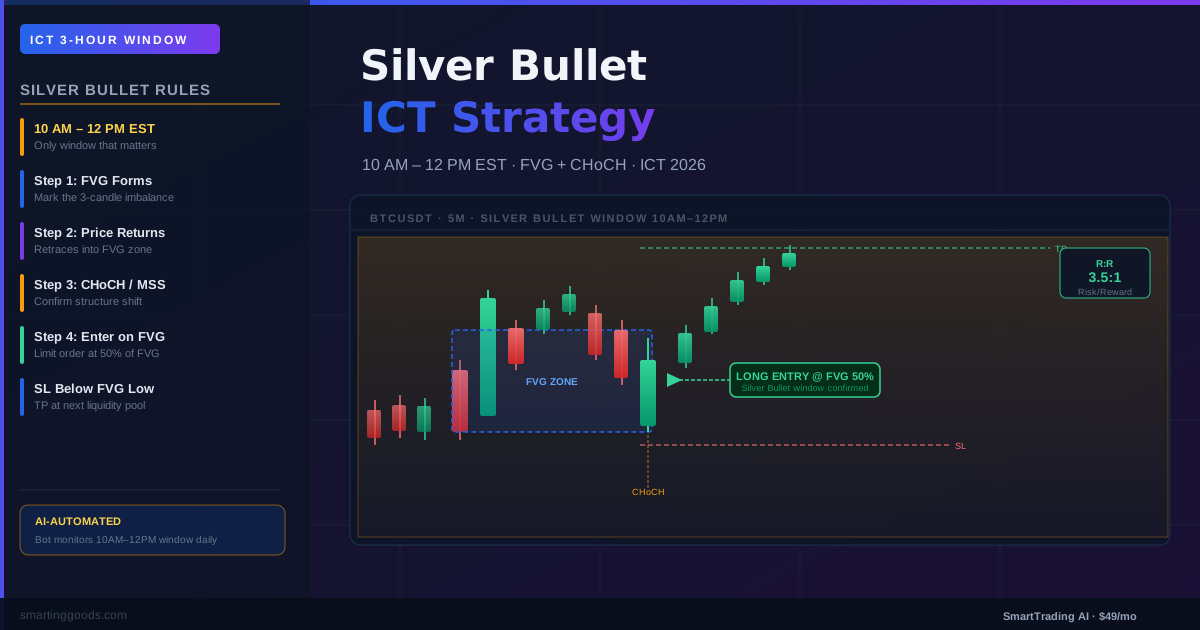
ICT Silver Bullet Strategy: The 3-Hour Trading Window
The ICT Silver Bullet is a 3-hour window trade strategy using FVG fills at 10 AM, 2 PM, and 11 PM EST. Learn how to set it up and automate it on Binance Futures.
What Is the ICT Silver Bullet Strategy?
The ICT Silver Bullet strategy is a time-specific trading model developed by Michael J. Wuollet (ICT) that targets Fair Value Gap (FVG) entries within three defined one-hour windows each trading day. Unlike setups that require scanning all day, the Silver Bullet gives you exact times to sit at your screen — and exact price action signatures to look for when you get there.
The three Silver Bullet windows are:
- 10:00 AM – 11:00 AM EST (primary — post-New York open reaction)
- 2:00 PM – 3:00 PM EST (secondary — afternoon reversal window)
- 11:00 PM – 12:00 AM EST (Asian Silver Bullet — overnight accumulation)
Within each window, you wait for price to create and then return to fill a Fair Value Gap formed on the 1-minute chart. That FVG fill is your entry trigger.
How to Execute the Silver Bullet Setup
Step 1 — Establish the Daily Bias
Before any Silver Bullet window opens, determine whether the day is bullish or bearish. Use the prior day's high/low, overnight range, and the direction of the New York open displacement. You should only trade Silver Bullet setups that align with the daily bias — long setups on bullish days, short setups on bearish days.
Step 2 — Wait for the Silver Bullet Window
Sit on your hands until the clock hits the window start time. The 10 AM EST window is the most reliable because it captures the post-open reaction after the initial New York session volatility settles.
Step 3 — Mark the FVG on the 1-Minute Chart
As price moves during the window, watch for a 3-candle imbalance (Fair Value Gap) to form on the 1-minute chart in the direction of your daily bias. A bullish FVG is an upward gap between the high of candle 1 and the low of candle 3. A bearish FVG is the mirror.
Step 4 — Enter on the Return to the FVG
When price pulls back into the FVG (the gap gets filled), that's your entry. Enter at the 50% midpoint of the FVG or at the first touch of the gap. Your stop loss goes just below the lowest point of the FVG for longs (above the high for shorts).
Step 5 — Target a 2:1 or 3:1 Risk/Reward
Silver Bullet targets are typically the nearest liquidity pool above (for longs) or below (for shorts) — a prior swing high/low, an Equal High/Low (EQH/EQL), or an open FVG at a higher timeframe level.
Why the 10 AM Window Is the Most Powerful
The 10 AM EST Silver Bullet aligns with a critical institutional behavior: after the New York open (7-9 AM) creates volatility and triggers stop hunts, the market often pauses briefly before committing to the day's true direction. The 10 AM window captures this second commitment. Smart money has already built its position during the open; the Silver Bullet entry is your chance to get on board as the real move begins.
This timing also explains why the 1-minute FVG is so reliable in this window — institutions are actively filling orders, and the imbalance they create is genuine supply/demand, not noise.
Silver Bullet on Bitcoin and Crypto Futures
The 10 AM EST Silver Bullet works directly on BTC/USDT Binance Futures because the New York session heavily influences crypto prices. The 2 PM EST window is slightly less reliable on crypto due to lower institutional participation in the afternoon, but the 10 AM window is a staple of crypto day traders using ICT methodology.
The Asian Silver Bullet (11 PM EST) is also relevant for crypto specifically — it captures the Asia session range manipulation that precedes the London open, which is a core Power of 3 pattern.
Silver Bullet + FVG Confluence Rules
- The FVG must form inside the Silver Bullet window, not before it opens.
- Only trade FVGs that align with the daily bias — never counter-trend Silver Bullets.
- For the strongest setups, the FVG should overlap with a higher-timeframe (5m or 15m) Order Block or FVG.
- If price blows through the FVG without bouncing (full gap fill with no reaction), the setup is invalidated — do not chase.
Automating the Silver Bullet with AI
The Silver Bullet's power is also its limitation: you have to be watching at exactly 10 AM, 2 PM, or 11 PM EST for minutes-level precision entries. Most traders miss these windows or hesitate when the moment comes. The Smarting Goods AI trading bot eliminates this entirely — it monitors the 1-minute chart during all three Silver Bullet windows on Binance Futures, detects FVG formation and the subsequent fill, and executes the entry automatically.
Access the SmartTrading AI platform and never miss a Silver Bullet setup again.
Frequently Asked Questions
What time is the ICT Silver Bullet?
The three Silver Bullet windows are 10:00–11:00 AM EST (primary), 2:00–3:00 PM EST (secondary), and 11:00 PM–midnight EST (Asian Silver Bullet). The 10 AM window is the most widely used and highest probability.
What timeframe does ICT Silver Bullet use?
The entry is executed on the 1-minute chart, but your daily bias and context come from the 15-minute and 1-hour charts. ICT himself uses this multi-timeframe approach for all Silver Bullet trades.
What is the Silver Bullet entry trigger?
A Fair Value Gap (3-candle imbalance) forms on the 1-minute chart during the Silver Bullet window. Price returns to fill this FVG, and the first touch of the gap is your entry signal.
Can the Silver Bullet be traded on crypto?
Yes, especially the 10 AM EST window on Bitcoin futures. The New York session influence on BTC is strong enough that the post-open 10 AM Silver Bullet is a reliable setup on Binance Futures.
How do I automate Silver Bullet trades?
The Smarting Goods AI bot monitors all three Silver Bullet windows on Binance Futures, detects 1-minute FVG formation, and executes entries automatically when the setup confirms.